Football, explained: a complete guide to everything Oddsivio does
Anyone can tell you what happened. We show you why it happened, who reported it, how often that person turns out to be right — and what we expected before kickoff, graded in public.
A 12–14 minute read. Ten minutes here and you'll never read a scoreline, a transfer rumour, or a goal clip the same way again — because you'll know how to check it. You'll learn how to move around Oddsivio in seconds, read a match for the why before kickoff, see what our model expects to happen and exactly how often it's been right, trace any transfer rumour to the person who reported it, watch goals that come with meaning, and build a home page that follows your club and your players — all in one place.
Football is drowning in data and starved of meaning
You can find out what happened anywhere. The scoreline, the xG number, the latest rumour — they are a search away on a dozen sites. What you can't find is why it happened, and who to trust when someone tells you. That gap is the whole reason Oddsivio exists. We are the readable layer that turns stats, rumours and replays into meaning. Football, explained.
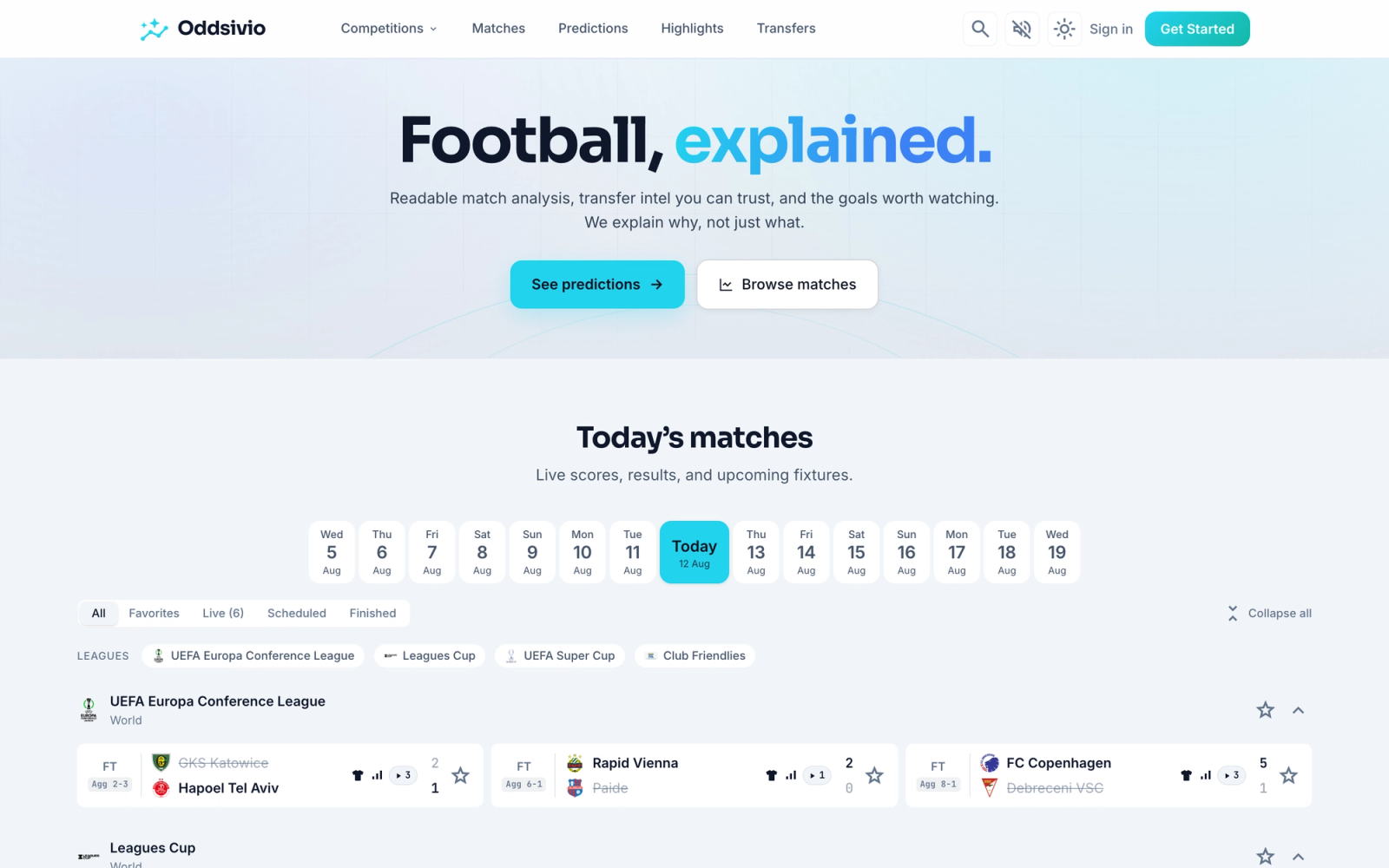
Three pillars do the work. Analysis explains a match in plain English — before kickoff, not after. Transfers tells you who reported a move and how often that reporter is right. Highlights brings you the goals worth watching, anchored to the reason they mattered. And running through all of it, a fourth habit: Predictions — what our model expects to happen, published before kickoff and scored in public after.
Here is the part that should make you trust us a little: when a reporter breaks a story, we show their public track record — the misses included. And we keep score on our own calls too, in public, where you can hold it against us, as our values spell out.
If you've ever thought "another stats site I don't need," the gap the big sites structurally leave out is meaning. This guide is a quick tour, top to bottom — so let's start with how you find your way around.
Getting around in 60 seconds
You won't get lost here. Everything lives in the same place on every page, so once you've seen it once, you've seen it everywhere.
Start at the top. The nav strip carries the four things you came for: Matches (the match analysis), Predictions, Highlights, and Transfers — with Competitions, the dropdown of every league and cup, sitting beside them. A theme toggle flips between light and dark; pick what's easier on your eyes and forget about it.

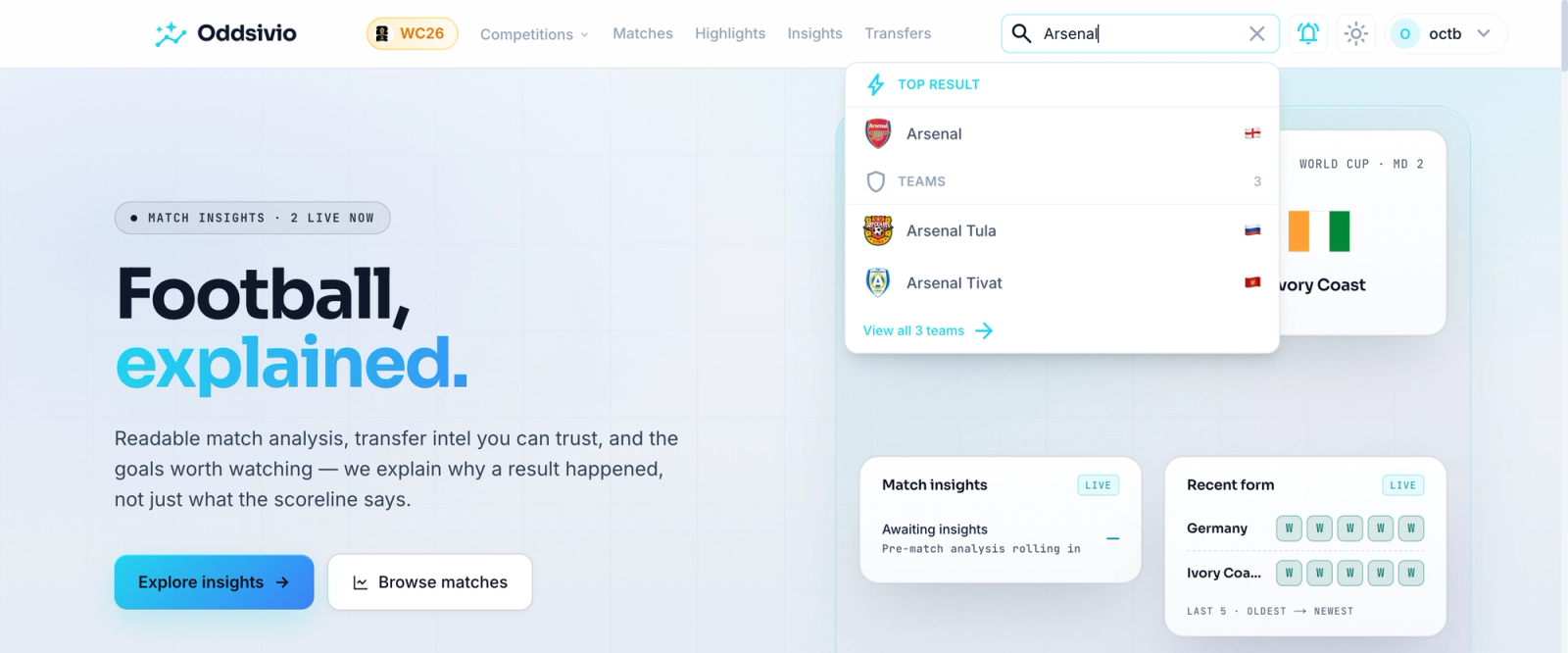
The fastest move is Search. Press Ctrl+K (⌘K on Mac) from anywhere — any page, any time — and start typing. Results come back instantly, grouped by what they are: a top match, then teams, players, matches and competitions. Type "Arsenal" and you're one keystroke from the club.
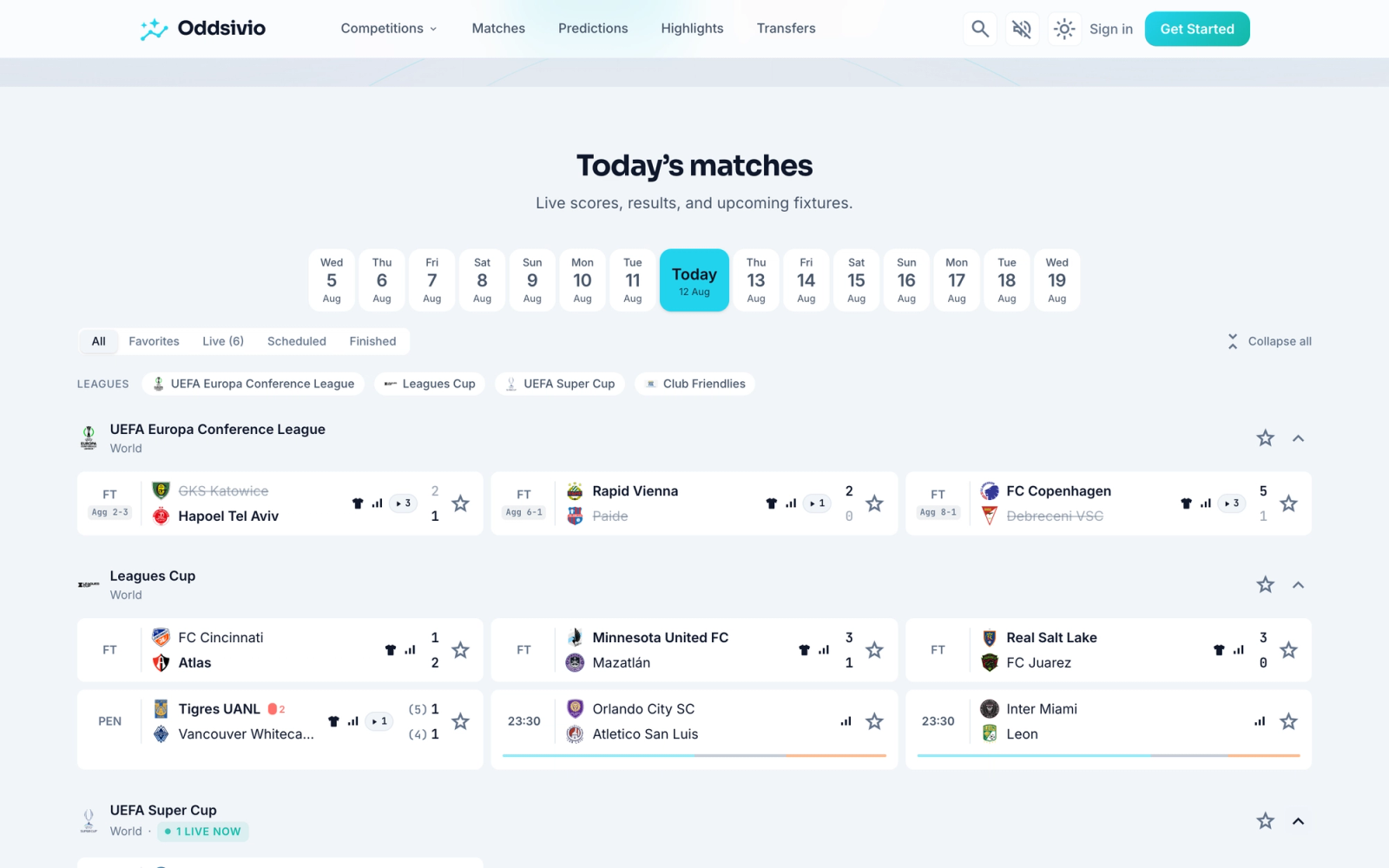
The homepage sets the scene with "Today's matches" — a date strip, league filters, and every game live, finished or still to come — with our predictions for the week ahead one scroll below (more on those in a minute).
Every surface answers "why," and most things sit one click from the match they belong to. So let's open one.
Analysis: the why, in plain English — before kickoff, not after
Analysis is the front door. Start at the matches hub: every fixture today, grouped by competition — European qualifying rounds, the UEFA Super Cup and the Leagues Cup right now, plus the friendlies that warm up a new season — so you scan the day, then open the one you care about.
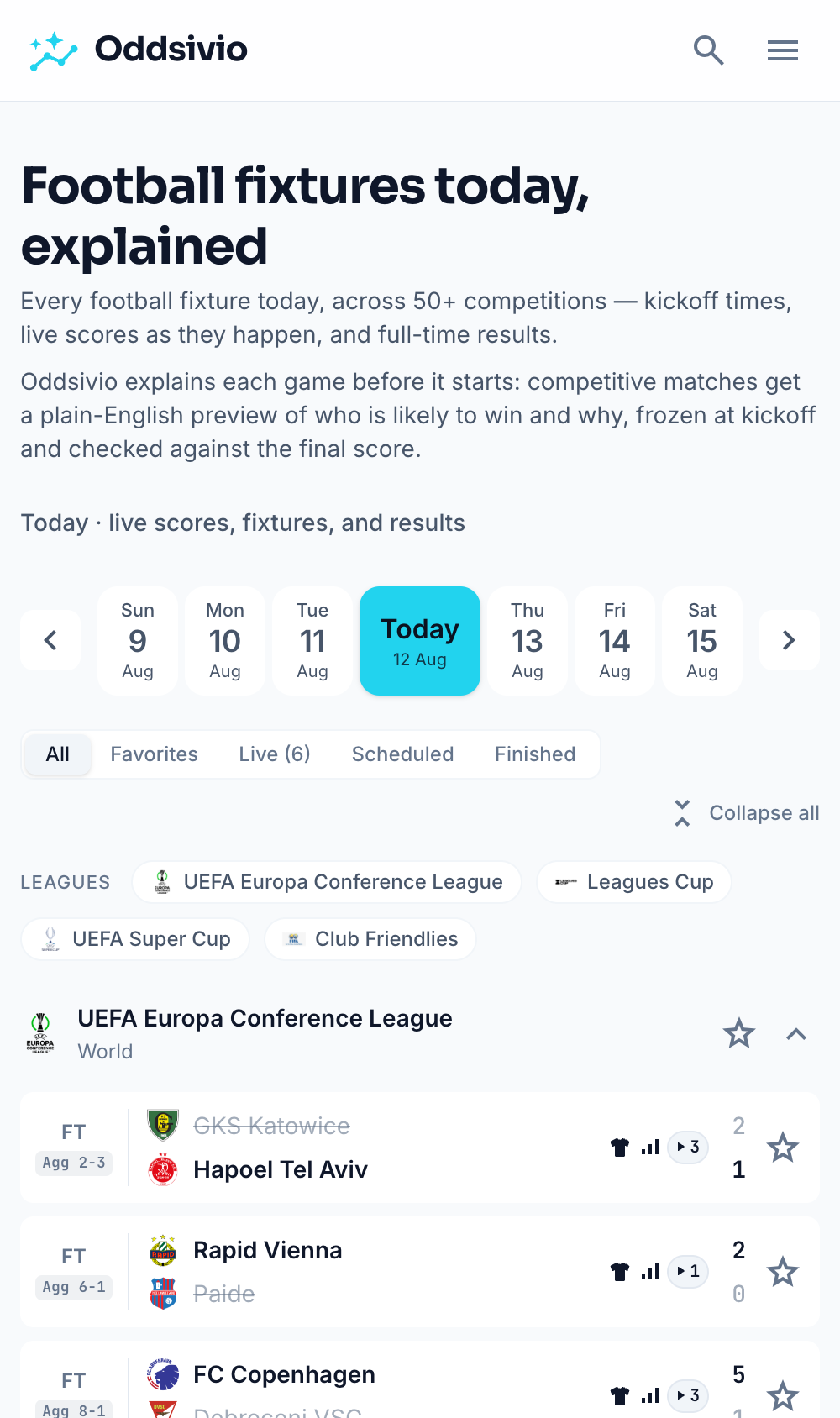
The promise is on the page itself: every competitive match gets explained before it starts — a plain-English read on who is likely to win and why, frozen at kickoff and checked against the final score. Friendlies deliberately get no model output; when there's nothing honest to say, we say nothing.
The numbers still come paired with meaning after the whistle too, never dumped on you. Take Netherlands 5–1 Sweden from the World Cup in June. The scoreline tells you what. The match page tells you why: Expected Goals — xG, explained simply: how good the chances each side actually created were — read 2.61 to 1.01. So the Netherlands didn't just win; they built far better openings and finished them clinically, five goals from 2.61 xG. That one line turns a lopsided result into something you understand. Below it sit the lineup pitch, per-player ratings — Cody Gakpo the best on the day at 9.3 — and the top performers.
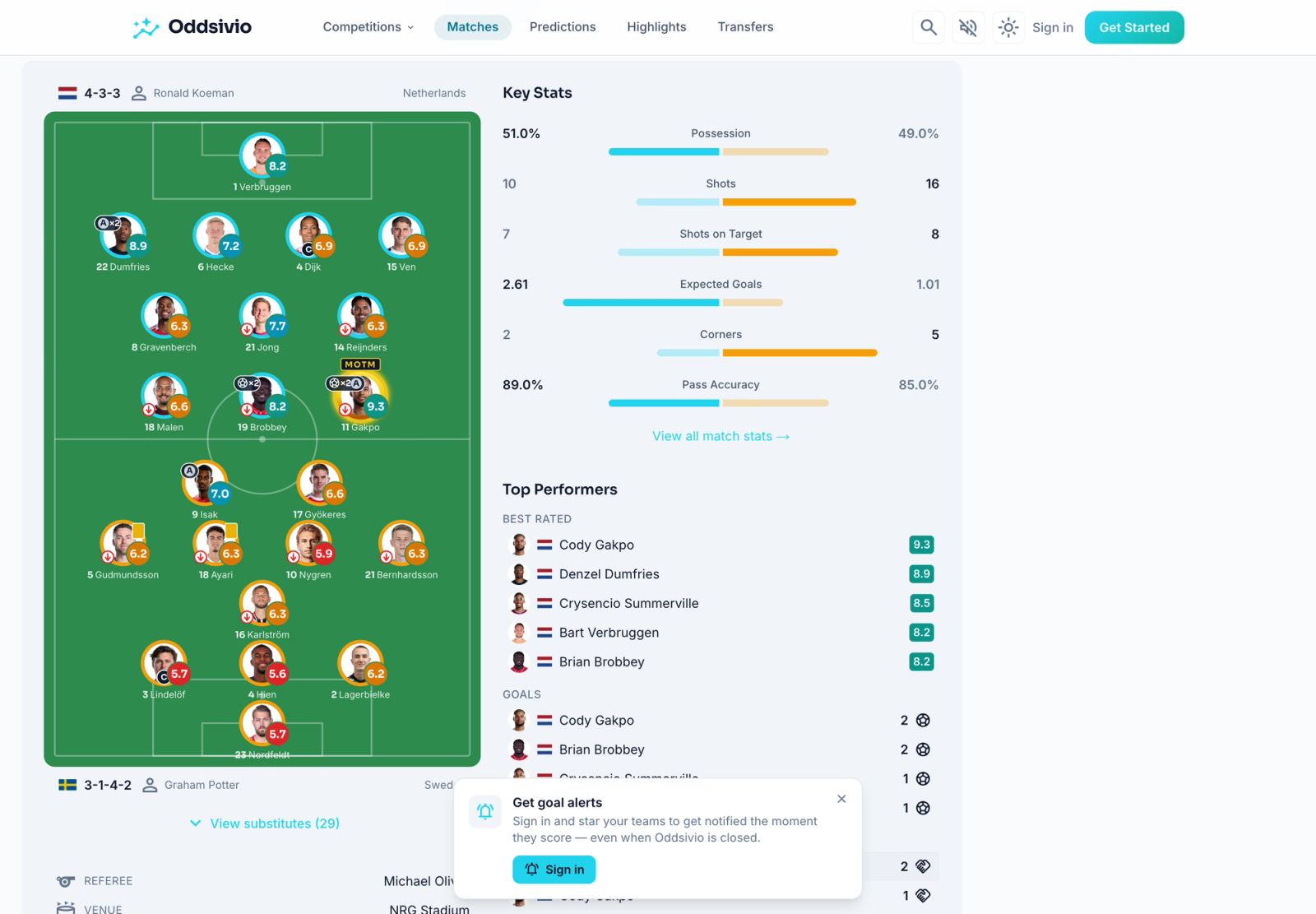
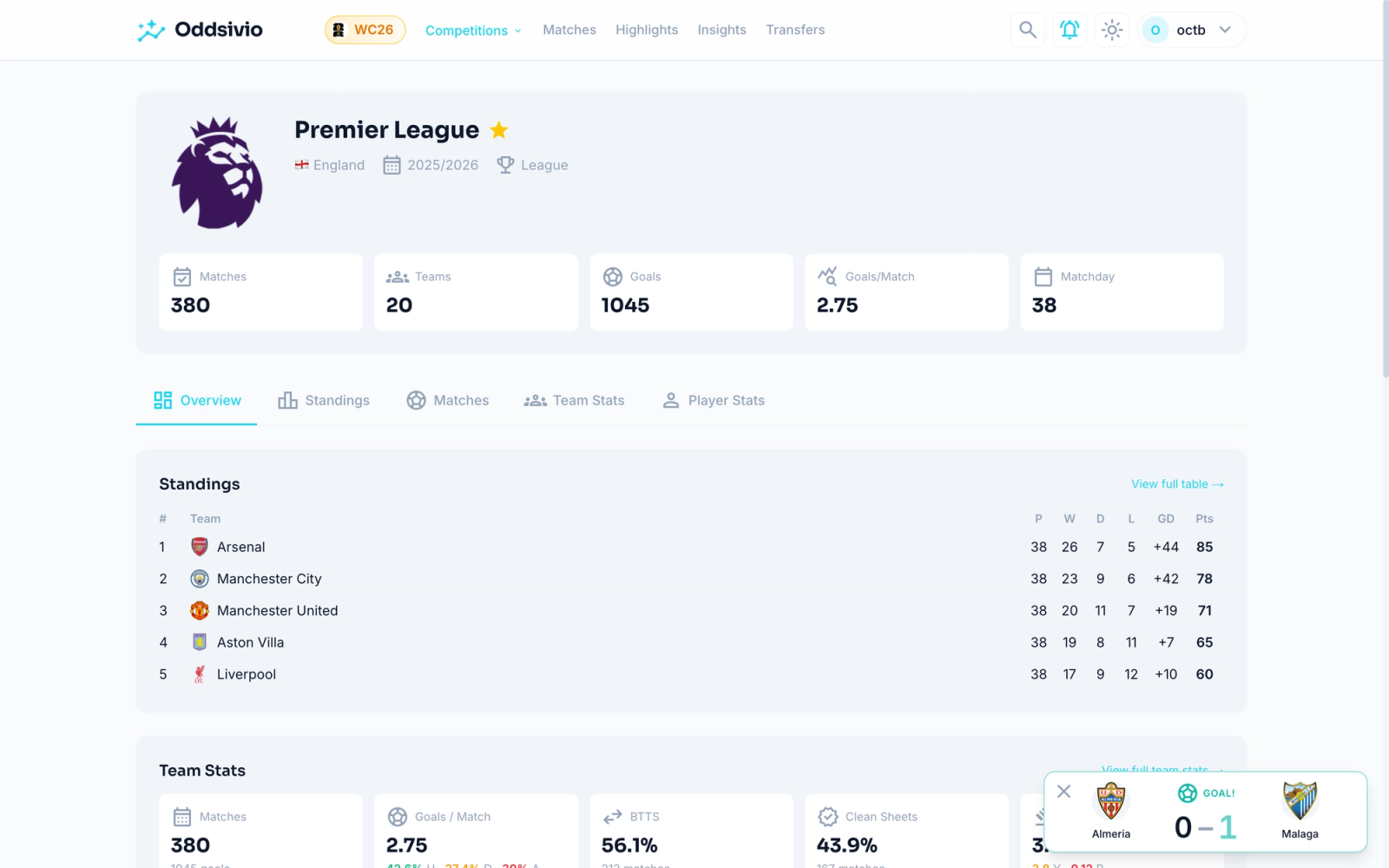
This is the part a stats app skips. Then widen the lens. A competition page reads the table, not just the rows — open the Premier League for standings, team stats and player stats, with the same "why" applied to a whole season.
A match read tells you why. The obvious next question is what do you think will happen? — and that one deserves its own receipts.
Predictions: frozen before kickoff, scored in public
Most sites that publish football predictions want you to remember the wins and forget the rest. We built ours the other way round: every forecast is published before kickoff, locked when the whistle blows, and graded against the final score — misses included, on a public record you can audit.
Here's what that looks like. Before each covered match, Sirius — our prediction model — reads the measured evidence (results, form, scoring and defensive signals, matchup patterns) and publishes how likely each result is: home, draw, away. The card shows the most likely result with its chance, and the key factors behind it in plain English — including the evidence that counts against the call.
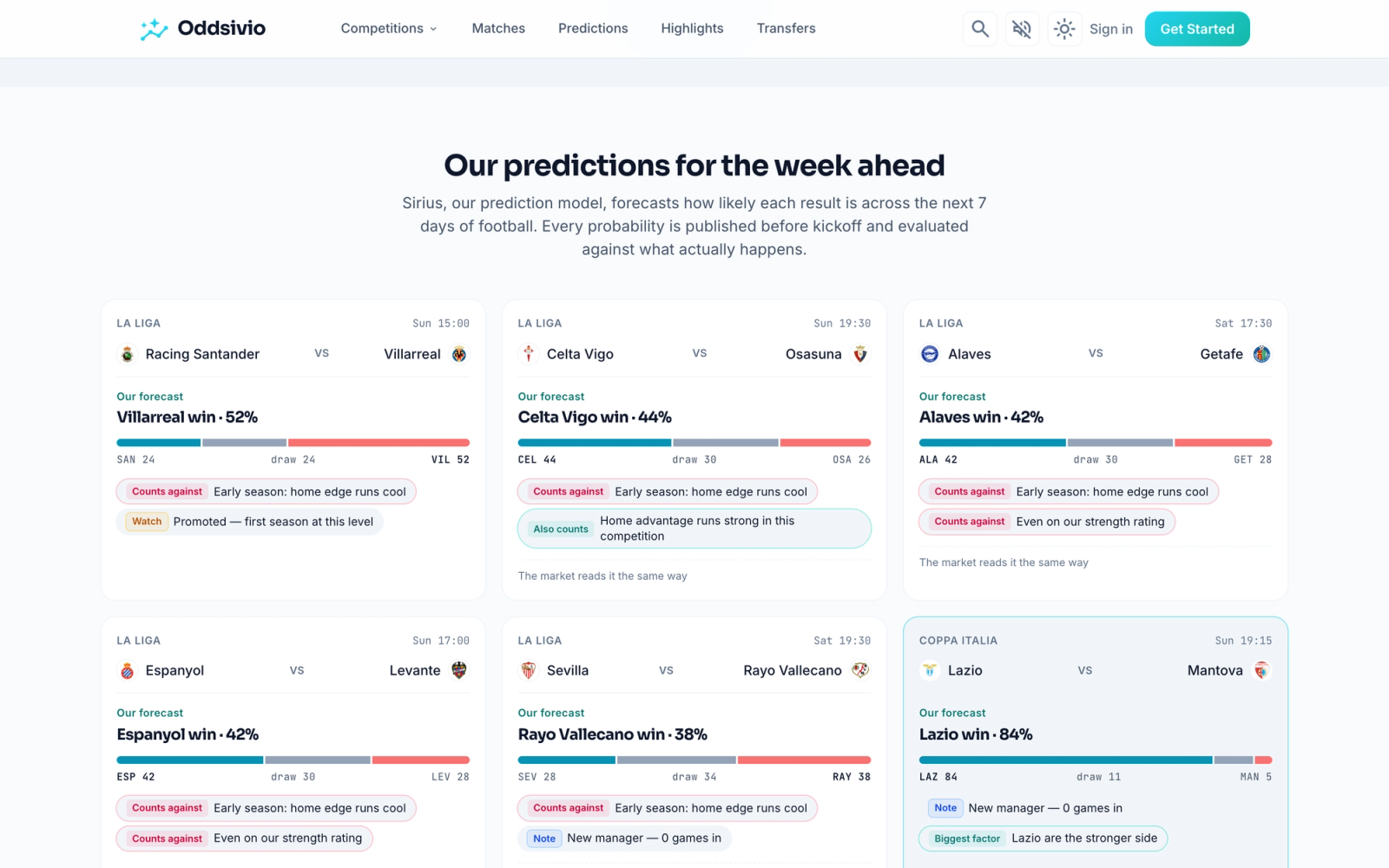
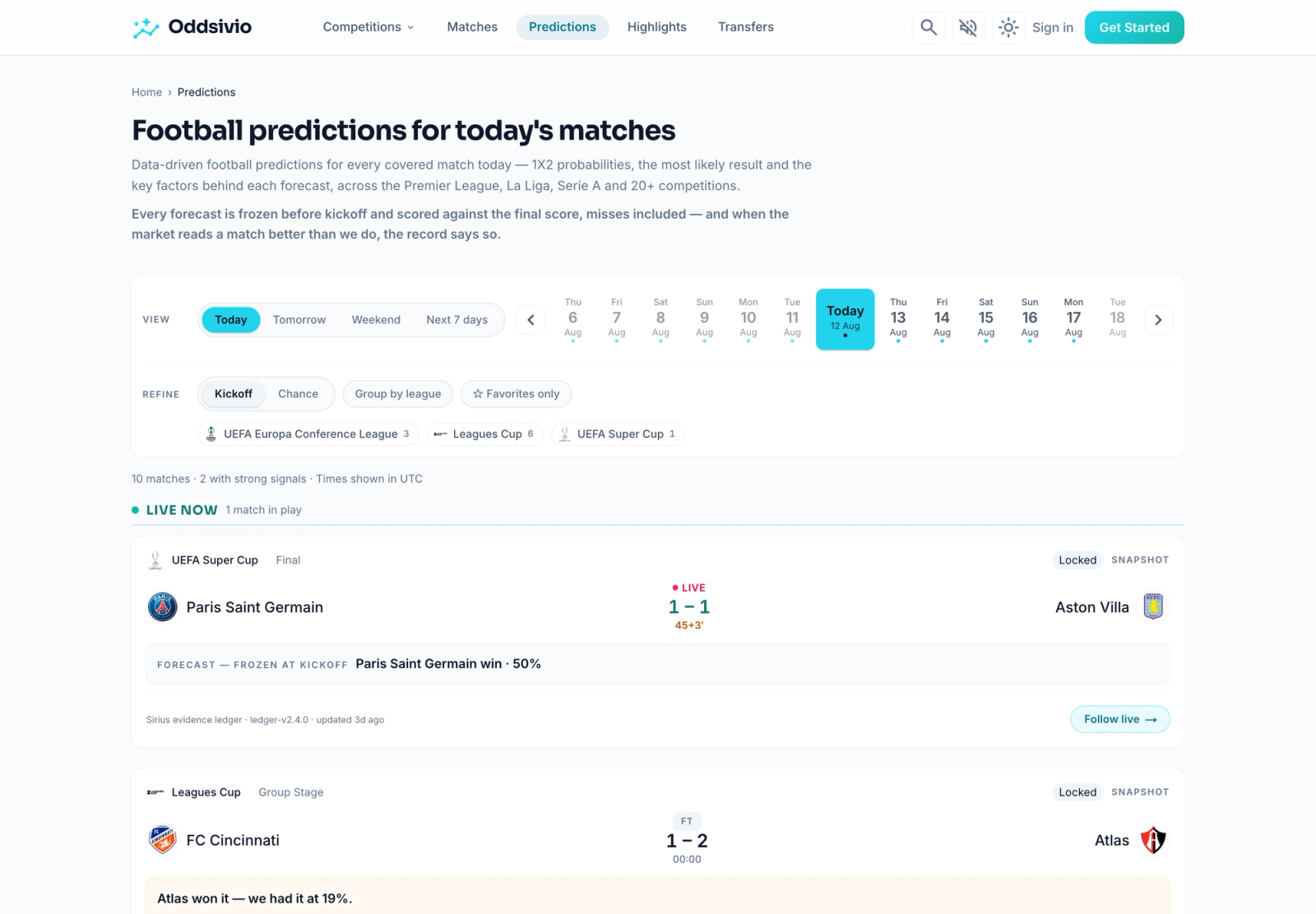
The predictions hub collects every covered match for today and the week ahead. Once a game kicks off, the forecast you see is the one we published — nothing is quietly rewritten. And at full time it gets scored, right there on the card. On the day we took these screenshots, the hub was showing the UEFA Super Cup live — our frozen line read "Paris Saint Germain win · 50%" — one card above a finished cup tie that read, in full: "Atlas won it — we had it at 19%." That sentence staying on the page is the entire point.
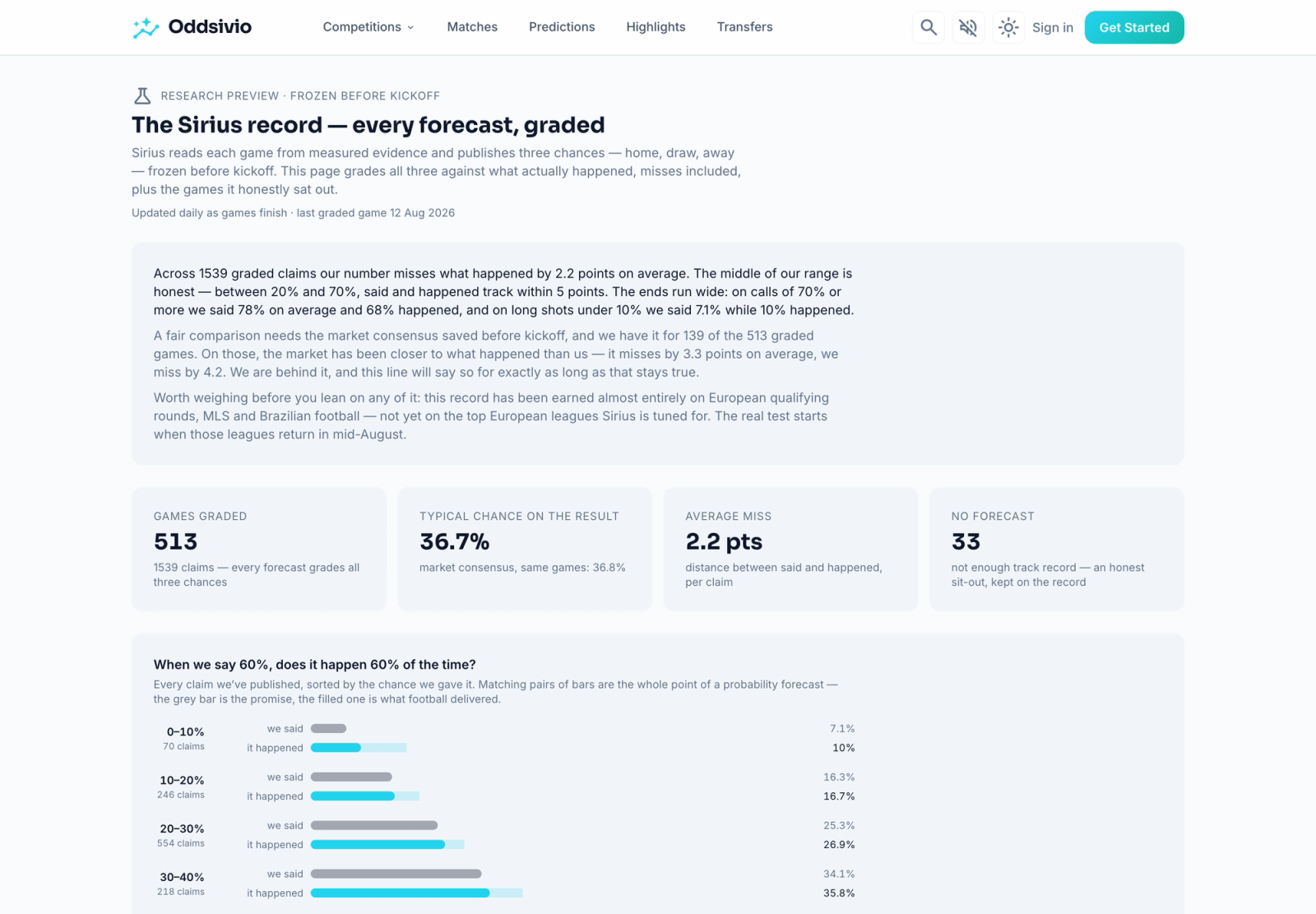
Then there's the page that keeps us honest: the Sirius record. Every forecast we've ever published, graded — 513 games and 1,539 claims so far, missing what happened by 2.2 probability points on average — plus the matches the model honestly sat out. The chart on that page asks the only question that matters of a probability forecast: when we say 60%, does it happen 60% of the time? And the record includes the comparison we'd be most tempted to hide: on the games where the market consensus was saved before kickoff, the market has so far been closer to what happened than us. The page says so, in plain text, and will keep saying so until the record flips.
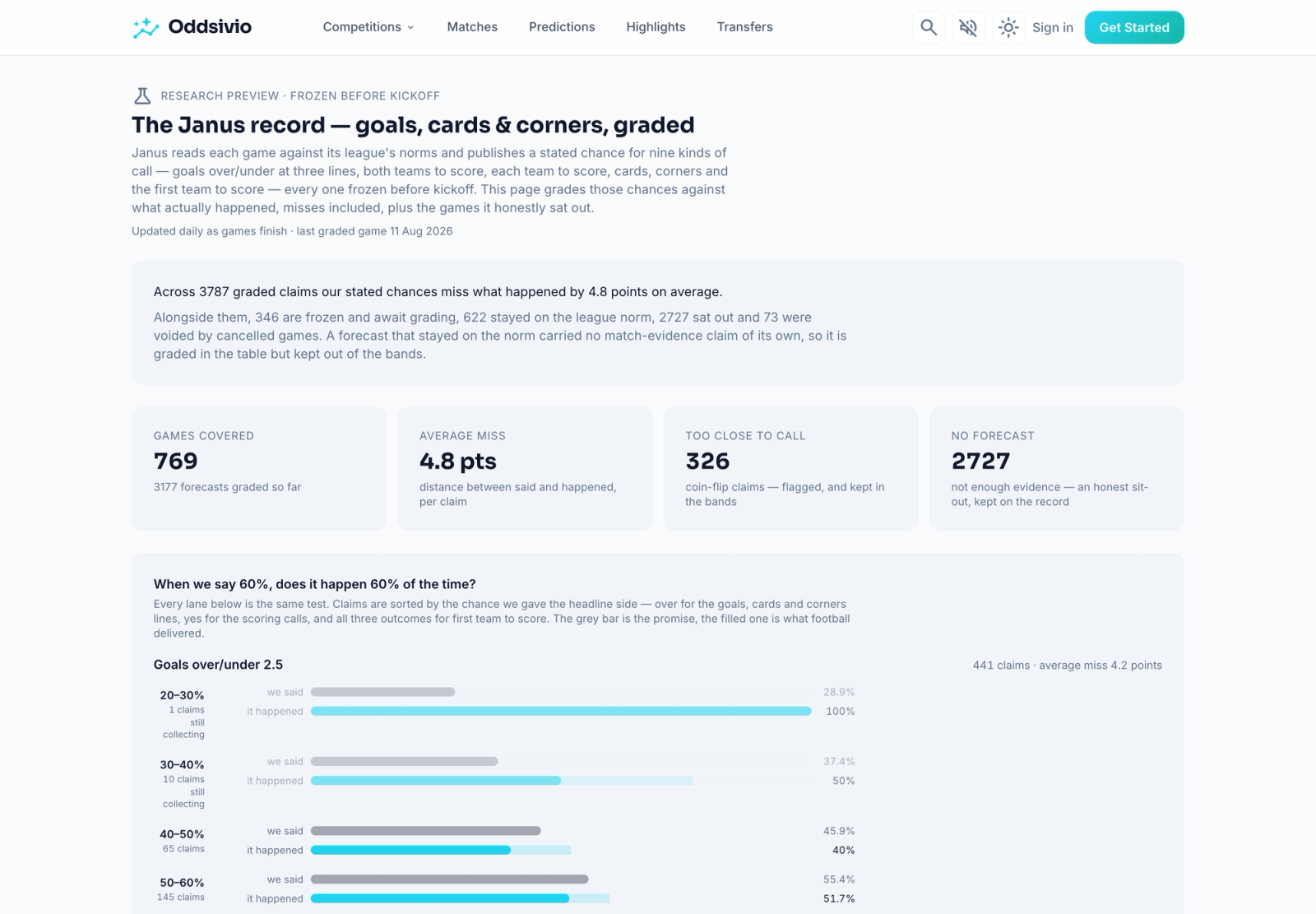
Match results aren't the only calls. Janus, the second engine, reads each game against its league's norms and publishes a stated chance for nine kinds of call — goals over/under at three lines, both teams to score, each team to score, cards, corners and the first team to score. It gets the identical treatment on its own record page: 3,787 graded claims across 769 games at the time of writing, missing by 4.8 points on average — and where a lane is still too young to judge, the page says "still accruing" instead of pretending.
Read the framing on those pages and you'll notice what's missing: certainty. We publish probabilities with a public record, never guarantees — and when the evidence is too thin, the model publishes nothing and the sit-out is logged like everything else. If you want the vocabulary behind any of it — what calibration means, what an "average miss" is, how forecasts stack up against the market's final word — the prediction-terms glossary and the closing line, explained walk through every term with live examples.
You've seen what we expect and how we grade it. The next question fans ask is who's moving — and whether to believe it.
Transfers: who reported it — and how often they're right
You know the group chat that won't let a rumour die. This is the section that ends it. One screen shows you who actually broke the story; the next shows you whether people like them tend to be right. Take Marc Cucurella to Real Madrid — first reported 14 June, 27 reports behind it, 18 from tier-1 sources, led by @FabrizioRomano. You don't have to take our word, or his. The receipt is right there. (Spoiler: this one happened.)
Two screens do that work. The first is the wire. The second is the receipt.
The window, live
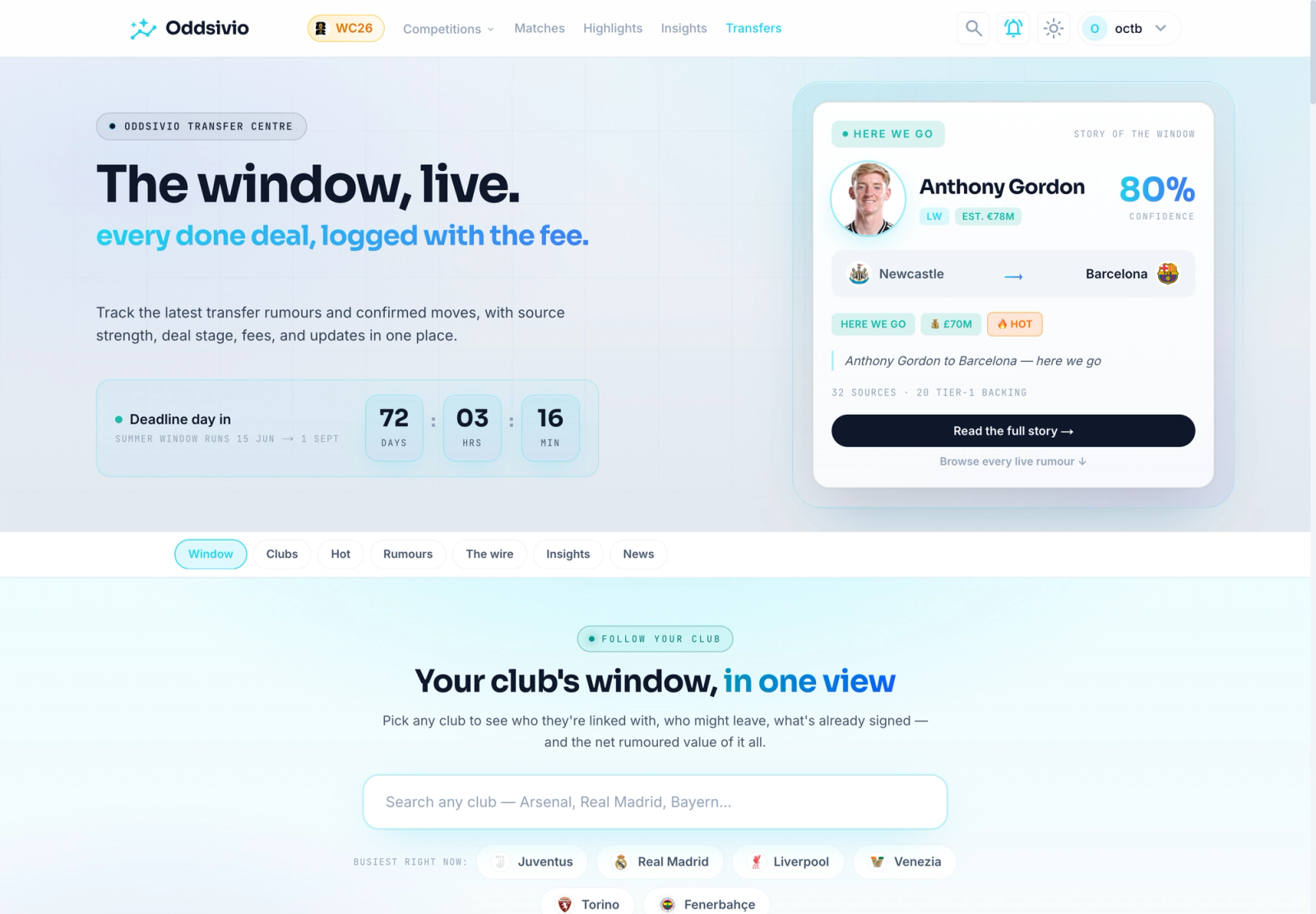
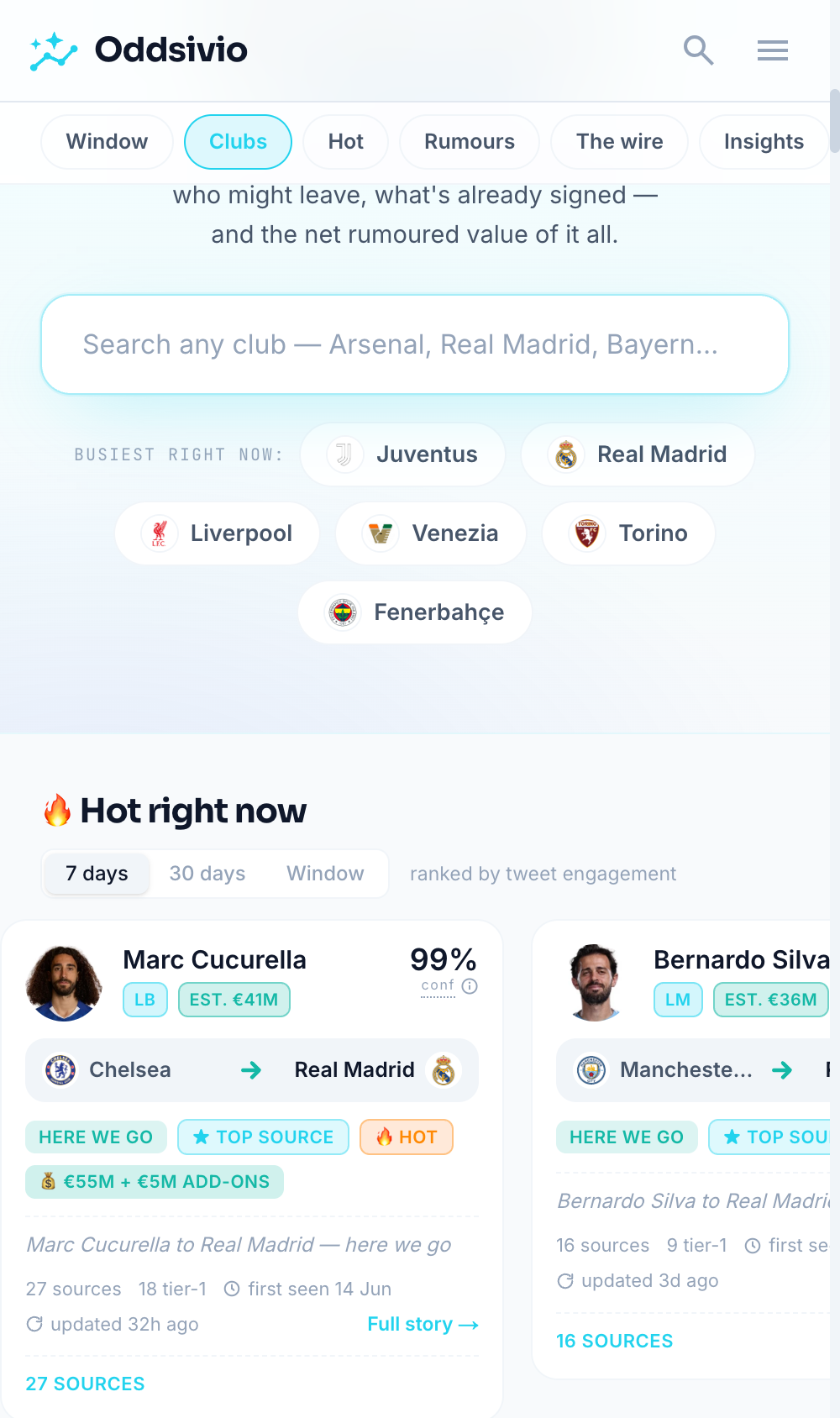
Open Transfers and you land on the window with receipts: who is linked where, how far along each move is, what fee is being quoted, and — the part that matters — who reported it, with every story tracked to an outcome.
Each rumour rides a card. A stage badge tells you the state of the move — Early link, Talks, Advanced talks, Here we go, Deal off, or Official. Next to it sits a source-confidence figure and a source count. (That confidence figure on the cards and the "signal strength" on a story's own page are the same reading shown two ways — a weighted measure of how solid the sourcing is.) Filter chips at the top let you cut the noise: Deal off, Official, Top sources.
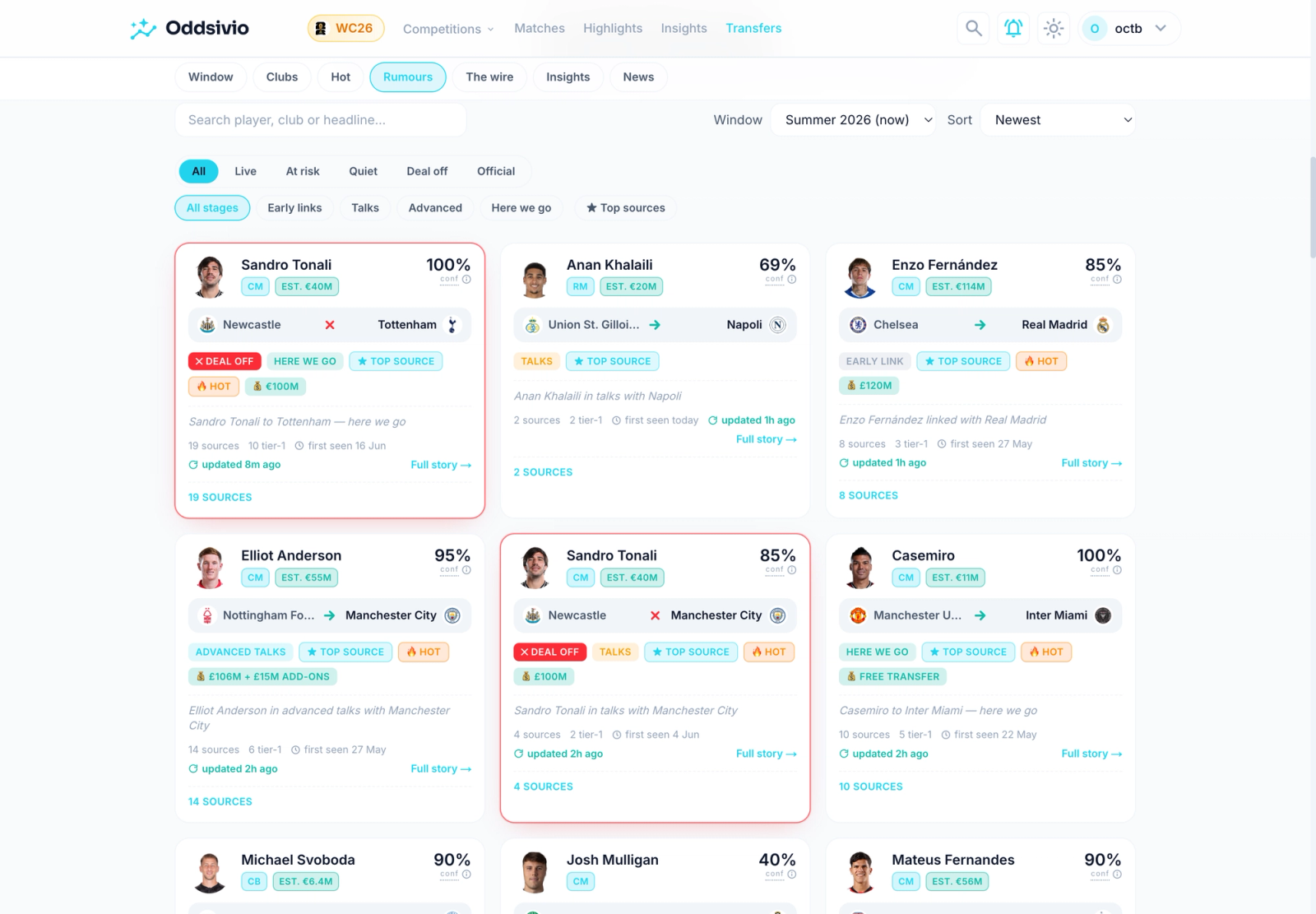
Two filters make it yours. "Your club's window" narrows the feed to one team's links, ins and outs — handy if you only care about your side. "The Insider Wire" ranks the tier-1 journalists, so you can see who is actually breaking news.
Now trace one story to the person who reported it. Marc Cucurella to Real Madrid was first reported on 14 June, backed by 27 reports including 18 from tier-1 sources, led by @FabrizioRomano.
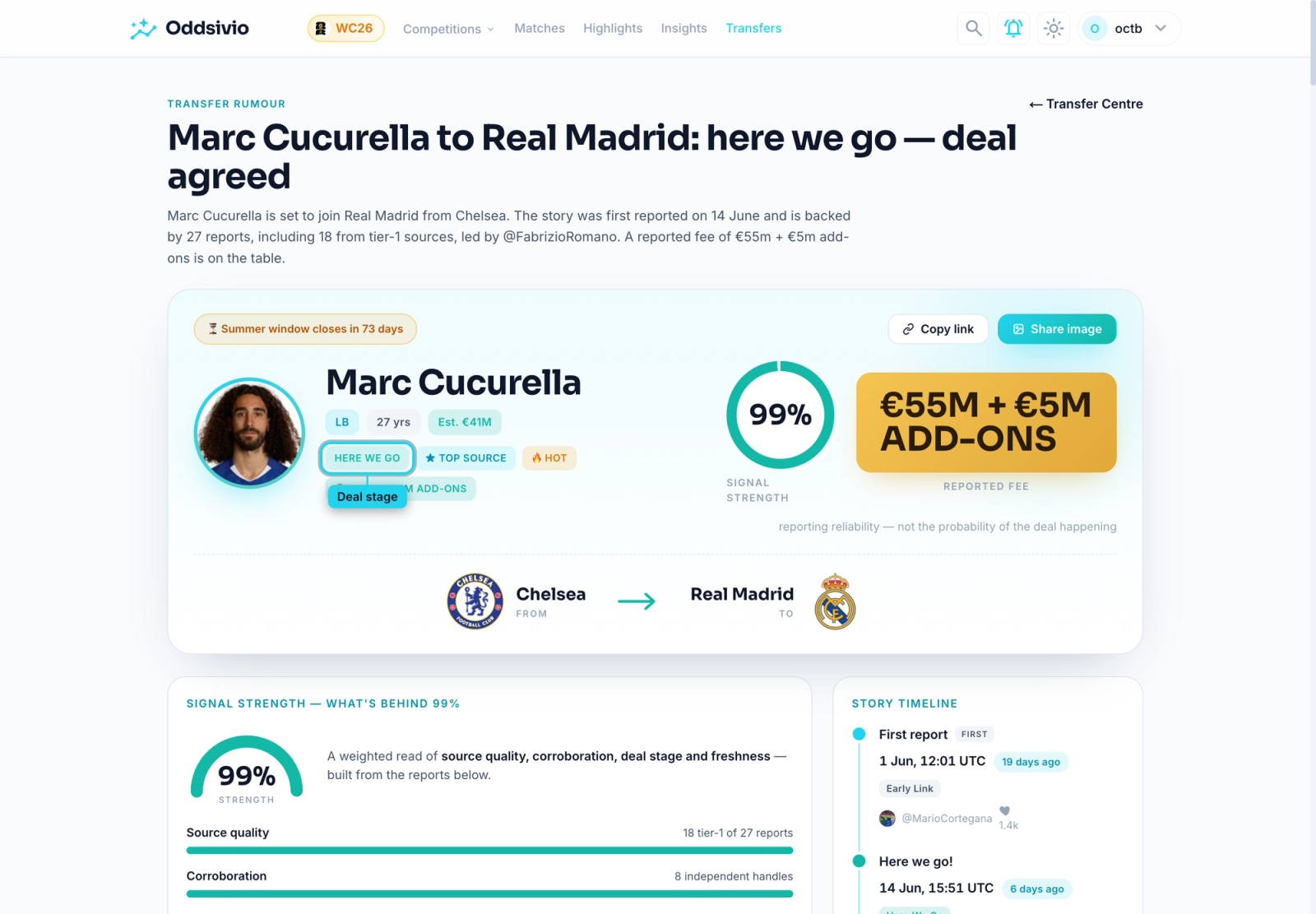
Read that again, because it is the whole point. The signal strength is about how reliable the reporting is. It is not a forecast of who ends up signing.
And because every story is tracked to an outcome, this one now carries its ending: Cucurella joined Real Madrid on 1 July, for the €55m the reporting said. Logged: came true.
Do the rumours come true?
Now the screen that earns the rest. A public scorecard — not for the players, for the rumours. Every story we track gets graded in the open: it came true, it fell through, or it faded. Including ours. Including the ones we got wrong.
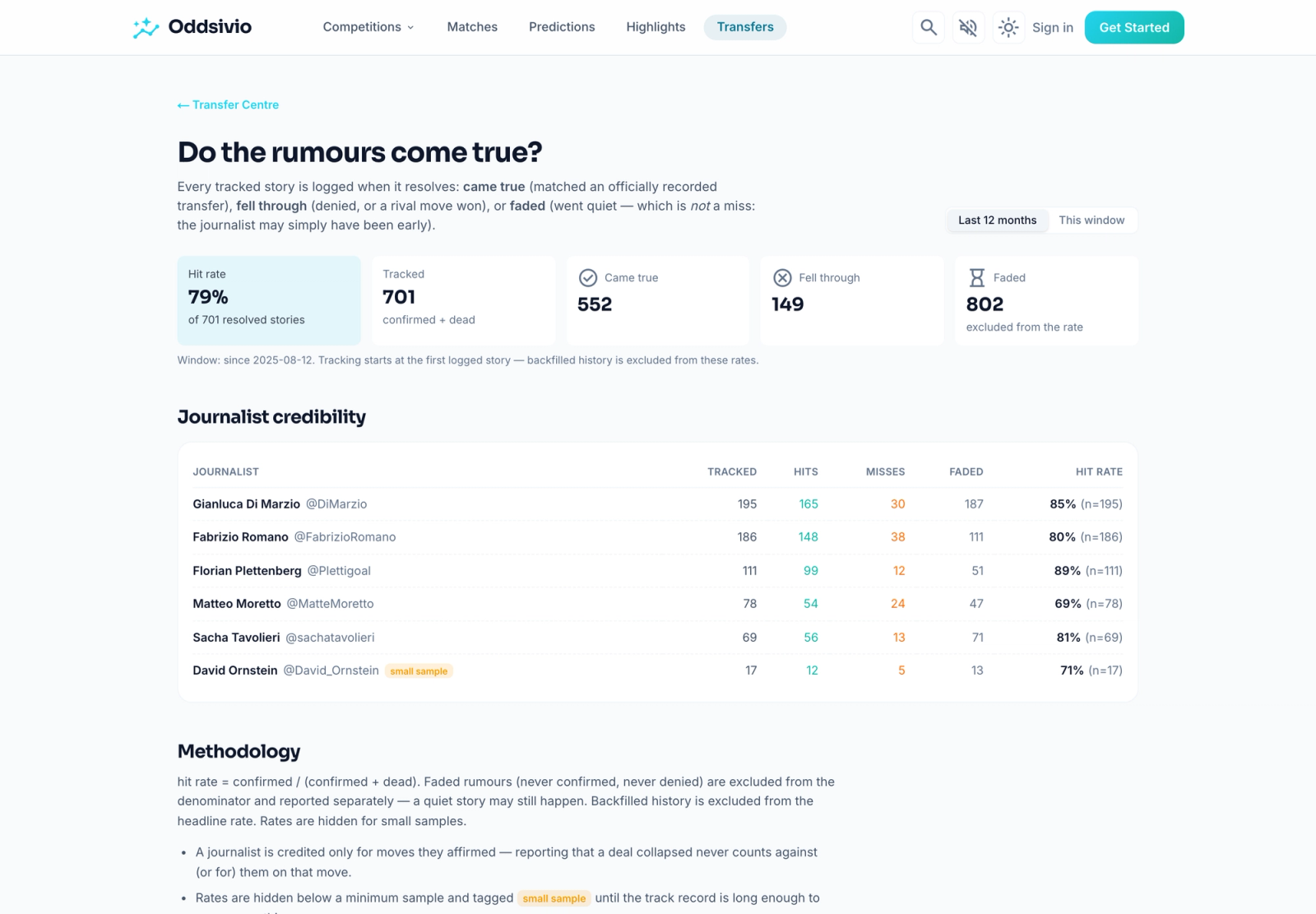
Every tracked story is logged when it resolves. Came true means it matched an officially recorded transfer. Fell through means it was denied, or a rival move won. Faded means it went quiet — and faded is not counted as a miss, because the reporter may simply have been early. That fairness is the reason this page travels.
When this guide was first published in June, the tracker was days old and nearly every row wore a "small sample" tag. Two months of receipts later it reads differently: 701 resolved stories over the last twelve months, 79% of them came true, and the journalist credibility table now shows a real hit rate next to a real sample size for the reporters who move the market — while rates stay hidden wherever a sample is still too small to mean anything. The method is published openly on the page, and the record stays on screen either way: when a reporter, or Oddsivio, gets one wrong, that stays too.
You've read the why and traced the rumour. Now watch the moment — with the same honesty about where the clip comes from.
Highlights: the goals worth watching — and why they mattered
You already get goal clips on social. So what makes this different? The clip arrives with the meaning, and it is sourced honestly.
Highlights live in a hub called The replay room: "Goals, cards, and key match moments in one place, organised by match, team and player." It is official-first — rights-holder clips come first, and anything else is clearly labelled. No murky reuploads dressed up as the real thing. And it's fast: when a goal goes in during a covered match, the official clip usually lands within minutes, while the game is still on.
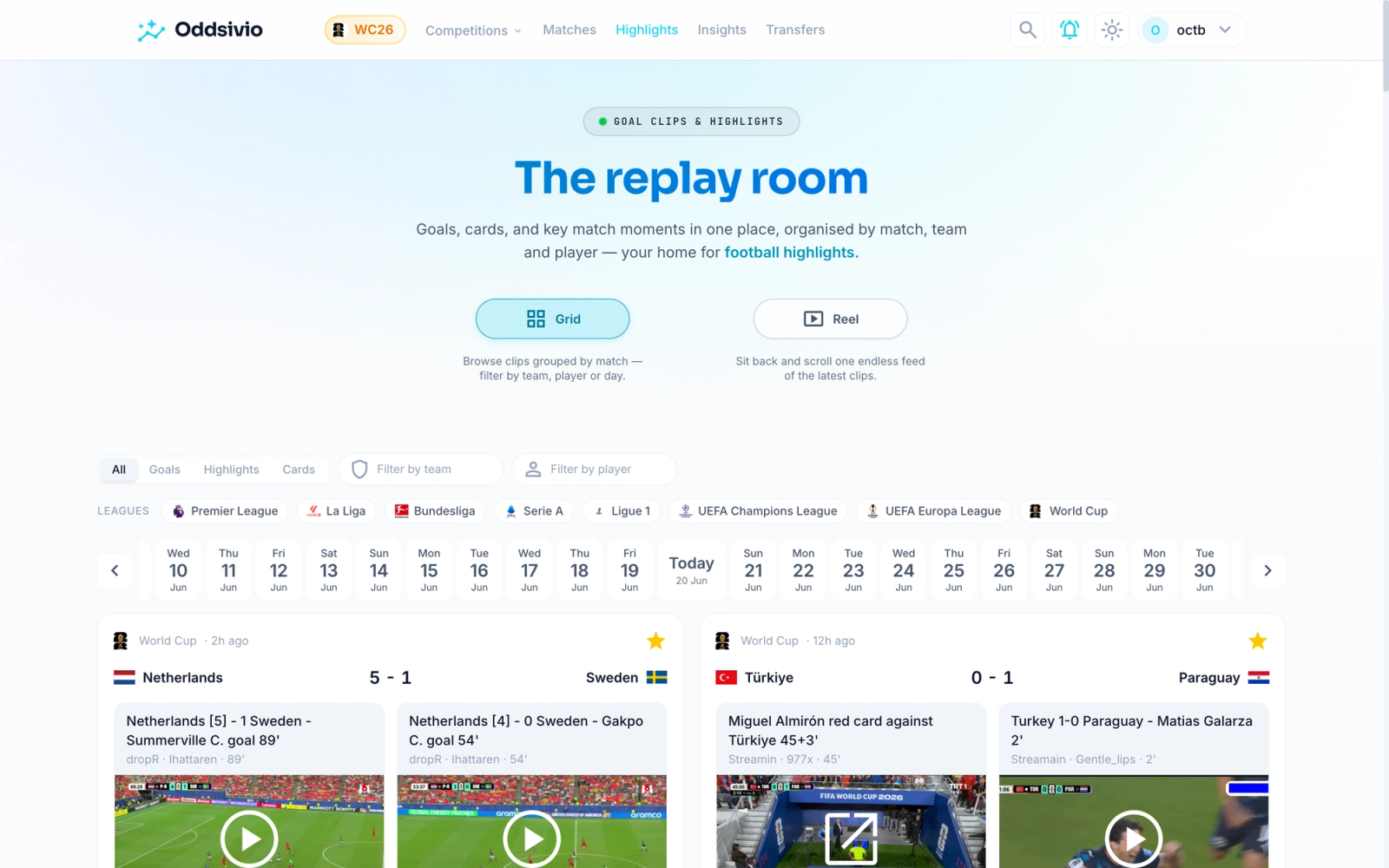
Find a moment fast. Filter by competition (Premier League, La Liga, Bundesliga, the European cups and more), by team, or by player. Flip between Grid and Reel, and narrow to Goals or Cards.
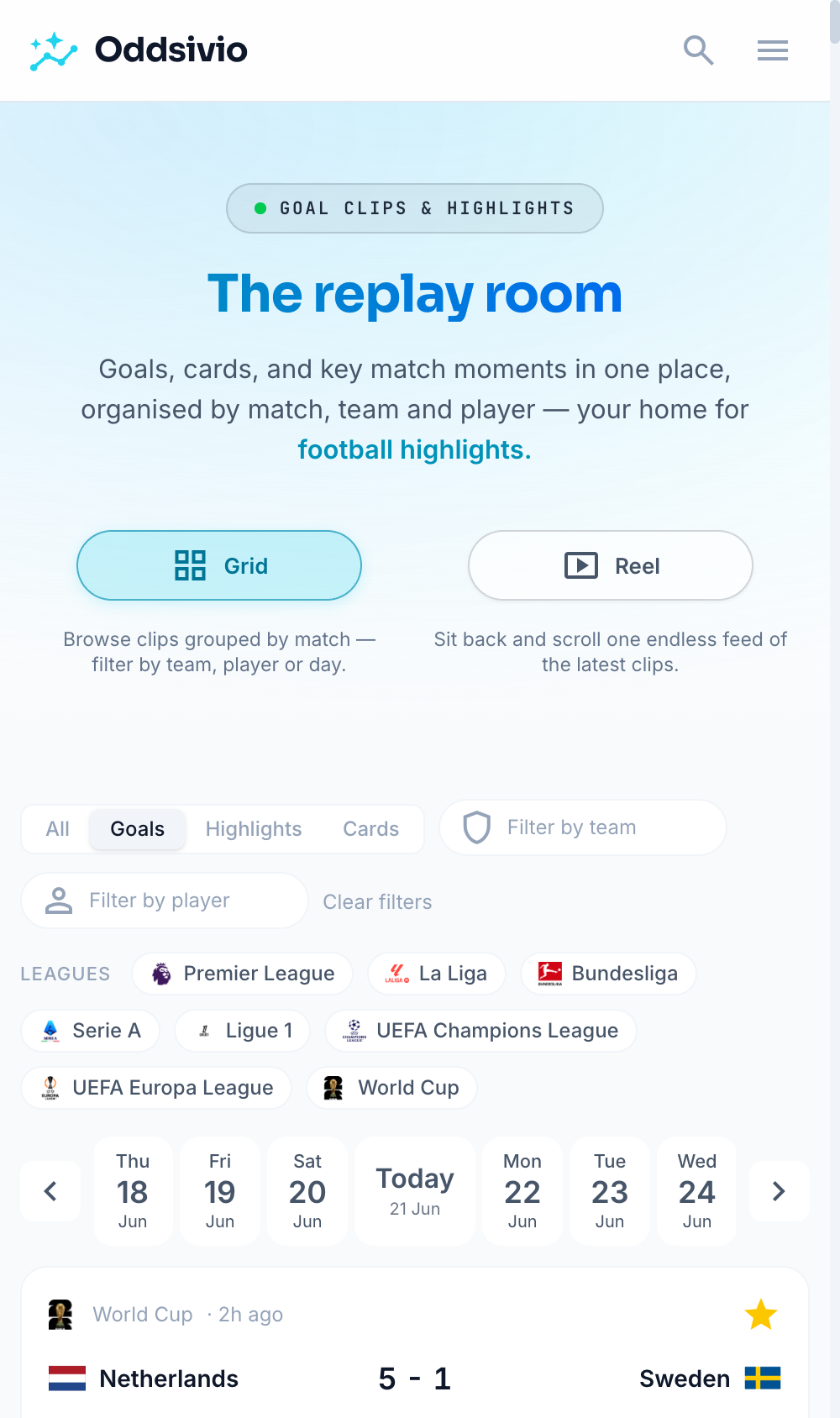
Here is the anchor move. Take Netherlands 5–1 Sweden again: you can watch Gakpo's goal at 54' and Summerville's at 89', then read straight back into the analysis to see why the Dutch ran up five. The chances were better and they were finished. Watch the goal, then read why it mattered — that is the part a feed never gives you.
Four sections, one site. The reason to come back is that it can revolve around your team.
Follow your club, your players, your way
A tour is nice once. The reason to come back is that Oddsivio remembers what you care about. (Want it in your inbox too? Field Notes, our free weekly email, sends the plain-English week in football — more on that at the end.)
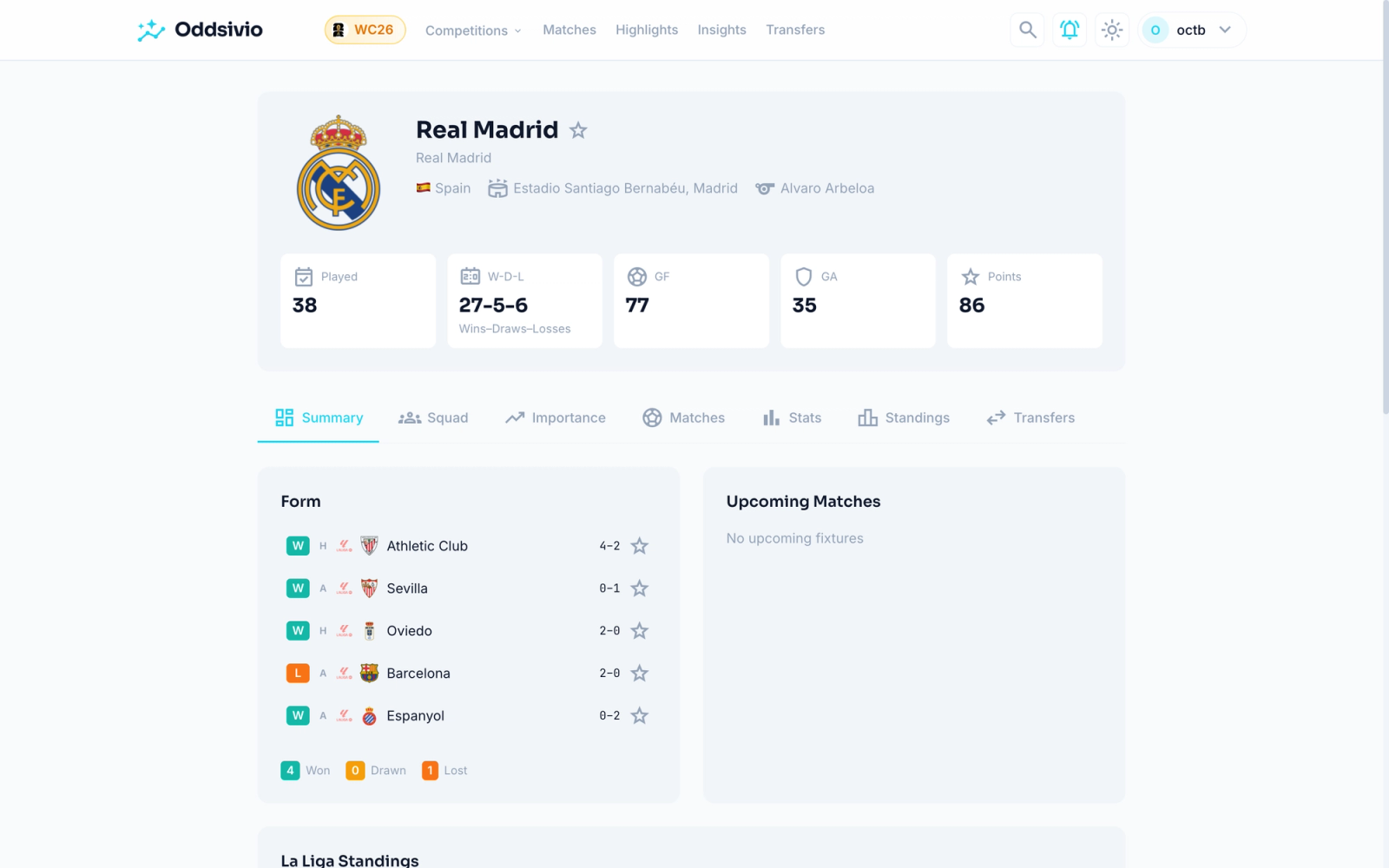
Start with a team page. Pick a club and you get one home for it — the full story in one place. The Real Madrid page leads with the record and recent form, then upcoming matches, the La Liga standings, season stats and top performers. Tabs run across the top — Summary, Squad, Importance, Matches, Stats, Standings, Transfers — so the goals, the fixtures and the rumoured ins and outs all sit under one crest.
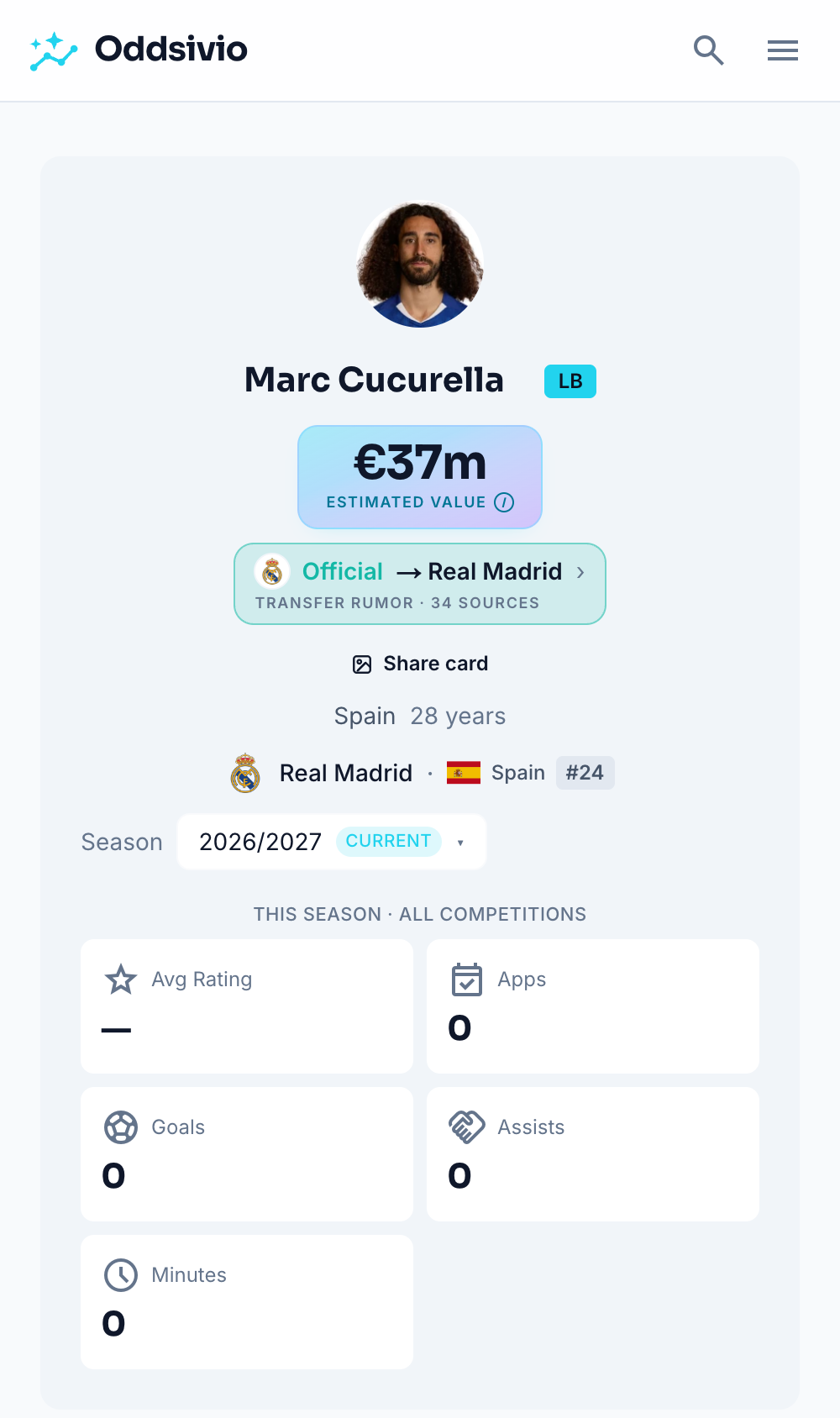
Want to follow a person, not a club? Player pages do the same job for an individual — and they close the loop on the story you traced earlier. Open the Marc Cucurella page today and the header says it plainly: Real Madrid, shirt 24, the move stamped Official on his card — with an Oddsivio estimated value of €37m above his season and career numbers.
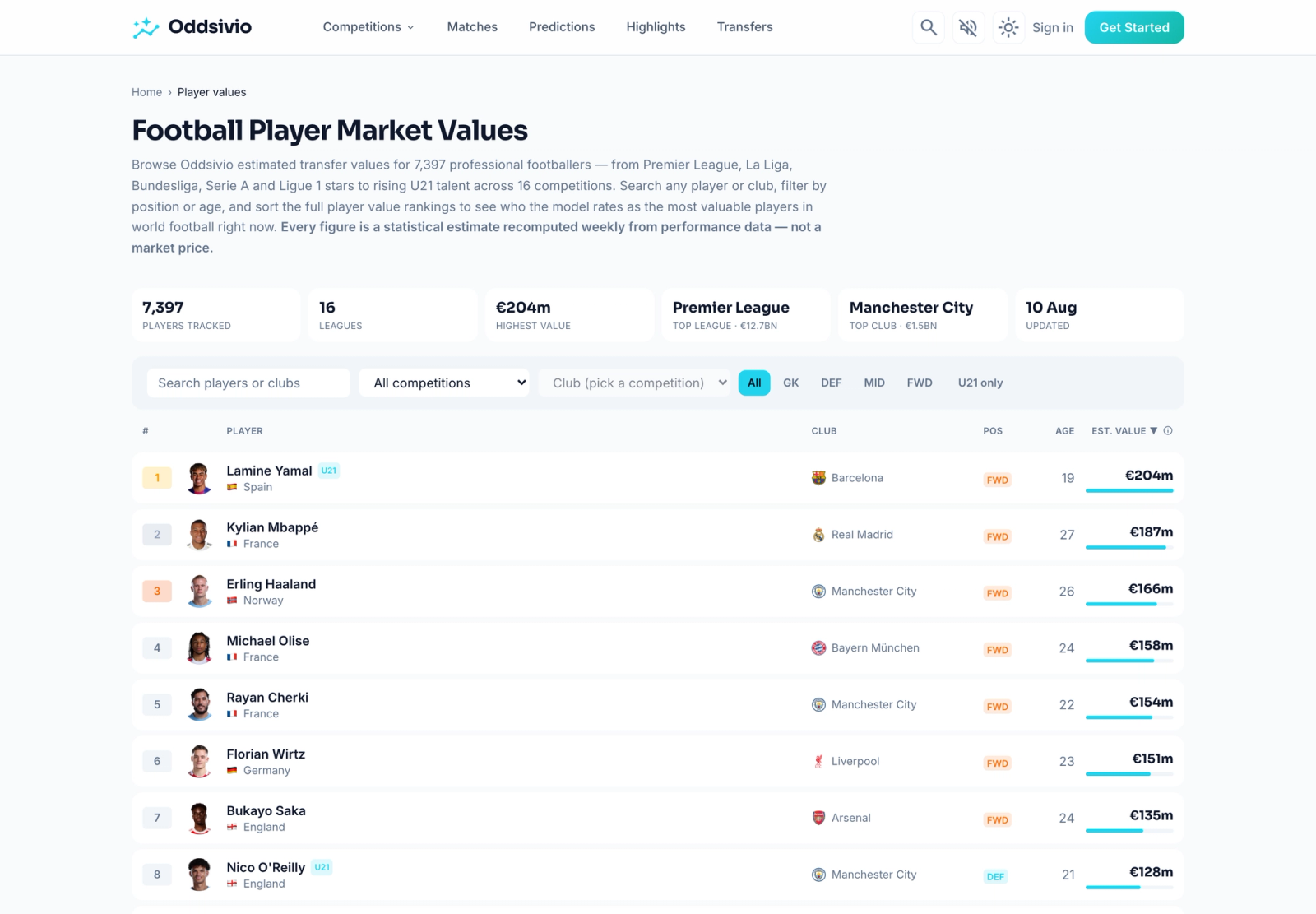
That value isn't decoration. Every eligible player on Oddsivio carries an estimated transfer value in euros, recomputed weekly from roughly 90 signals — recent output, minutes, age and position, league strength, trajectory — calibrated against real transfer-market benchmarks. Browse all 7,397 of them on the player values page, search any player or club, filter by position, age or U21 — and read exactly how the model works, including the numbers we refuse to publish. One honest rule everywhere: it is a statistical estimate, not a market price.
And when you'd rather be told than keep checking: goal alerts. Star a team or a match (a free account with a verified email is what makes the stars yours) and Oddsivio pings your phone the moment they score — kick-off, full-time and the goal clip too, even when the site is closed. On iPhone that takes a one-time Add to Home Screen, and the step-by-step setup guide walks through every tap. Until it's set up, match pages will offer you the shortcut themselves.
Search is the thread that ties it together. Press Ctrl+K (⌘K on Mac), type a name, and you jump straight to any team, player or match in two keystrokes.
So on a match day the loop is simple: open your club's page, read the preview, see what we expect, watch the goals, check who is being linked. One destination, the whole story.
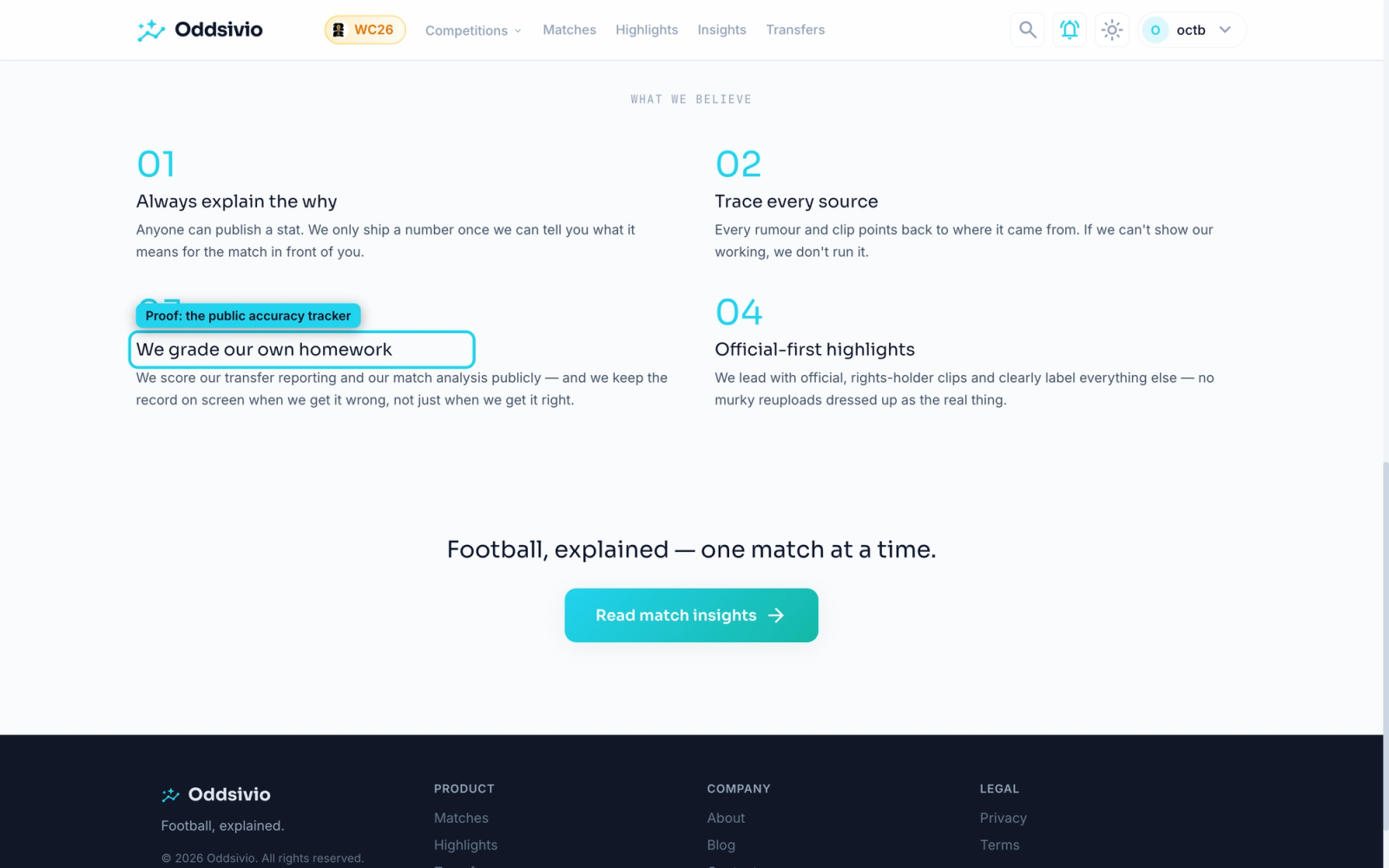
We grade our own homework
Most football sites only show you the calls they got right. We do the opposite. We grade our own homework — Oddsivio scores its transfer reporting and its match analysis publicly, and keeps the record on screen when it gets something wrong, not just when it gets it right.
That value sits alongside the others on our About page. We always explain the why — we only ship a number once we can tell you what it means for the match in front of you. We trace every source — every rumour and clip points back to where it came from, and if we can't show our working, we don't run it. Our highlights are official-first — rights-holder clips, with everything else clearly labelled. And football is the only sport we do — one game done properly, rather than many done thin.
You've already met the proof three times over. The accuracy tracker grades our transfer stories. The Sirius record grades every match forecast we've published, next to the final score it was scored against — including the line admitting the market consensus has been closer than us so far. The Janus record does the same for goals, cards and corners. None of it is a gimmick bolted on for show — it's this value made visible. The misses stay on screen next to the hits. Naming a miss in public is the feature, not a flaw. We explain; we don't sell.
Oddsivio is here to explain football, not to sell you certainty — nobody honest can. What it will do is show you why a match looks the way it does, say what it expects before kickoff and grade itself after, trace every rumour to the person who reported it, and keep every record visible even when it does not go our way. Where a feature touches the wider market, it is labelled plainly and treated as analysis to understand, never advice to act on.
That is the whole bargain: we keep our receipts in the open, including the ones we'd rather not show you.
Four ways people actually use Oddsivio
Here is what that looks like on a normal night. Four journeys, each short enough to repeat to a friend.
"Why did we lose?" The match ends and the scoreline does not explain itself. You open the match page, read the numbers with their meaning — Netherlands beat Sweden 5–1 off an Expected Goals gap of 2.61 to 1.01: better chances, finished clinically — then watch the goals that decided it. Analysis and Highlights, in one place.
"What does tonight look like?" Before kickoff, you open Predictions and see the most likely result with its chance, plus the evidence for and against the call. Before trusting any of it, you glance at the record of every forecast we've published. You are not being sold certainty; you are being shown a track record.
"Is this rumour real?" You see a transfer story online. Press Ctrl+K, search the player, open the story, and check who reported it. Then check that reporter's record on the accuracy tracker, which logs every tracked story as came true, fell through, or faded. You are not asking who will win — you are asking whether the story holds up.
"What is my club's window looking like?" Open your club's window in one view: every link, the stage of each one, and who is behind it. Then glance at the tier-1 journalist wire to see who is driving the market that week.
Four questions. Four pages. One habit.
Do one thing
Don't sign up yet. Pick one match you actually care about — your team's next game, or a result that annoyed you — open it on Oddsivio, and read the why instead of the score. That's it. If that one read tells you something the scoreline didn't, you'll know whether the rest is worth your time.
Then, when you want it to remember your club — and tap you on the shoulder the moment they score — make a free account. The button in the top-right corner says exactly what it does: Get Started. Star your club, and the match reads, transfer stories, and goals that matter to you come to the front, with goal alerts on your phone if you want them. (Two quiet extras, once you're in: open the accuracy tracker and watch the receipts pile up as the window closes, and subscribe to Field Notes — the plain-English week in football, in your inbox.)
And next time the group chat is still arguing about a rumour at midnight, don't type a paragraph. Send the accuracy tracker and let the record end it. When someone swears they know why their team lost, send the match read, not your opinion. When someone promises you tonight's result, send the forecast record — the one that grades itself. Settling it for them — that's the moment they sign up too.
Football, explained.