Kane, Mbappé and Yamal: three cases for the 2026 Ballon d’Or
Kane has the strongest season-long scoring record, Mbappé the most compelling collection of scoring crowns, and Yamal a claim that reaches beyond the scoresheet. The difficult part is deciding how much each should count.
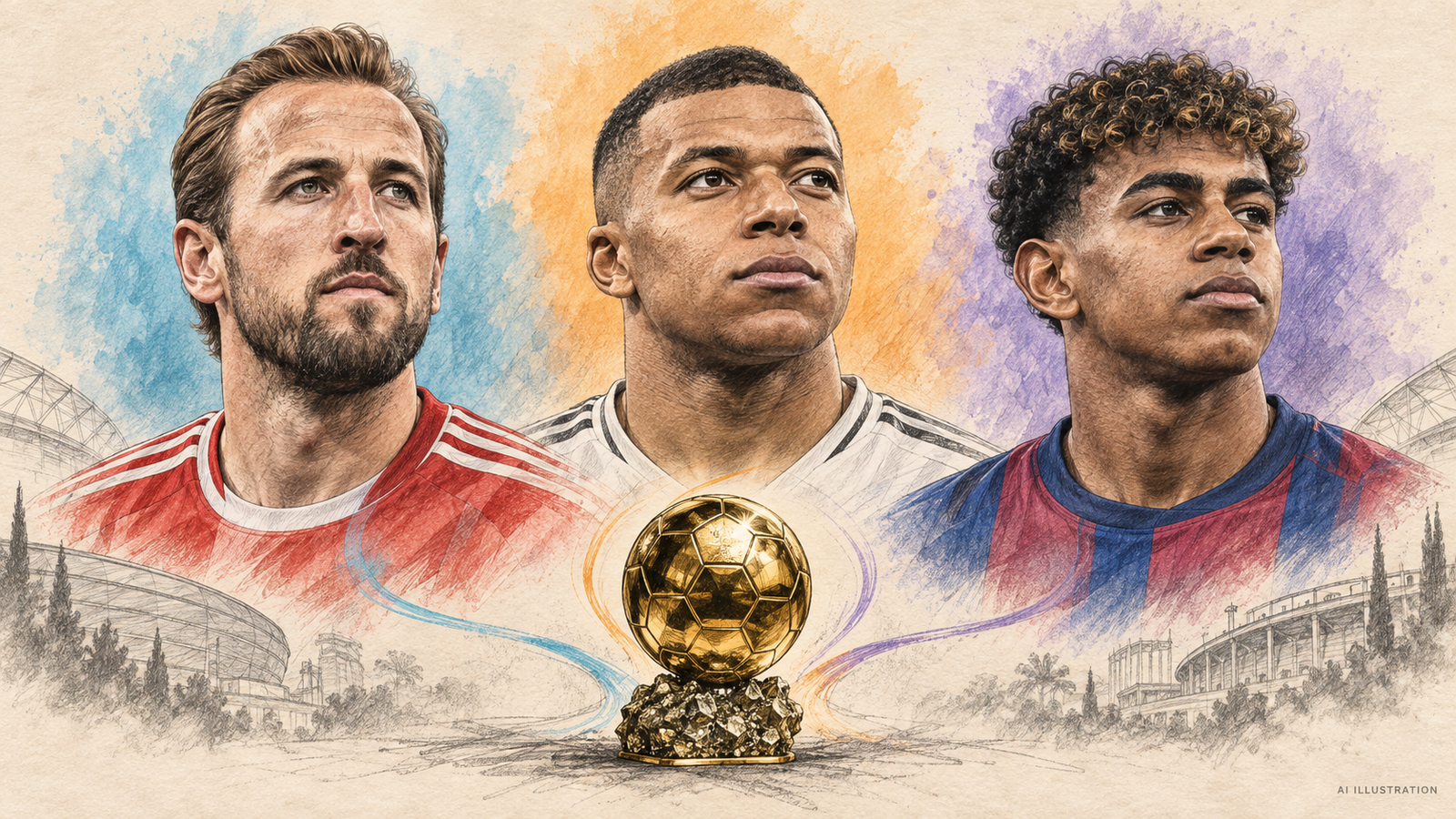
Harry Kane scored all three goals in a cup final. Kylian Mbappé finished as the leading scorer in both the Champions League and the World Cup. Lamine Yamal won the World Cup after being named the best player in Spain’s league. Each has a performance or an honour that could headline a winning Ballon d’Or argument. DFB, UEFA, FIFA, Barcelona.
Each also has something the other two can question. Kane’s season ended short of the biggest European and international trophies. Mbappé’s individual honours came without a team title. Yamal’s World Cup medal demands a closer look at his personal contribution to Spain’s success.
Our preference in this head-to-head is Kane. His case survives the most obvious challenges to it: remove penalties, account for playing time, look beyond the Bundesliga. Mbappé is the strongest challenger on individual production across the biggest competitions. Yamal requires us to take creation and influence seriously, while resisting the temptation to assign one player all the credit for a winning team.
What the Ballon d’Or criteria ask voters to weigh
The award’s rules help frame that judgment. They put individual performance first, followed by team performance and achievements, then class and fair play. They provide no numerical weighting that automatically converts a World Cup, a league title or ten goals into a winning score. The reference period runs from 3 August 2025 to 19 July 2026. September’s performances belong to a different season, however fresh they are in voters’ minds. Official Ballon d’Or regulations.
These are three candidates from a wider shortlist, rather than an official final three. The winner will be announced at the London Palladium on 26 October. UEFA’s nominations announcement.
How the three seasons compare
For a consistent starting point, our comparison counts competitive club and senior international matches within that period. Goals include penalties; friendlies and shootout kicks are excluded.
Harry Kane
- Competitive appearances: 63
- Goals: 72
- Assists: 8
- Goals + assists: 80
- Club goals + assists: 61 + 7
- World Cup goals + assists: 6 + 1
- Team titles: Bundesliga, DFB-Pokal, German Supercup
Kylian Mbappé
- Competitive appearances: 56
- Goals: 57
- Assists: 13
- Goals + assists: 70
- Club goals + assists: 42 + 6
- World Cup goals + assists: 10 + 4
- Team titles: None
Lamine Yamal
- Competitive appearances: 55
- Goals: 25
- Assists: 20
- Goals + assists: 45
- Club goals + assists: 24 + 17
- World Cup goals + assists: 1 + 0
- Team titles: LaLiga, Spanish Super Cup, World Cup
Source: Oddsivio match records, checked against Opta competition totals and official tournament reports. The combined totals also include World Cup qualifiers played within the reference period. Method and source details appear below.
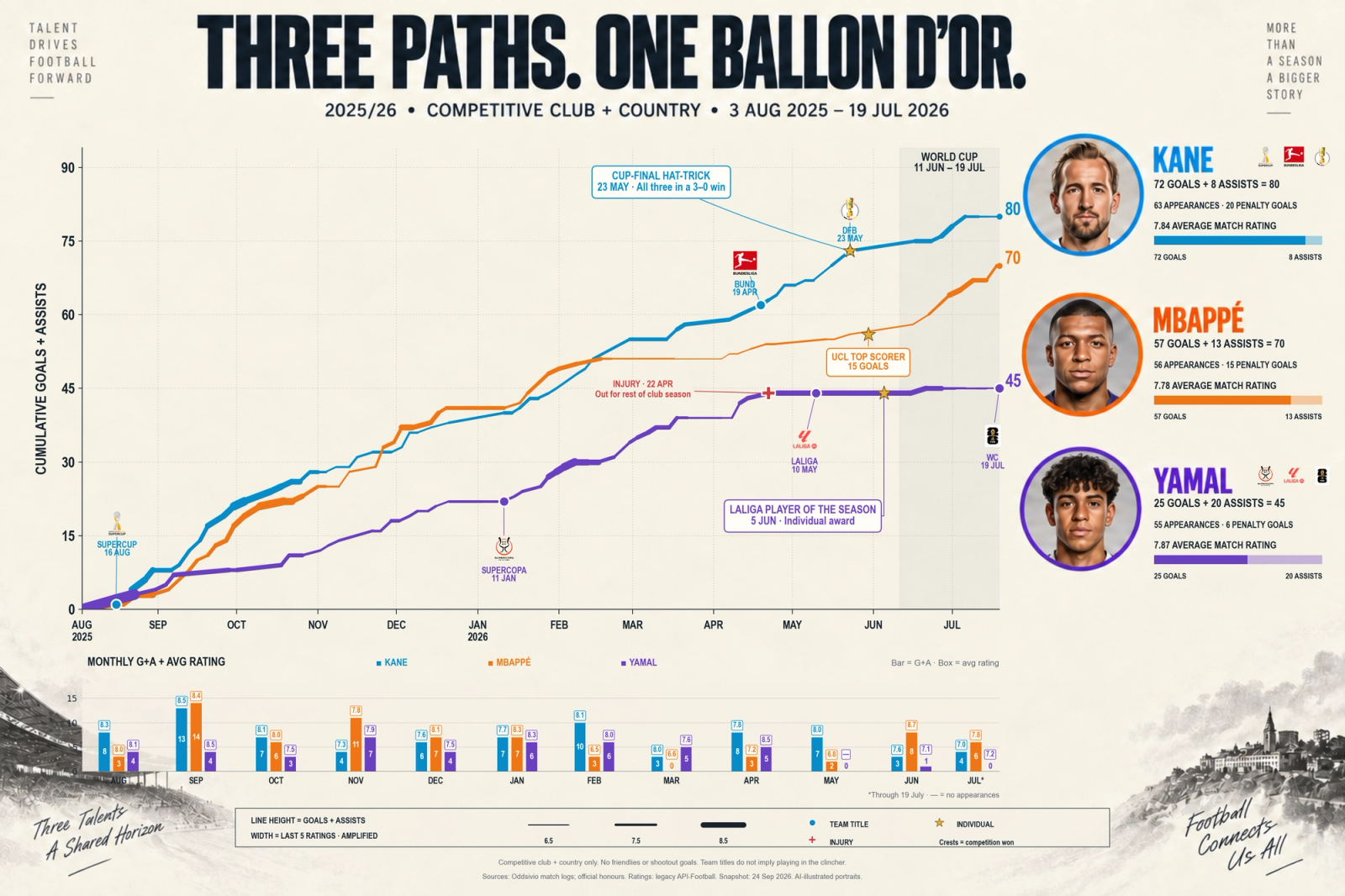
Open the full-size infographic to inspect the monthly ratings, trophies and achievement markers.
The shape of that season matters. Mbappé led Kane 48–45 on combined goals and assists at the end of January. By the end of May, Kane led 73–56. Mbappé then added 14 at the World Cup to Kane’s seven, narrowing the final gap to ten. Yamal’s line barely moved after his April injury, yet he finished the period as a world champion. The same chart shows Kane’s spring surge, Mbappé’s stronger World Cup return and the limits of judging Yamal by his recorded output.
Harry Kane: the strongest season-long scoring case
Strongest case
Kane’s strongest argument begins with the scale of his club season: 61 goals in 51 appearances, including 36 in the Bundesliga and 14 in Europe. His league tally secured the European Golden Shoe. This was sustained scoring across several competitions, with a domestic double and the Supercup alongside it. Bundesliga’s season breakdown, Bayern’s Golden Shoe announcement.
The penalty objection reduces the numbers without reversing the order. Across their club competitions, Kane recorded 1.13 non-penalty goals plus assists per 90 minutes, against Mbappé’s 0.89 and Yamal’s 0.85. Those are our calculations from the same Opta source. They account for minutes and remove penalty goals; they cannot account for the quality of every opponent, the chances teammates supply or the different jobs each player performs. Even with those limits, Kane’s advantage remains substantial. Opta: Kane, Mbappé, Yamal.
There is also a decisive performance to attach to the total. In the DFB-Pokal final on 23 May, Kane scored every goal in Bayern’s 3–0 win over Stuttgart. His scoring supplied the entire margin in the match that completed the double. DFB’s final report.
Europe provides a useful direct comparison. Kane and Mbappé both scored in both legs of their Champions League quarter-final; Bayern advanced 6–4 on aggregate. That result strengthens Kane’s season, but the goals on both sides make it difficult to portray the tie as an individual failure by Mbappé. UEFA’s first-leg report, Bayern’s second-leg report.
What is missing
The strongest objection to Kane is the setting in which much of that dominance came. Bayern’s domestic superiority makes league totals an incomplete comparison with players elsewhere. Even the Bundesliga’s own Player of the Season award went to teammate Michael Olise, a reminder that scoring is only one part of attacking value. Bundesliga’s award announcement.
And the two biggest opportunities ended in semi-final defeats: Bayern against Paris Saint-Germain, England against Argentina. Kane scored in both European legs, including a late equaliser in the return, but neither performance took Bayern to the final. A voter who places exceptional weight on the World Cup can reasonably prefer another candidate. Kane’s case rests on the strength of the whole season, with the cup final as its clearest winning moment. Bayern’s semi-final report, England’s semi-final reaction.
Kylian Mbappé: scoring crowns across three competitions
Strongest case
Mbappé’s answer is an extraordinary spread of individual success: 25 LaLiga goals, 15 Champions League goals and ten World Cup goals, finishing top scorer in all three. His Champions League total came in just 11 appearances. If the first question is who repeatedly produced against elite opposition for club and country, he has a powerful claim. Real Madrid’s Pichichi announcement, UEFA’s scoring table, FIFA’s World Cup awards.
His World Cup is the strongest numerical reply to Kane: ten goals and four assists, twice Kane’s seven combined contributions. It also complicates the familiar picture of Mbappé as merely a finisher. Across the competitive reference period, he supplied 13 assists, five more than Kane. France finishing fourth cannot make those contributions disappear. Opta’s international record.
What is missing
The missing team trophy nevertheless matters because collective achievement is part of the award’s criteria. The organisers’ own nominee profile records none for Mbappé. His case asks voters to reward an exceptional individual season through Madrid’s defeat by Bayern and France’s semi-final loss to Spain. That is a legitimate interpretation of an individual award, but it needs more than the assertion that team results are irrelevant. Official nominee profiles.
Nor do three scoring crowns automatically settle it. Thirteen of his 15 Champions League goals came in the league phase; the remaining two came against Bayern. He scored in the quarter-final, yet Madrid’s campaign stopped there. At the World Cup, two of his ten goals came in the third-place match after France’s title challenge was over. They count fully towards the Golden Boot; a judgment about decisive influence should still distinguish those settings. UEFA’s goal breakdown, England–France match report.
Lamine Yamal: creative influence beyond goal totals
Strongest case
Yamal’s strongest response begins with the work these totals measure less fully. His club season produced 24 goals and 17 assists. Kane and Mbappé supplied 13 club assists between them. As a winger carrying both scoring and creative responsibility, Yamal deserves to be judged on both; expecting him to match a centre-forward’s goal total would narrow the comparison before it begins. Opta’s club record.
He changes how opponents defend. Villarreal midfielder Santi Comesaña explained the problem in February: opponents had moved from marking Yamal with a fullback to adding cover from a central midfielder. That attention leaves another Barcelona player free. Comesaña called it “invisible work” and described his coach’s insistence that Yamal must not be left one against one. His influence can create the opening several actions before anybody receives credit for an assist. Comesaña’s interview with EL PAÍS, 28 February 2026.
There is a specific reason to look beyond his one goal and zero credited assists at the World Cup. Against France in the semi-final, Yamal won the penalty that Mikel Oyarzabal converted to open the scoring. His direct involvement in breaking that match open adds nothing to the G+A line. A statistic can be correctly recorded and still fail to describe an important contribution. Barcelona’s semi-final report.
He gives a neutral a reason to tune in. Thierry Henry put that appeal into words on CBS in April. Praising Michael Olise and Yamal together, he urged them to keep playing freely: “you’re making it enjoyable for everybody.” His praise concerned the pleasure their football produces, rather than a scoring milestone. Henry’s CBS comments, reproduced by Le Parisien.
ESPN’s Sam Marsden identified that same attraction in his August 2025 season preview: Yamal commanded attention because the spectator could not predict his next move. More recently, analyst Axel Torres called him “the most entertaining player in the world” while leaving him outside his own Ballon d’Or top five. Admiration for the spectacle extends beyond those campaigning for him to win. Marsden’s ESPN preview, Torres on Cadena SER, 24 September 2026.
That is a serious part of Yamal’s case: the anticipation when he receives the ball, the defender forced to react, the possibility that a crowded flank suddenly becomes an opening. A fan can choose to watch Barcelona or Spain for those moments. The argument is about the quality and imagination of his play, with goals and assists recording only some of its consequences.
The invention comes with achievement. LaLiga named him its Player of the Season. Barcelona won the Spanish Super Cup and the league, before Yamal returned from injury to help Spain win the World Cup. Those honours connect his creative influence to recognition and team success. LaLiga’s award announcement, RFEF’s Super Cup report, Barcelona’s league-clinching report, FIFA’s World Cup final report.
What is missing
The case needs the same scrutiny as the others, though. Barcelona exited the Champions League in the quarter-finals against Atlético, despite Yamal scoring in the second leg. His April injury then ended his club season; he was absent when Barcelona clinched LaLiga against Madrid. UEFA’s quarter-final report, Barcelona’s injury update, Clásico squad announcement.
And the World Cup’s best-player award went to Rodri. Yamal earned his winner’s medal, but that does not establish that he was the principal reason Spain won the tournament. RFEF on Rodri’s Golden Ball.
That distinction is where a Yamal vote must do its hardest work: explain why his creative influence across the season outweighs Kane’s greater scoring contribution and Mbappé’s exceptional World Cup production. Pointing to the trophies establishes a serious candidacy. Assessing his share of those successes is what determines how high it belongs.
The wider field and a different weighting of the season
Torres’s post-World Cup ranking put Rodri first and also left Kane outside the top five. His emphasis on that tournament illustrates how a different weighting of the season changes the answer. Torres’s assessment on Cadena SER.
There are credible claims beyond this comparison. Rodri was the World Cup’s best player; Khvicha Kvaratskhelia won the Champions League and UEFA’s Player of the Season award. Any argument that treats winning one of those tournaments as essential must give them serious consideration too. UEFA on Kvaratskhelia.
Our verdict among these three
Among these three, Kane offers the strongest combination of sustained individual output and a direct role in winning honours. His lead survives removing penalty goals and adjusting for minutes; his 14 European goals answer the suggestion that it was all domestic; his cup-final hat-trick connects the scoring to a trophy.
Mbappé would be a defensible choice for a voter most persuaded by repeated scoring excellence across the Champions League and World Cup. Yamal would be a defensible choice for one who judges his creative influence on successful teams to outweigh the gap in recorded output. Our order is Kane, Mbappé, Yamal. It is an editorial judgment about the eligible season, not a prediction of the ballot. Kane’s case is strongest because it holds together across several tests, even after making room for what the other two did better.
Methodology and data notes
Research and scope. Research checked on 25 September 2026; match dataset frozen on 24 September. Combined figures and the timeline use Oddsivio’s competitive match records from 3 August 2025 through 19 July 2026, cross-checked against Opta competition aggregates. The 2025 Club World Cup falls outside the window.
Per-90 comparisons. Club per-90 comparisons use Opta minutes and assist definitions throughout, covering league, domestic cup, domestic supercup and Champions League. LaLiga’s Yamal award page lists a different assist total; our numerical comparisons consistently use Opta’s definition.
Chart and titles. Chart ratings come from API-Football match data and are provider assessments. No rating is assigned to a month without an appearance. Team-title markers identify the winning team’s achievement and do not imply that the player appeared in the clinching match.