Which club players carried the biggest international workload?
Eight of the players in our selected comparison completed four full internationals. Here is how the 21 September–6 October break played out for prominent outfield players at clubs in Europe’s five major domestic leagues.

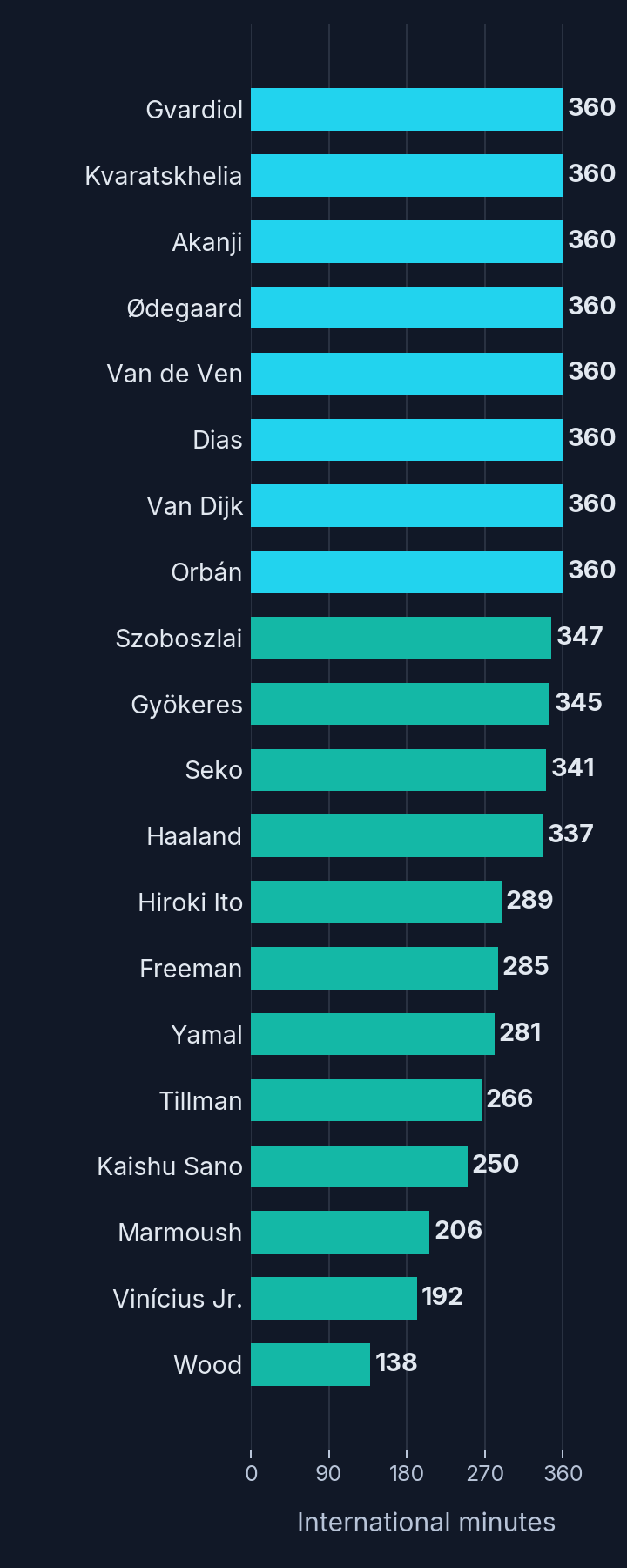
Martin Ødegaard, Virgil van Dijk and Joško Gvardiol return to club football with 360 international minutes apiece: four starts, four full matches and no regulation-time rotation. They share that total with five other players in this comparison. The extended break gave their national teams four games; those eight players were on the pitch for all of the nominal 90 minutes in each one. UEFA’s records confirm the totals for Ødegaard, Van Dijk and Gvardiol.
For supporters looking ahead to the return of domestic football, the useful distinction is between being called up and actually playing. Four appearances can mean four full matches, several early substitutions or a mixture of starts and brief spells from the bench.
This is a selected comparison of 20 first-team outfield players at clubs in England, Spain, Germany, Italy and France. Their national teams span all six confederations. Competitive internationals and senior friendlies both count. Missing or unresolved records have been excluded, so this is not an exhaustive league-wide or worldwide leaderboard.
The four-full-match group
Eight players in the selection reached 360 minutes. Each made four starts and four appearances. Their clubs span all five domestic leagues in this article; the group is much broader than the Netherlands pair alone.
- Martin Ødegaard — Arsenal, Norway · 360 minutes · 4 starts · 4 appearances
- Virgil van Dijk — Liverpool, Netherlands · 360 minutes · 4 starts · 4 appearances
- Micky van de Ven — Tottenham, Netherlands · 360 minutes · 4 starts · 4 appearances
- Joško Gvardiol — Manchester City, Croatia · 360 minutes · 4 starts · 4 appearances
- Rúben Dias — Manchester City, Portugal · 360 minutes · 4 starts · 4 appearances
- Khvicha Kvaratskhelia — Paris Saint-Germain, Georgia · 360 minutes · 4 starts · 4 appearances
- Manuel Akanji — Inter, Switzerland · 360 minutes · 4 starts · 4 appearances
- Willi Orbán — RB Leipzig, Hungary · 360 minutes · 4 starts · 4 appearances
The tie matters. There is no evidence here for declaring one of these eight the single most heavily used player. Under a convention that excludes added time, their recorded playing time is identical. Nor is 360 a universal ceiling: teams elsewhere can have different schedules or actual extra time.
Four starts did not always mean 360 minutes
Dominik Szoboszlai came close, with 347 minutes for Hungary. Viktor Gyökeres played 345 for Sweden, and Erling Haaland 337 for Norway. All three started four times, but their substitutions reduced their totals. Haaland’s sequence was 90, 90, 90 and 67 minutes. The final 23 minutes he did not play explain the difference from Ødegaard, his Norway team-mate. These totals agree with Szoboszlai’s UEFA record, Gyökeres’s and Haaland’s.
Lamine Yamal also started four games, but accumulated 281 minutes for Spain. His match totals were 90, 68, 45 and 78. That is 79 fewer than the full-match group despite an identical appearance and start count. It is a useful example of why “four internationals” alone tells a club supporter relatively little about playing time. UEFA’s Yamal statistics confirm the aggregate.
The picture extends beyond European national teams
Le Havre’s Ayumu Seko started all four of Japan’s games and played 341 minutes. Bayern Munich’s Hiroki Ito played 289, with three starts and one substitute appearance. Against Venezuela, Seko left at the official 71-minute mark and Ito replaced him, playing the remaining 19 nominal minutes. Japan’s September match sheets, Venezuela sheet, Ecuador sheet and final sheet establish those intervals.
That Venezuela substitution also shows why checking the source matters. The match feed placed it a minute later. We use the official sheet, rather than disguising the difference with rounding. Mainz’s Kaishu Sano totalled 250 minutes across three starts and was an unused substitute in Japan’s other game. Japan’s dated squad list confirms all three players’ clubs.
The United States provided another four-game schedule. Villarreal’s Alex Freeman accumulated 285 minutes, and Bayer Leverkusen’s Malik Tillman 266. Each made three starts and one substitute appearance. Their clubs are confirmed in the US Soccer roster; the totals come from the match-by-match calculation.
Tottenham’s Omar Marmoush played 206 minutes for Egypt, including two starts and a 50-minute substitute outing. Real Madrid’s Vinícius Júnior played 192 across three Brazil starts. The match records reconcile their individual intervals with the player-minute statistics; Tottenham’s international schedule and LaLiga’s Vinícius profile confirm their current clubs.
Nottingham Forest’s Chris Wood is the shorter-total counterpoint: 138 minutes from two New Zealand starts, 71 against Panama and 67 against Japan. He was absent from the complete squads for New Zealand’s earlier two games. The Panama sheet and Japan final sheet settle his playing time; the tournament squad list lists Forest as his club.
- Dominik Szoboszlai — Liverpool, Hungary · 347 minutes · 4 starts · 4 appearances
- Viktor Gyökeres — Arsenal, Sweden · 345 minutes · 4 starts · 4 appearances
- Ayumu Seko — Le Havre, Japan · 341 minutes · 4 starts · 4 appearances
- Erling Haaland — Manchester City, Norway · 337 minutes · 4 starts · 4 appearances
- Hiroki Ito — Bayern Munich, Japan · 289 minutes · 3 starts · 4 appearances
- Alex Freeman — Villarreal, USA · 285 minutes · 3 starts · 4 appearances
- Lamine Yamal — Barcelona, Spain · 281 minutes · 4 starts · 4 appearances
- Malik Tillman — Bayer Leverkusen, USA · 266 minutes · 3 starts · 4 appearances
- Kaishu Sano — Mainz, Japan · 250 minutes · 3 starts · 3 appearances
- Omar Marmoush — Tottenham, Egypt · 206 minutes · 2 starts · 3 appearances
- Vinícius Júnior — Real Madrid, Brazil · 192 minutes · 3 starts · 3 appearances
- Chris Wood — Nottingham Forest, New Zealand · 138 minutes · 2 starts · 2 appearances
“Apps” means appearances on the pitch. Being an unused substitute does not count.
Individual minutes and club exposure answer different questions
Manchester City’s three players in this selection contribute 1,057 minutes between them: Dias 360, Gvardiol 360 and Haaland 337. Liverpool’s Van Dijk and Szoboszlai contribute 707. Arsenal’s Ødegaard and Gyökeres contribute 705. The arithmetic is useful for showing how several international schedules can add up around the same club.

These are not complete squad totals and cannot establish which club had the greatest international exposure. City’s larger subtotal here includes three players, while the Liverpool and Arsenal examples include two. And no individual played 1,057 minutes: that number is the sum of three separate people’s playing time.
For the return to club football, the clearest finding is therefore the individual one. Eight selected players completed four full matches; others had noticeably less time on the pitch. Minutes describe match exposure. They do not, by themselves, demonstrate fatigue or predict injury: this calculation does not measure training, travel, match intensity or recovery.
How we counted
The window is 21 September–6 October 2026 inclusive by the organiser’s match date, including games that finished on 7 October in Bucharest. All included matches are final. The six discovered late-ending games were recorded as finished; the latest, Mexico–Chile, was first observed at full time at 07:38 Bucharest on 7 October. That is a verification timestamp, not a claimed whistle time. Final-status ledger.
We count nominal elapsed minutes: a full regulation match is 90; added time and shootouts are excluded. Actual extra time would count, but none of the selected fixtures had it. Starts, substitutions and on-pitch dismissals determine each interval; no selected player was dismissed on the pitch. Official match sheets take priority over conflicting feed clock labels. Identities are joined by stable player IDs and checked against country, name and current club; spelling variants are not counted twice.
Players with missing or unresolved relevant records are excluded rather than given zero. Unselected players are not assigned a workload. The calculations, claim ledger, team coverage and exclusions accompany this selected comparison. Current clubs were checked on 7 October 2026.