Best players of 2026/27 so far: eight standout starts, explained
Raphinha’s goals, Groß’s craft and Valles’s saves: eight standout players across Europe’s five major leagues, with the context behind their early-season form.

Raphinha has the strongest scoring case in our selection of the season’s early standouts. Twelve league goals in seven appearances will do that. But the most revealing starts also include a full-back with no assists, a midfielder working both sides of the ball, and a goalkeeper whose biggest intervention still left him one more save to make.
Those stories belong alongside the goals. David Raum’s passes have repeatedly led to shots without producing a recorded assist. Cristian Cásseres has combined chance creation with substantial defensive work. Álvaro Valles has helped Real Betis protect narrow leads, including one against Real Madrid.
Our eight selections cover the Premier League, LaLiga, Serie A, Bundesliga and Ligue 1, using league games through 20 September 2026. We have chosen different kinds of contribution, with at least 270 minutes played, and arranged the players by their stories rather than an overall score. Cups, European football, internationals and friendlies are outside the early-season totals.
To understand whether a start reflects an established strength, we also use Oddsivio’s rolling 24-month player profiles. Those comparisons cover all tracked official competitions and broad position groups, with a separate snapshot on 22 September. A high percentile means a high recorded rate relative to those peers; it does not mean the player is that percentage “good”. Competition strength is not adjusted.
Raphinha, Barcelona: the goals keep arriving in different ways
League snapshot: 7 appearances · 555 minutes · 12 goals, including 3 penalties · 3 assists.
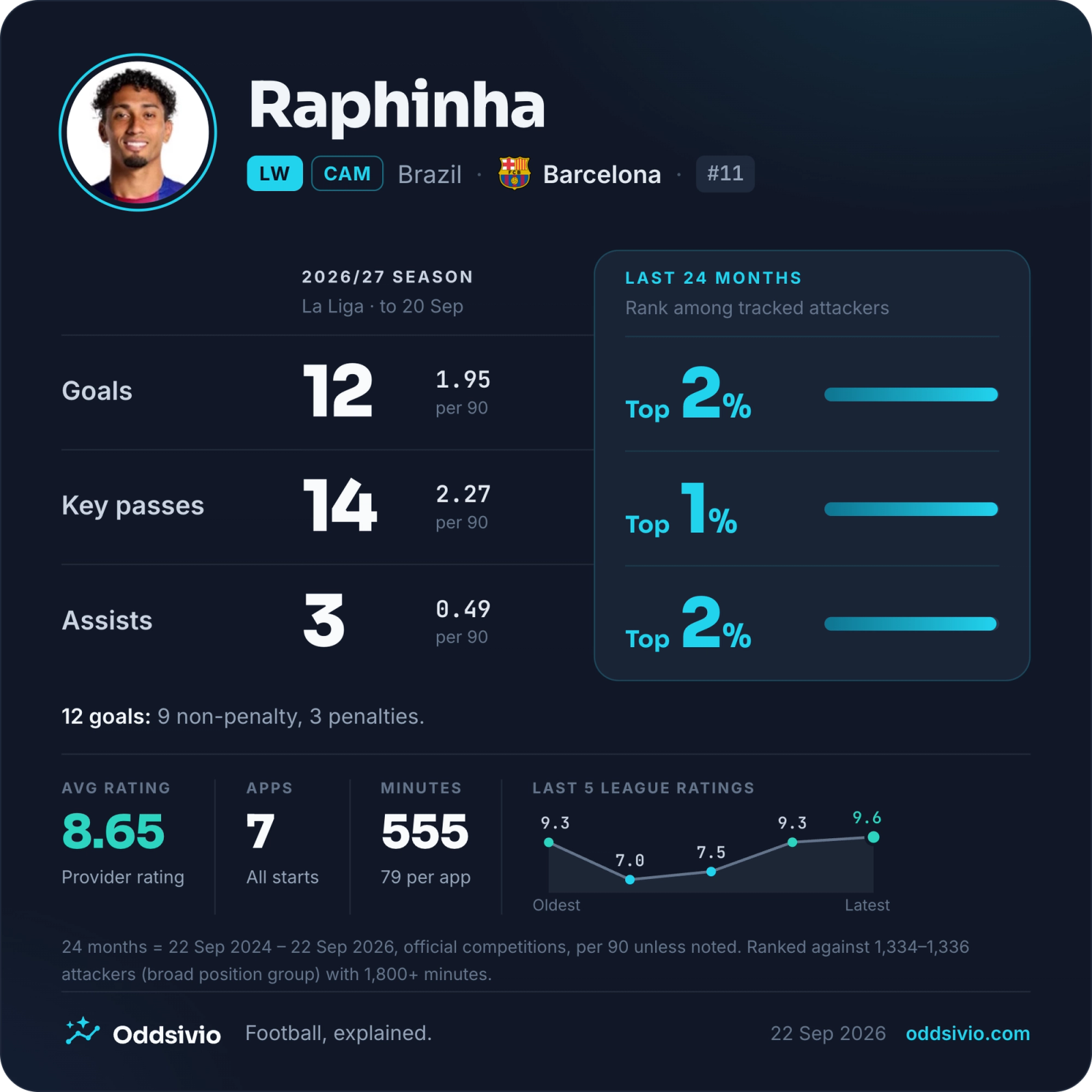
Raphinha’s latest hat-trick had a pleasing completeness. With Barcelona behind at Sevilla, he equalised with his right foot, put them ahead with a header, then finished the job with his left. The club’s report of the 3–1 win records three different finishes in a comeback built around him.
The season total remains exceptional after separating the penalties: nine non-penalty goals in 555 minutes. He has scored in six of his seven league appearances. The one goalless outing, at Levante, brought two assists.
There is a broader player behind that finishing run. In Raphinha’s statistical profile, his recorded key-pass rate over the last two years is around the 99th percentile among tracked attackers. His capacity to supply other players predates these September scorelines.
The team context matters. As our review of the strongest team starts showed, all seven opponents entered their matches substantially below Barcelona in the saved strength ratings. Raphinha has made spectacular use of those opportunities. Sustaining anything close to this scoring pace against stronger opposition is the next challenge.
Lamine Yamal, Barcelona: follow the pass before the finish
League snapshot: 7 appearances · 581 minutes · 7 goals, including 1 penalty · 4 assists · 28 recorded key passes.
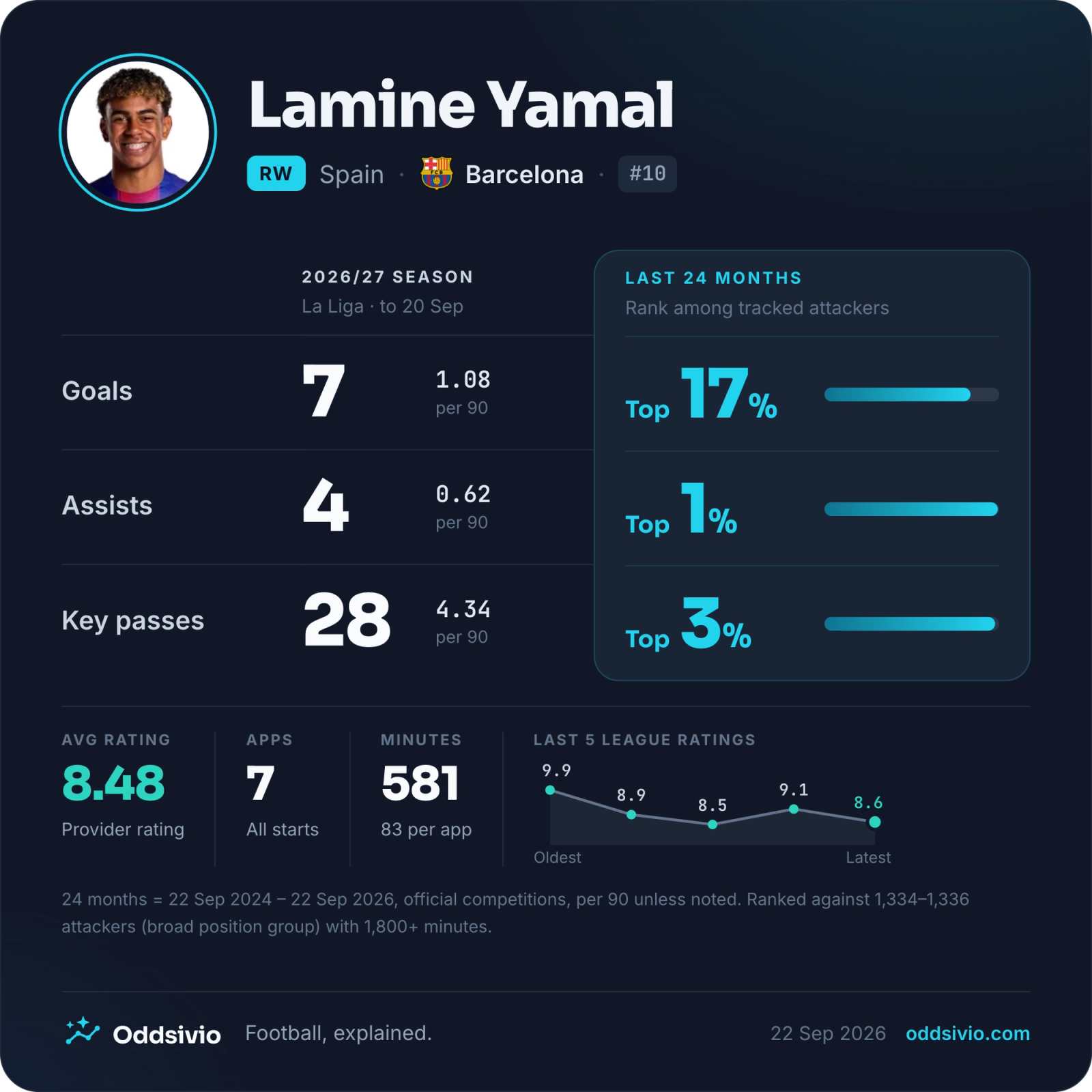
Two of Raphinha’s Sevilla goals began with Yamal: a cross for the header, then a pass behind the defence for the third. Within one match, the same partnership found two routes to goal.
Yamal’s wider contribution is visible in 28 recorded key passes—passes setting up shots—alongside his own seven goals. The number measures supply, while assists also depend on how the next player finishes. Neither tells us that every resulting shot was a good chance.
His longer-term profile adds useful perspective: the assist rate sits around the 99th percentile among tracked attackers over the 24-month window. That gives the creation a much bigger sample alongside this productive opening spell.
The scoring has come in bursts: two goals each against Rayo Vallecano, Valencia and Levante, followed by one against Racing Santander. The encouraging part is the variety of his contribution. On a day when he did not score at Sevilla, the passes still helped decide the match. Open the Sevilla match page to put the goals and assists together, or revisit the official LaLiga highlights.
Donyell Malen, Roma: six goals, and a partnership worth watching
League snapshot: 5 appearances · 345 minutes · 6 goals · no penalty goals.
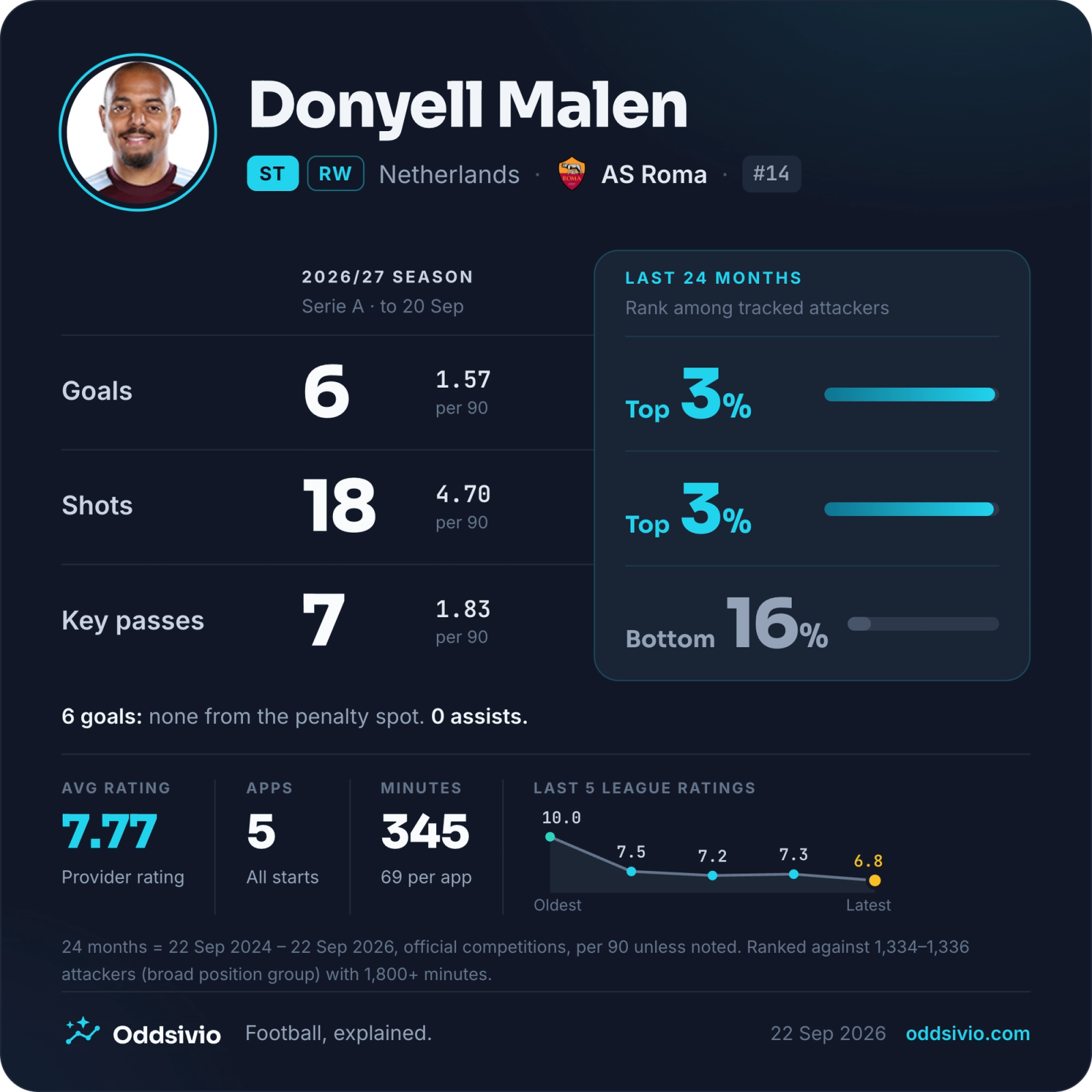
Malen introduced his season with a hat-trick against Fiorentina, with Paulo Dybala assisting all three. The league’s report captures a partnership already finding different finishes: a powerful left-foot strike for one goal, a simple final touch for another.
Two more followed at Lecce. Five of Malen’s six goals therefore arrived in the first two fixtures. His sixth came at Torino.
That concentration is worth keeping beside the total. He did not score against Atalanta or Inter, Roma’s two strongest opponents by their saved pre-match ratings. The next test is whether the supply and finishing can keep working against stronger opponents.
Oddsivio’s Malen profile places his two-year scoring rate around the 97th percentile among tracked attackers. The early burst has a longer history of goals behind it, though it remains a burst.
And Dybala’s own record deserves a share of the attention: four assists and 23 recorded key passes in this league window. The Fiorentina match is a good place to see why separating the finisher from his supplier would miss part of the story.
Michael Olise, Bayern Munich: one extraordinary evening, several kinds of influence
League snapshot: 4 appearances · 303 minutes · 4 goals · 1 assist.
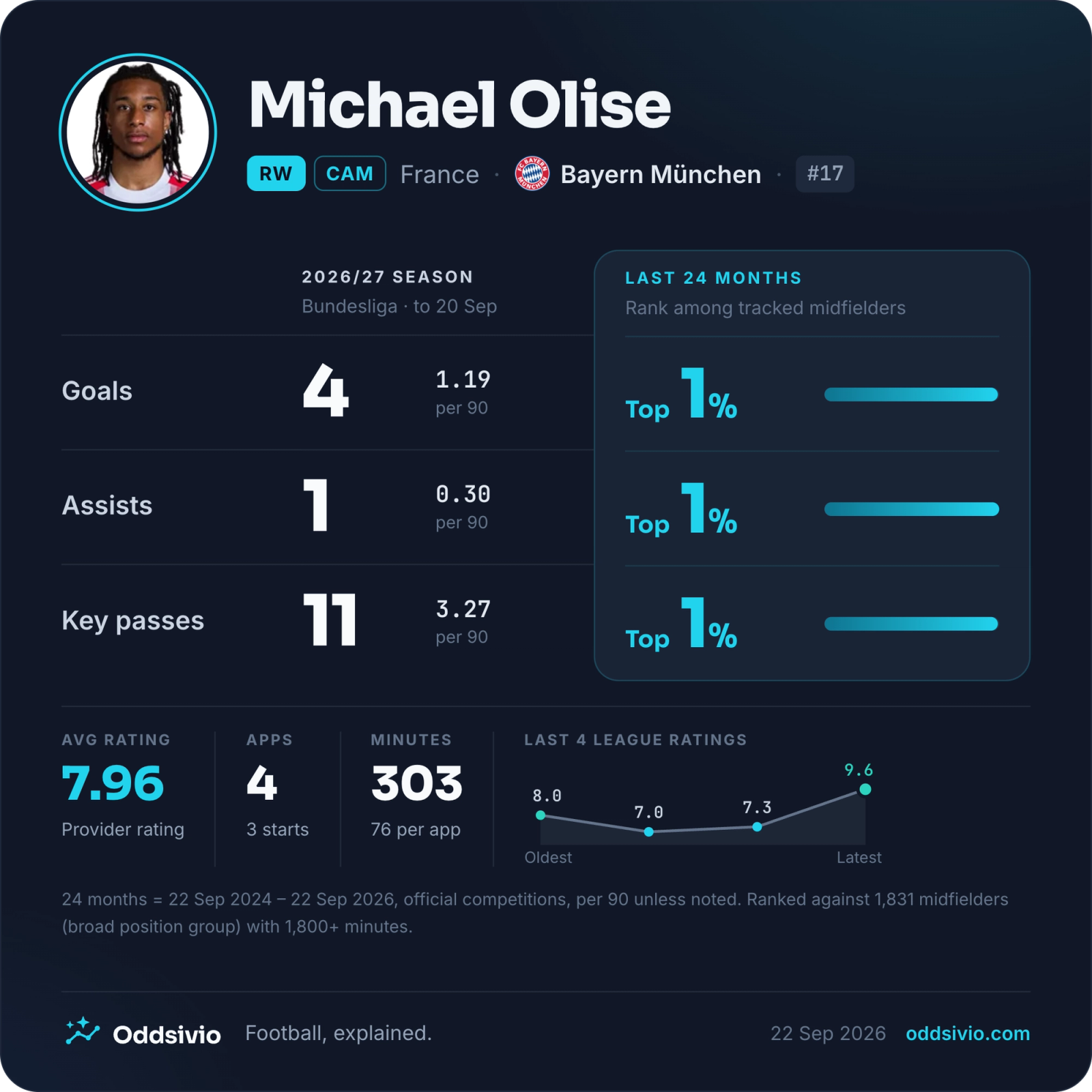
Olise’s hat-trick in Bayern’s 7–0 win over Union Berlin supplied the obvious headline. His other contributions made the evening more interesting still: he won the penalty converted by Harry Kane, then crossed for another Kane goal, according to the Bundesliga’s report.
The penalty won is separate from his one recorded assist. Keeping those actions distinct gives a clearer account of what he actually did.
Three of his four league goals came in that match. Across the whole opening window, he also recorded 11 key passes. It is enough to mark a highly productive start, with four appearances still a small base from which to judge consistency.
The two-year profile provides an intriguing counterpoint to the hat-trick: his assist rate sits at the top of the tracked midfielder comparison group on that metric. The group is broad and includes different roles; it is not a ranking of every winger’s overall quality. It does, however, give us a reason to keep watching the service as closely as the shooting.
Pascal Groß, Brighton: the scorer, the supplier and the difficult opponent
League snapshot: 5 appearances · 450 minutes · 3 goals, including 1 penalty · 3 assists.
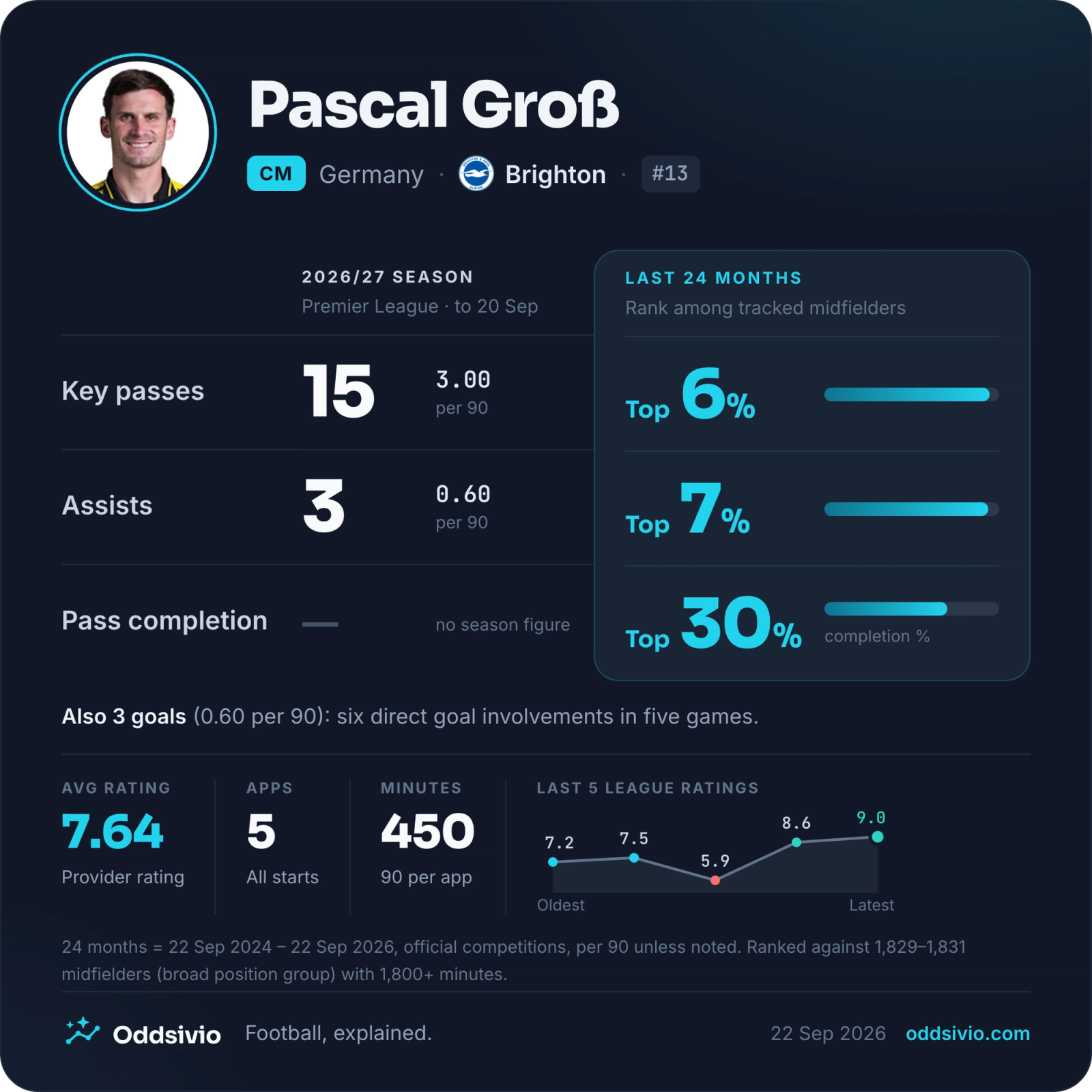
Groß’s contribution to Brighton’s 3–0 win over Arsenal was easy to appreciate without a spreadsheet. He opened the scoring from the right side of the area. Later, his corner found Chema Andrés for the third goal. Brighton’s report connects the open-play finish and the set-piece delivery.
Across five full league appearances, Groß has added 15 recorded key passes to his three goals and three assists. One goal was a penalty, against Coventry; two were non-penalty goals.
The opponent check strengthens this particular case. Arsenal entered the Brighton match with a saved strength rating of 2,232, the highest of Brighton’s five opponents. Groß’s productive afternoon came against a team rated much more strongly than a routine early-season mismatch. These ratings supply context, rather than a mathematical adjustment to his statistics.
His 24-month creation profile sits around the 94th percentile for key passes per 90 among tracked midfielders. That helps explain why the corner matters beyond one famous result: creating shooting opportunities has been a recurring part of his contribution.
Brighton’s Arsenal match page is the natural next stop. The next thing to watch is how often Groß can put the same combination of delivery and finishing into close games.
Cristian Cásseres, Toulouse: there is room for craft in the engine room
League snapshot: 5 appearances · 450 minutes · 4 assists · 18 recorded key passes · 23 recorded tackles.
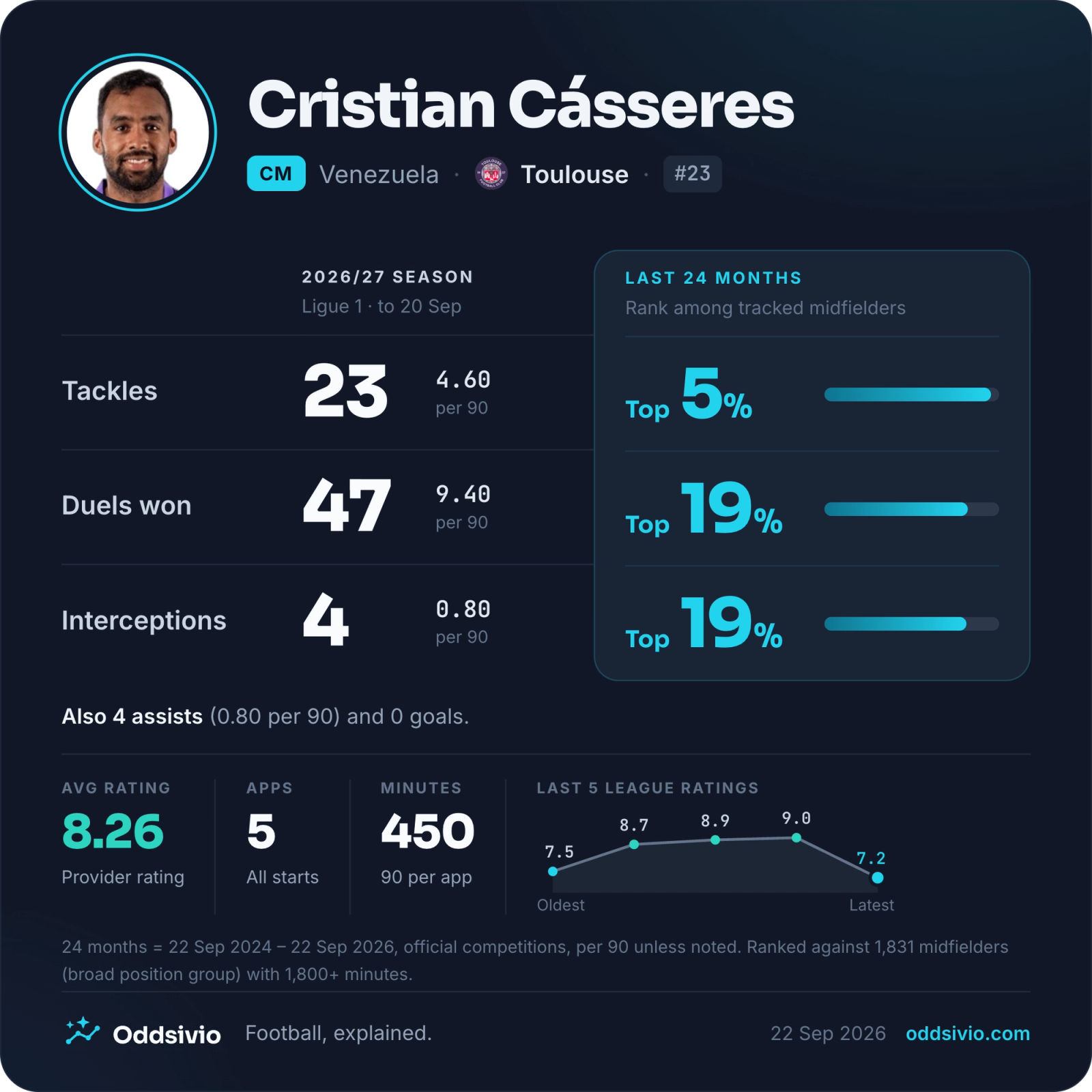
Cásseres makes the selection because two parts of his game show up together. Eighteen key passes and four assists speak to his work with the ball. Twenty-three tackles and 47 duels won show how much recorded work he has done contesting it.
There is a useful longer-term contrast within his player profile. His tackle rate is around the 96th percentile among tracked midfielders, while his key-pass rate is around the 65th. The defensive activity has a strong two-year base; the early-season creation is especially worth following to see whether it lasts.
Toulouse’s announcement of his contract extension describes a midfielder involved in recovering possession and launching attacks. Our recorded figures show activity in both areas, without proving every tackle was well judged or every pass incisive.
The team’s results also keep the individual case honest: Toulouse took five points from five games. Cásseres contributed two assists in the 2–2 draw at Lorient, but influence on the scoresheet has not yet made Toulouse a consistent winning side. That is precisely why worthwhile players can be found well below the top of the table.
David Raum, RB Leipzig: what zero assists can hide
League snapshot: 4 appearances · 360 minutes · 0 assists · 17 recorded key passes.
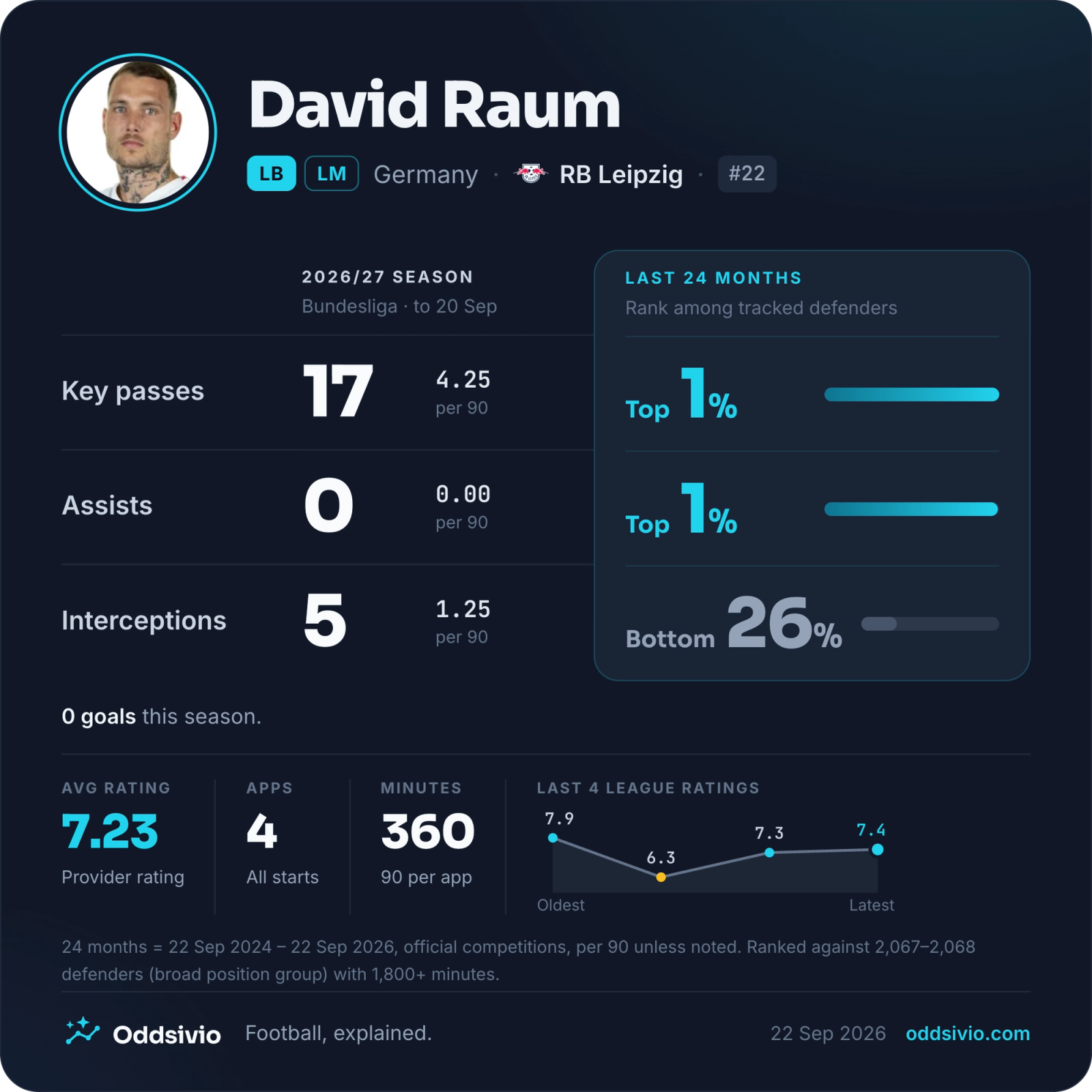
The Bundesliga’s official player page shows Raum with no goals and no assists after four appearances. Stop there and an important part of his start disappears.
Oddsivio’s saved match records contain 17 key passes across those four games. Those passes were followed by shots, even though none of his passes became a credited assist. It would be a leap to say his team-mates wasted 17 great chances: the count does not tell us where or under what pressure the shots were taken.
The longer-term profile makes the attacking contribution more persuasive. His recorded key-pass rate—3.09 per 90—sits at the top of the tracked defender group over 24 months. That group includes centre-backs as well as full-backs, so the comparison is broader than “best left-back”.
It also tells us very little by itself about his defending. Leipzig have won twice and lost twice, including a 2–0 defeat at Leverkusen in their latest league game. Raum earns attention here as a source of shots. The next question is what kind of chances that supply produces.
Álvaro Valles, Real Betis: saving the penalty was not the end of the job
League snapshot: 7 appearances · 630 minutes · 31 recorded saves · 4 clean sheets.
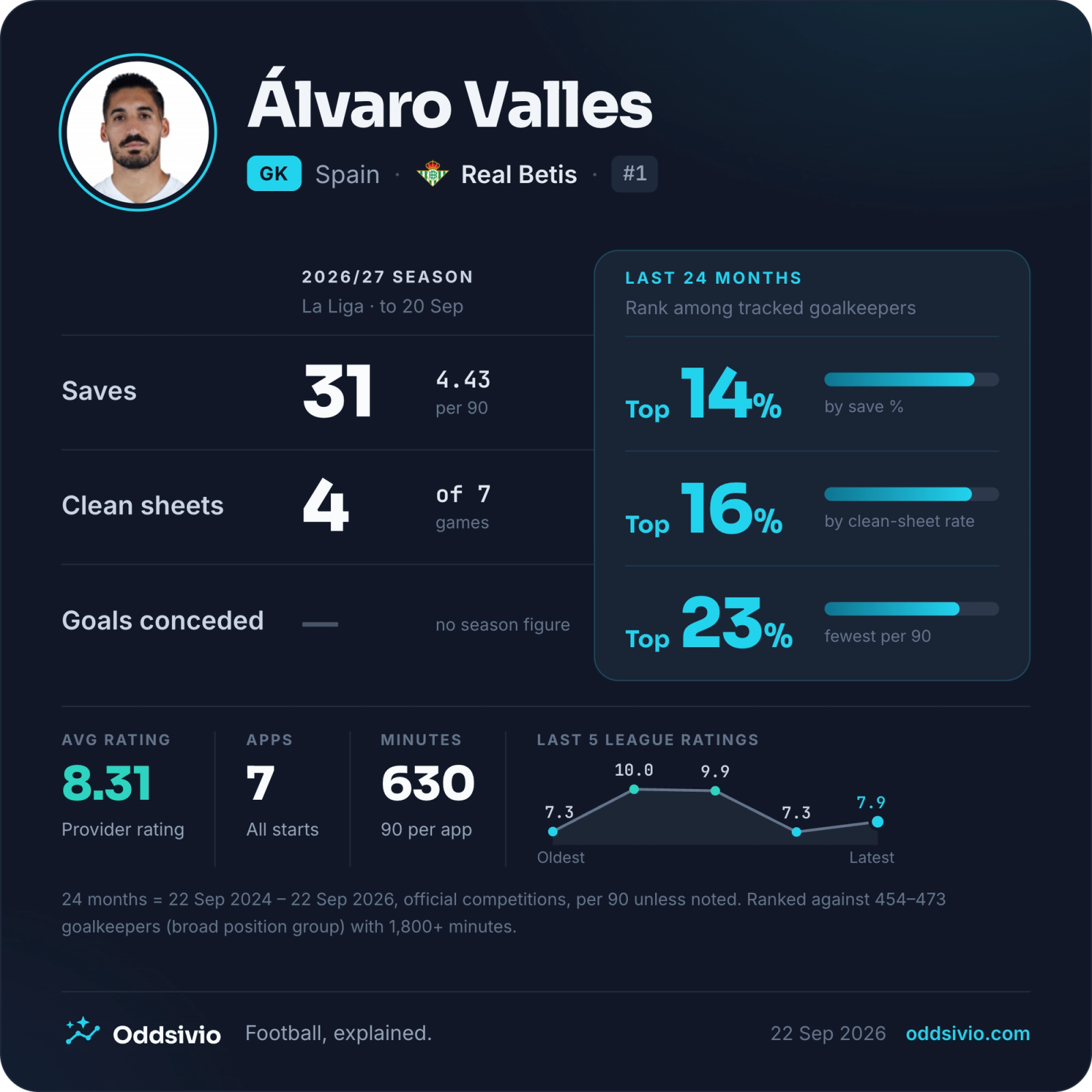
Betis were protecting a 1–0 lead against Real Madrid when Valles saved Kylian Mbappé’s added-time penalty. There was still another intervention to make: he then kept out an Espí header in the final passage of play, as Madrid’s own report records.
The saved match statistics give him six saves that night. He followed it with seven in the 2–1 win at Villarreal. Across the opening seven games, he has played every minute and kept four clean sheets.
Those are substantial contributions to a strong start, with a clear reminder of the limits: Betis also conceded five at Levante. A goalkeeper’s story includes the difficult afternoons.
On Valles’s longer-term profile, his save percentage is around the 86th percentile among the tracked keepers with sufficient coverage for that metric. That is useful background, but save percentage is affected by the shots a team allows. We do not have a complete comparable measure of post-shot chance difficulty here, so 31 saves cannot be translated into a number of “goals prevented”.
The Madrid match puts the abstract total back into a recognisable football situation: a narrow lead, a penalty, and then the need to reset immediately for the next ball.
What this selection leaves open
There are other compelling starts. Erling Haaland scored five non-penalty goals in five league appearances. Dybala’s supply has helped Roma, and defensive specialists can influence matches without accumulating either goals or assists. An eight-player selection makes room for different stories; it cannot settle every comparison.
The same distinction applies to money. Oddsivio’s estimates on 21 September put Groß at approximately €8.2m and Raphinha at €100.0m. Both can deserve a place in this article. A model value estimate answers a different question from “who has played well this month”, and is neither a transfer fee nor an asking price. The player-value pages and each player’s value history let readers explore that question separately.
For following form, start with the player’s Matches tab, then check the competition and minutes behind an eye-catching total. Use the longer-term profile to see which traits have a broader base. On the linked match pages, the events, statistics and available highlights help put the action back around the numbers.
The next phase will test different things: whether Malen’s burst becomes a steadier flow, whether Cásseres keeps creating at this rate, whether Raum’s supply produces goals, and whether Valles can keep protecting tight margins. Those are concrete reasons to keep watching.
The next generation has its own stories, too. Our 10 U21 breakthrough candidates for 2026/27 examines the young players earning starts, influencing matches and taking on bigger roles.
How we chose the players and checked the numbers
This is an editorial selection from 250 completed 2026/27 league matches, using the same fixed cohort as Part 1 of this series. The saved-data snapshot was taken on 21 September at 13:59:58 UTC / 16:59:58 Bucharest time. The cutoff follows each league’s local kickoff date through 20 September. Postponed Levante–Athletic Club is excluded.
Every selected player has at least 270 league minutes. We checked goals and assists against current named match events, separated penalty goals, and reviewed contributions within roles. Regulation minutes are capped at 90 per appearance; this makes Yamal’s total 581 rather than the raw provider sum of 584. We have not constructed an overall cross-league player score.
Key passes, tackles, duels and saves are recorded provider counts. Some underlying absent fields can be stored as zero, so these are not a guarantee of complete event coverage. Goal and assist reconciliation passed for all eight selected players; unresolved event inconsistencies elsewhere in the wider dataset are another reason to avoid a definitive universal ranking. We have not inferred individual xG from team totals.
The 24-month profiles are a separate snapshot, refreshed at 05:40 UTC on 22 September, covering 22 September 2024–22 September 2026. They compare the recorded metric with players in the same broad position group across covered official competitions. Each metric needs at least 1,800 covered minutes and ten qualifying peers; coverage and peer counts can differ. Every minute counts equally, and league strength is not adjusted. Percentiles are rounded in the prose.
Club and league reports are linked beside the match details they support. The player cards use saved data and real profile portraits; the cover is labelled as an AI illustration. This article was prepared with AI-assisted research and calculations, checked against the retained records and primary sources.