Why these Nations League results already matter for Euro 2028
This autumn can shape next year’s qualifying draw—and leave a second route to the finals. Here is what matters for teams in every league, and why the hosts complicate the picture.

Wales’ 2–1 win over Norway on 1 October was an immediate breakthrough: their first victory in League A. Greece’s 2–2 draw with the Netherlands, after winning in Germany, kept an impressive autumn going. Those results also belong to a competition that will help shape the route to Euro 2028. FAW match report · UEFA’s results
The connection has two parts. A team’s Nations League ranking determines its seeding for the Euro qualifying draw. Winning a Nations League group can also put it near the front of the queue for a playoff if qualification later goes wrong.
Neither amounts to qualifying for the Euros this autumn. But both can change the difficulty of getting there. That makes the remaining Nations League matches relevant well beyond the race to win the competition.
First: this autumn shapes the qualifying draw
The Euro 2028 qualifying draw takes place in Belfast on 6 December 2026. It will use the interim overall rankings from the 2026/27 Nations League. That means the rankings after the league phase finishes in November—not the FIFA world rankings and not the final Nations League standings after the knockout stages in 2027. UEFA draw announcement · EURO regulations, Article 13
The order is built in layers:
- League comes first: every League A team ranks ahead of every League B team, followed by C and D.
- Group position comes next: within a league, all group winners rank ahead of all runners-up, then third-placed teams, then fourth-placed teams.
- Results separate teams with the same finish: points come first, then goal difference and further tie-breakers.
A League B winner therefore cannot overtake a League A bottom-place finisher simply by collecting more points. Nations League regulations, Article 19
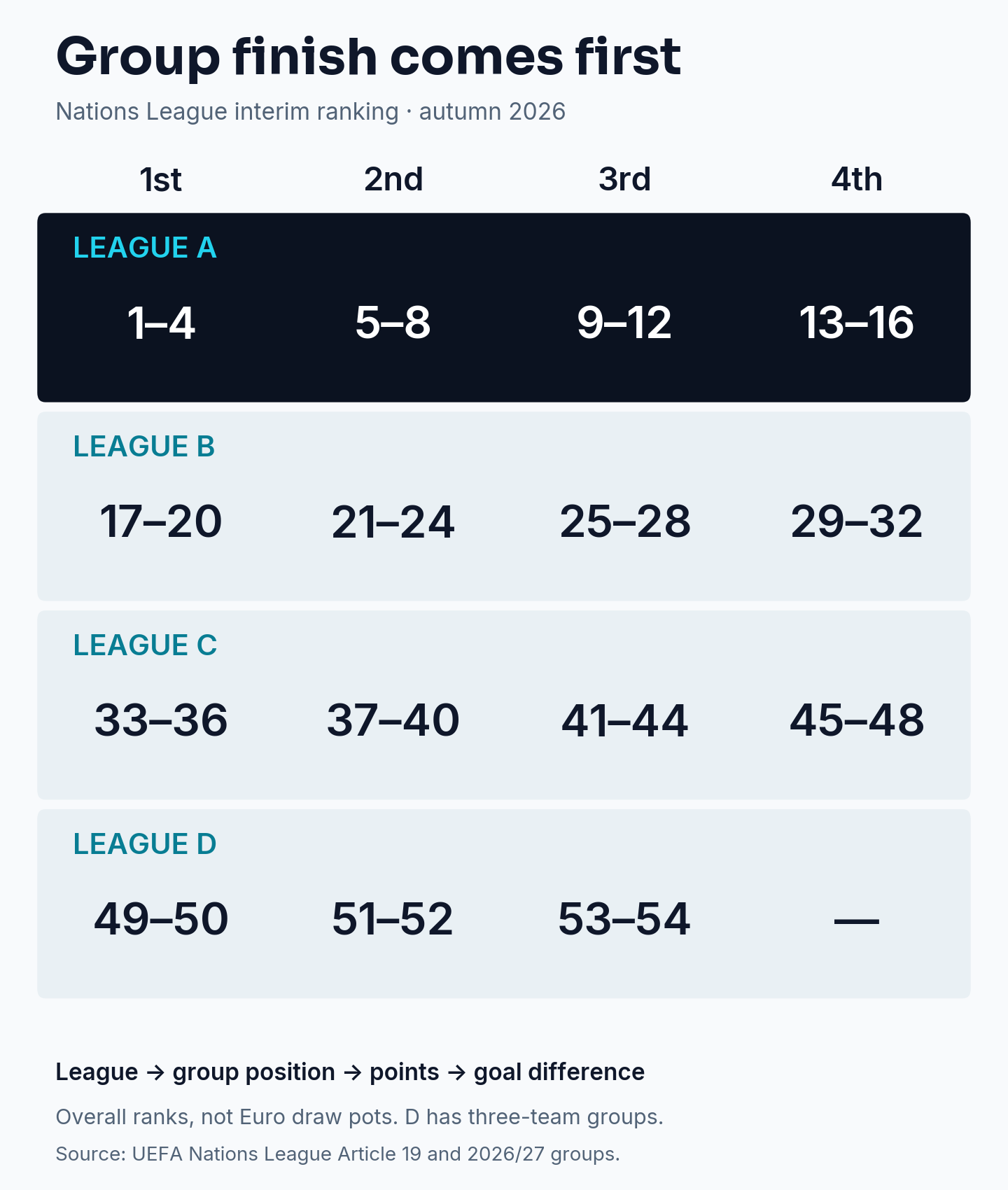
Consider Scotland and Romania, in different League B groups. If both finish second, their results are compared within the runners-up band. If Scotland finishes first and Romania second, Scotland ranks higher regardless of their respective points totals. The same principle applies to France and Portugal in A, or Albania and Slovakia in C.
That also explains the limits of a big score. Finland’s 7–0 win against San Marino on 26 September could help its goal difference in a later comparison. It cannot, by itself, lift a second-placed Finland above another League C group winner. First secure the better group finish; then the margins can matter. UEFA results
Better seeding can improve the chances of a more favourable draw. It cannot promise easy opponents. UEFA also applies scheduling and other draw restrictions: for example, Nations League quarter-final winners are represented through placeholders and assigned to four-team qualifying groups. A higher rank can still leave a team in the same pot. The final pots depend on the completed league phase and UEFA’s draw procedure.
The main route remains next year’s qualifying groups
In 2027, teams will play home and away in 12 qualifying groups of four or five. Twenty places at the finals are awarded through those groups:
- All 12 group winners qualify.
- The eight highest-ranked runners-up qualify.
- The other four runners-up go into the playoff process, unless a host reserved place has already taken them directly to the finals.
Nations League points do not carry over into these groups. Everyone starts the qualifying competition afresh. EURO regulations, Article 14
Why the “best runners-up” table will need care
A runner-up in a five-team group plays eight matches; one in a four-team group plays six. To compare them, UEFA removes the five-team group’s results against the team that finishes fifth. Points, then goal difference and the remaining criteria, decide the comparison.
Those matches still count in the actual group table. They are removed only for the relevant cross-group ranking. EURO regulations, Article 23
A hypothetical example: Team A finishes second with 16 points, including two wins against the eventual fifth-placed side. Its comparison total is 10. Team B finishes second in a four-team group with 11 points. Team B ranks higher among the runners-up, despite having fewer points on its ordinary group table.
The identity of the bottom team can therefore matter to countries elsewhere in Europe. Fans will need the adjusted runners-up table, not just the points column beside their own team.
The hosts have two reserved places between four teams
England, the Republic of Ireland, Scotland and Wales all enter qualifying. Hosting does not give each of them an automatic place.
There are two reserved finals places in total. They go to hosts that miss direct qualification; if more than two hosts need them, the two highest in the overall Euro qualifying rankings receive them. That ranking prioritises group finish, then qualifying results. Nations League ranking is only the final tie-breaker if all the earlier criteria are equal; FIFA ranking is not used. EURO regulations, Articles 13, 14 and 23
For example, imagine England qualifies directly and the other three hosts do not. Only two of those three can be rescued by the reserved places. The remaining host would need to earn a playoff place under the normal rules to keep its campaign alive.
Northern Ireland is different. Belfast hosts the draw, and Northern Ireland must be drawn separately from the four hosts, but it is not one of the four associations eligible for these reserved places.
The host exception also affects everyone else: each unused reserve becomes another finals place available through the playoffs.
Second: winning a Nations League group can create a fallback
The playoff field is selected after the Euro qualifying groups are complete. UEFA’s order is:
- The remaining qualifying runners-up enter first.
- Vacancies go to Nations League group winners from A, B and C, in interim ranking order, skipping teams already in the finals or playoffs.
- If too few of those winners remain, the next place goes to the highest-ranked League D group winner, unless it has already qualified for the finals or playoffs.
- Further vacancies go to the highest-ranked remaining Nations League teams, whether or not they won their group.
That is a priority list, not a promise that every Nations League winner gets a playoff. There is also no guaranteed Euro finals place for each league. EURO regulations, Article 16
Here is the consequence that makes League C especially interesting. A League C group winner gets considered in the group-winner stage before a League A side that did not win its group. The League A team’s better overall ranking does not allow it to jump that particular queue.
Imagine Slovakia wins C3 and Germany finishes second in A2, then both finish outside the top two in their Euro qualifying groups. Slovakia would have group-winner priority. Germany would have to rely on the later allocation of any remaining places. This is an illustration of the rule, not a forecast for either country.
For Malta, Lithuania and the other League D teams, the fallback is narrower still. Winning a group matters, but UEFA gives the special conditional opportunity to the better-ranked of the two winners. League D teams still have the ordinary Euro qualifying route available to them.
Why the playoffs can have eight teams—or twelve
Euro 2028 has 24 places. Twenty are filled through qualifying groups. The other four are divided between host reserves and playoffs.
The format depends on how many reserved places the hosts use:
- Two used: eight playoff teams, split into two four-team paths. Single-match semifinals and finals produce two qualifiers.
- One used: twelve teams in three four-team paths. Single-match semifinals and finals produce three qualifiers.
- None used: eight teams play four home-and-away ties, producing four qualifiers.
UEFA’s qualification-format announcement
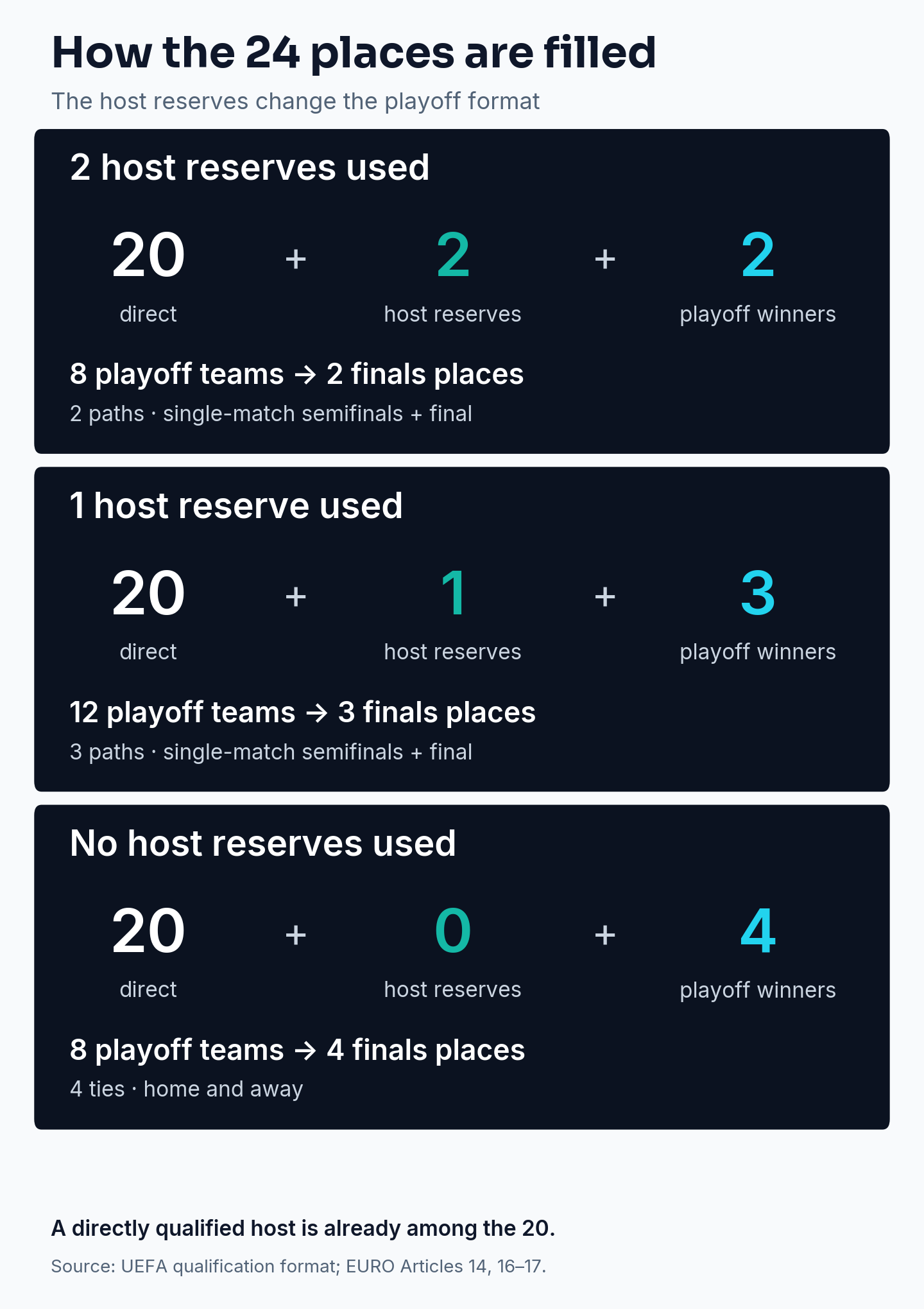
The middle scenario has the largest playoff field. That can feel counterintuitive: fewer available finals places do not always mean fewer playoff participants.
There is another moving part. A host receiving a reserved place might otherwise have been one of the four qualifying runners-up entering the playoffs. Removing it opens a playoff vacancy for the Nations League allocation. This is why it is misleading to advertise a fixed number of Nations League “tickets” now.
A fallback can also mean a harder playoff
Qualifying runners-up rank ahead of Nations League entrants for playoff seeding. So finishing second in the Euro qualifying group can be valuable even when it does not bring direct qualification.
In the semifinal-and-final formats, pots 1 and 2 host the semifinals. The final is hosted by the winner of the semifinal involving the pot 1 team—even if that top seed loses. In the two-legged format, the seeded team plays the second leg at home. EURO regulations, Articles 16 and 17
A Nations League fallback keeps a route open. It is no reason to treat next year’s qualifying group as optional.
What to watch in the remaining Nations League games
For a team chasing first place, the stakes are unusually broad: a stronger ranking and group-winner priority for the possible fallback. That applies to the heavyweight groups in A and to the contests involving Poland, Romania and Sweden in B, or Iceland, Bulgaria, Estonia and Luxembourg in C.
For a team unlikely to win its group, the next finishing position still matters. A move from fourth to third, or third to second, improves the ranking band. Once two teams share a final group position, points and goal difference help separate them.
Remember that the October break is not the end of this calculation. There are two more Nations League matchdays in November. And within an individual Nations League group, head-to-head results are the first tie-breakers; do not mistake an overall goal-difference advantage for a settled group position. Nations League regulations, Article 15
The dates to keep:
- 4–6 October 2026: the fourth Nations League matchday.
- 12–17 November 2026: the final two league-phase matchdays; the interim ranking is then settled. UEFA Nations League calendar
- 6 December 2026: Euro qualifying draw in Belfast.
- March–November 2027: Euro qualifying groups.
- March 2028: Euro qualifying playoffs. UEFA qualifying schedule
- 9 June–9 July 2028: the finals. UEFA tournament schedule
Three things these results cannot do
Winning the Nations League does not automatically qualify a country for Euro 2028. The relevant fallback comes from the group-phase rules and still requires qualifying through a playoff.
A Nations League promotion playoff is not a Euro qualifying playoff. The former belongs to the Nations League cycle in March 2027; the latter is scheduled for March 2028. A promotion result cannot retrospectively improve a qualifying draw already held in December.
The new tiered European qualifying format is not the system for Euro 2028. UEFA’s reform is for the period after this tournament. UEFA’s reform announcement
For now, the useful question after a Nations League result is how it changes a team’s likely group finish. That is where the two Euro consequences begin: the position it takes into the draw, and whether it has group-winner priority if a second chance is needed.