What changes around Ronaldo when Portugal change their striker?
Félix scored beside both strikers. Four changes to Portugal's starting XI make the Norway win a question about the whole attack, rather than a verdict on Ronaldo.
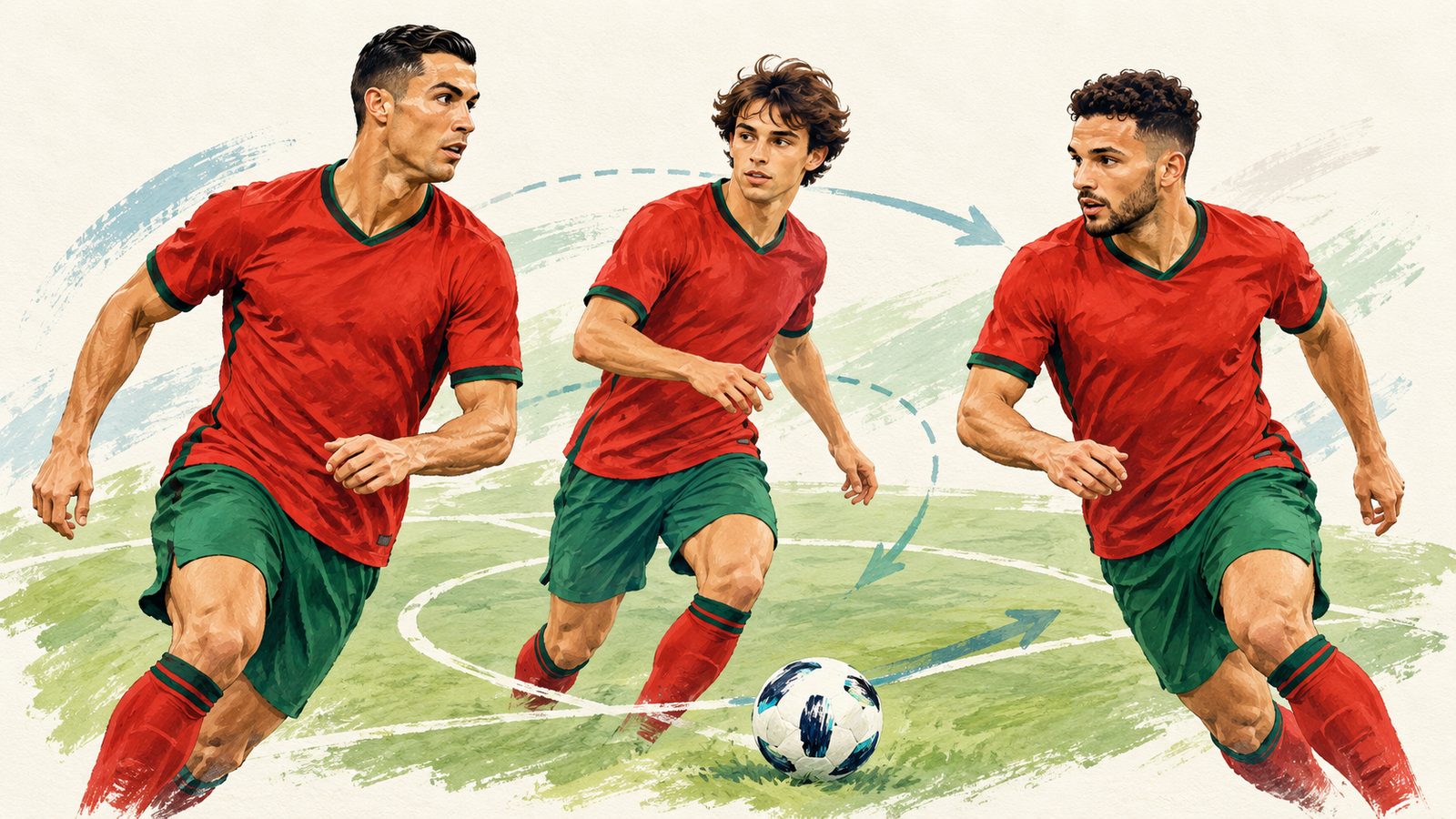
João Félix scored the winner with Cristiano Ronaldo beside him against Wales. Three days later, he scored with Gonçalo Ramos in the side against Norway. Portugal won both games. The player at centre-forward changed; an important source of goals stayed the same. UEFA's Wales record, Norway's official match record
That gives Portugal a more useful question than choosing a side in the Ronaldo argument. When Jorge Jesus changes his striker, who supplies the width, who finds space near goal, and who makes the first move to win the ball back?
The early evidence points to changes across the attack and midfield. It leaves much less certainty about what the striker switch, by itself, changed in Portugal's play.
Norway was a different team selection
Portugal beat Wales 1–0 in Lisbon on 24 September, then won 2–1 in Oslo on 27 September. Ronaldo started the first game; Ramos started the second, with Ronaldo remaining on the bench. But the goalkeeper and back four were the only complete unit left intact.
Alongside the striker change, João Palhinha and João Neves replaced Rúben Neves and Vitinha, while Francisco Conceição came in with Bruno Fernandes absent. Félix and Pedro Neto started both games. Counting the names gives four changes, not one. Official Wales XI, official Norway XI
Jesus also gave a recovery explanation. Before the Norway match, he said Ronaldo's nearly 70 minutes against Wales made another immediate start unsuitable, and that Vitinha had not yet recovered. He wanted quick wide players who could take on opponents and get through Norway's last defensive line. Those are the coach's stated reasons, reported by A Bola, rather than independent measurements of the players' condition. Jesus's pre-match explanation
Even the substitution against Wales is an imperfect comparison. Ramos replaced Ronaldo in the 67th minute, with Portugal already leading, but Palhinha replaced Rúben Neves at the same time. Any change in how Portugal played afterwards would need to account for the midfield change and the score as well. FAW's match feed
Félix gives the attack a point of continuity
Félix's two goals matter because they keep another attacking role in the picture. A centre-forward does not have to score for the player near him to be decisive. Equally, Félix scoring beside both Ronaldo and Ramos prevents us from treating his success as something that began when Ronaldo left the XI.
The supply around that partnership matters. RTVE's report describes the Norway opener as a move begun by Nuno Mendes, with Pedro Neto delivering the ball for Félix to finish. It is a reported example of a full-back and a wide attacker helping create the chance, rather than a striker manufacturing everything himself. Rubén Heras's RTVE report
Conceição's selection adds another question. Jesus wanted attackers capable of beating a defender, not simply keeping the ball. If a wide player draws an extra opponent toward him, the players inside can benefit. That is the tactical idea; establishing how often it actually happened in Oslo needs footage, including attacks that failed.
Ramos's winner starts with a defensive job
Ramos restored Portugal's lead shortly after Norway equalised. He intercepted goalkeeper Ørjan Nyland's pass and chipped him. The move illustrates why a striker's work before his team has possession belongs in the discussion too. RTVE's match account
In his post-match remarks, reported by A Bola from RTP and Canal 11, Ramos said he had noticed a midfielder behind him and anticipated Norway trying to play inside. Once he won the ball, the goalkeeper's position made the chip his first thought. Ramos's explanation
There are two parts to that account: Norway made an expensive mistake, and Ramos described preparing to exploit the pass. Both can be true. Neither tells us, from one incident, how consistently Portugal coordinated their pressure or whether the same opening would have appeared with Ronaldo on the pitch.
The distinction matters for everyone around the striker. A first chase works best when teammates make the easy passes harder. Without that support, a forward can run a long way while the opponent simply passes around him. To judge the team, we need to see those supporting movements as well as the interception.
Getting into the box and finishing are separate questions
Ronaldo's Wales match supplies the other side of the comparison. The FAW report records a close-range chance early in the second half from a Rúben Neves cross. Ronaldo missed it. Portugal had still delivered the ball to their centre-forward near goal. FAW's account
A miss matters to the result. It does not, by itself, tell us that the route to goal was broken. The same caution applies to Ramos's finish: taking one chance does not establish that Portugal repeatedly filled the box more effectively.
The useful comparison would follow several attacks. Does the striker stay near the centre-backs or move toward the ball? When he moves, does Félix advance into the space? Is someone available for a pass back from the byline, as well as for a cross toward goal? Those details would explain what the partnership gives Portugal. A team sheet cannot answer them.
The current debate has more than two sides
Portuguese opinion has been critical without always agreeing on the replacement. Before the Norway game, A Bola's Hugo Vasconcelos questioned Ronaldo's readiness to start, but also doubted whether Ramos was an obvious solution after his Wales appearance. That was a columnist's assessment, not a medical finding. Vasconcelos's column
After Oslo, deputy editor Alexandre Pereira argued for looking at movement and the context of Ronaldo's minutes. “4-4-2 and 4-3-3 count for little when movement takes over,” he wrote, in our translation. A formation label tells us much less than the actions of the players within it. Pereira's column
International reports also resist a simple success story. Ben Fisher described Portugal's supposed new era as “rather run of the mill.” The Guardian
AS's Aritz Gabilondo praised Félix but stressed the defending and saves needed to survive in Norway. His closing description of Portugal was “does not enchant, but does endure”, in our translation. Winning away did not mean controlling every part of the match. Gabilondo's report
Jesus's own post-match explanation was situational. He had planned to use Ronaldo, then chose other players as the game developed. That supports reading a selection as a decision for a particular match, rather than a permanent verdict on the captain. Francisco Sebe's press-conference report
What to watch in the next Portugal attack
Portugal's next scheduled games are away to Denmark on 1 October and at home to Norway on 4 October. The starting lineups remain future decisions at this article's cutoff. FPF's calendar
Watch the jobs around whoever starts up front:
- When a full-back advances, who keeps an option inside him?
- When Félix comes toward the ball, who threatens the space nearer goal?
- When the striker moves to close down a defender, who blocks the next pass?
- When a wide player reaches the byline, are there different targets for a cross and a pass back?
Those are useful questions with Ronaldo, Ramos or another forward. Portugal's first two wins under Jesus confirm different selections and contributions from several players. They leave the movement of the whole attack as the next thing to establish.
Reporting cutoff: 30 September 2026, 12:37 EEST. This article uses official match records, original journalism and attributed player/coach accounts. The linked highlights required login or were restricted in this location; no match footage was successfully reviewed. Reported actions above are attributed, and claims about repeated movement or comparative box occupation remain unproven.