Premier League after six rounds: who's ahead of expectations?
Manchester City are furthest ahead of our forecasts and Fulham are furthest behind. We look at eight clubs and what happened in their games.

At the MKM Stadium on 22 August, Semi Ajayi and Nobel Mendy gave newly promoted Hull City a winning start against Manchester United. Ajayi scored after Senne Lammens pushed Oliver McBurnie's effort from a corner onto a post, as United's official report describes. It was Hull's first league game of the season, and Hull's own report called Ajayi's finish “a first Premier League goal since 2017”. Then Mendy headed in Regan Slater's free kick, and Hull won 2–0.
Six league games in, Hull have 9 points. Our forecasts for those six games added up to 3.60. And those are the last forecasts we published before each kick-off, not numbers worked out afterwards.
So where does a number like 3.60 come from? Well, before every match Sirius gives each result a chance. For Hull City–Manchester United, it was 8.3% for a Hull win, 19.2% for a draw and 72.5% for a United win.
A win is worth three points and a draw is worth one, so Hull's share of that game was three times 8.3%, plus 19.2%, which comes to 0.44 of a point. Do the same for all six games, add them up, and you get Hull's expected points: 3.60. They've actually taken 9.
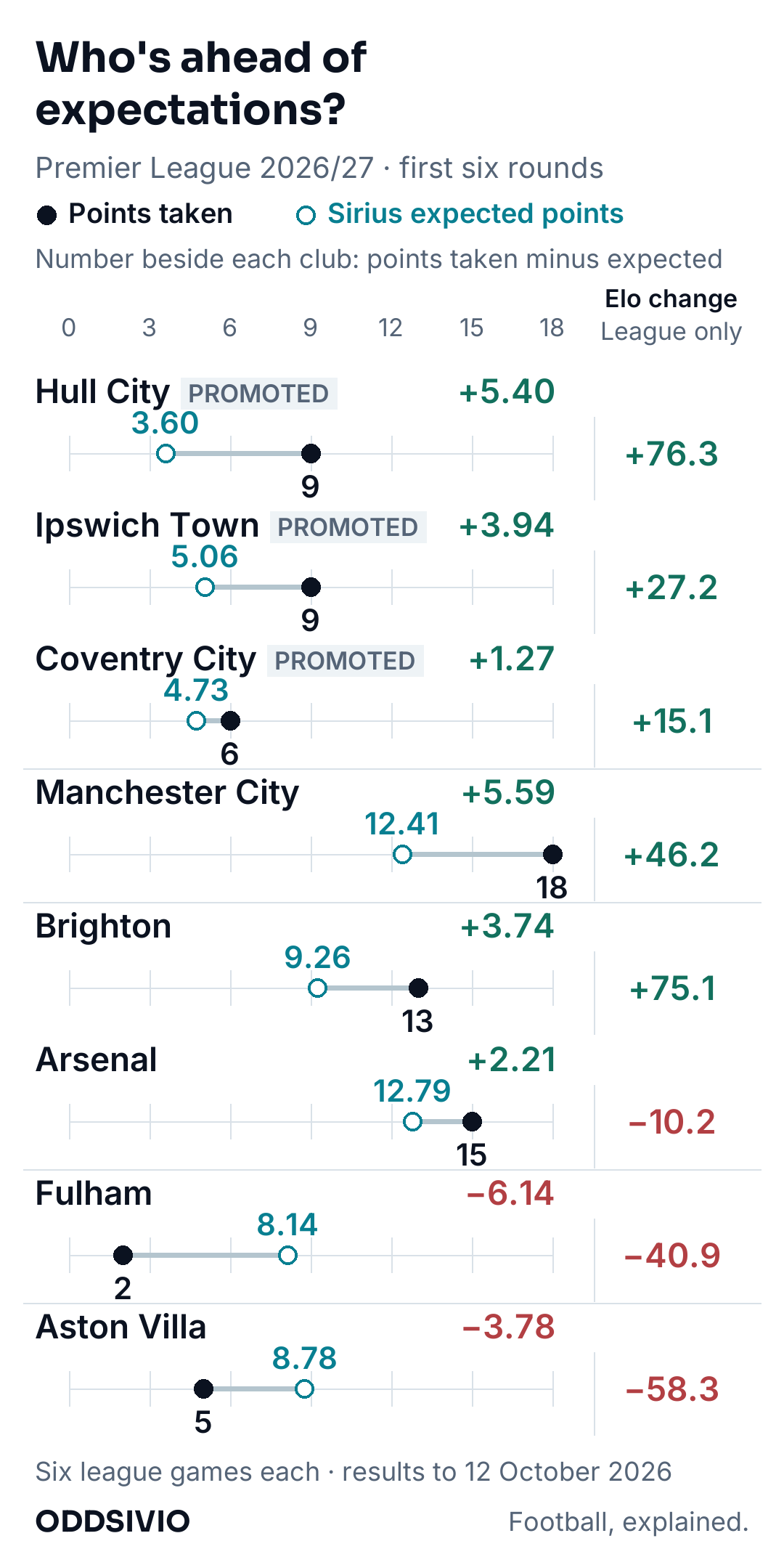
Hull, Ipswich and Coventry are all ahead
Hull City: 9 points · Sirius expected 3.60 · Elo +76.3
Hull's next win came at the Coventry Building Society Arena on 29 August, when Mohamed Belloumi sent Liam Millar through to score. Hull's official account describes a quick break after clearing a ball into their own box. Millar finished in the 82nd minute to make it 1–0, and we'd given Hull's win at Coventry an 18.9% chance.
So Hull are 5.40 points ahead of the forecasts, and those two wins account for most of that. Hull scored from set pieces against United and a quick break at Coventry. Those goals explain how Hull won, but six games can't tell us whether the same routes to goal will keep working.
Hull's nine points come from two wins and three draws. They held Aston Villa to a 0–0 draw at the MKM Stadium on 5 September, when we'd given Villa's win a 62.1% chance. Then Belloumi scored both Hull goals in the 2–2 draw at Chelsea on 12 September, at Stamford Bridge, where we'd given Hull a 5.8% chance of winning and the draw a 22.2% chance.
For Ipswich, Zian Flemming scored a late winner at Selhurst Park on 12 September. Ipswich's official report describes him turning in the rebound from Leif Davis's header against the bar to beat Crystal Palace 3–2. We gave Ipswich's win a 16.7% chance, their lowest win probability in a game they won.
Ipswich Town: 9 points · Sirius expected 5.06 · Elo +27.2
But Anan Khalaili had put Palace ahead. The league record has Emersonn equalising before Axel Disasi's straight red card in the 34th minute, with the score at 1–1. Palace then fell behind, equalised through Jørgen Strand Larsen and only lost to Flemming's 90th-minute goal. Ipswich had an extra player, but still needed that last finish to take three points.
At Portman Road on 10 October, Ipswich had to come back again, this time against Fulham. Ryan Sessegnon put the visitors ahead before Abdoul Ouattara equalised in the 88th minute and Dara O'Shea headed the winner at 90+1, with Ipswich's report describing Jack Clarke's free kick finding O'Shea. We'd given Ipswich's win a 20.6% chance. The 2–1 win means late winners have settled both of these games, and Ipswich are 3.94 points ahead of the forecasts.
Coventry began with a 3–0 defeat at Arsenal on 21 August, when Kai Havertz, Bukayo Saka and Martin Ødegaard scored at the Emirates Stadium. Brighton won at the Coventry Building Society Arena on 13 September, Coventry's fourth league defeat in four. Charalampos Kostoulas and Malick Yalcouyé had already scored when Taiwo Awoniyi received a straight red card in the 53rd minute. The league record shows Brighton adding three more to win 5–0, but Coventry were already two goals down when the card was shown.
Coventry City: 6 points · Sirius expected 4.73 · Elo +15.1
Then Jay Dasilva scored at the City Ground on 19 September, taking Carl Rushworth's pass over the defence to beat Nottingham Forest 1–0, as Coventry's official report describes. We gave Coventry's win an 11.0% chance. Igor Jesus later put the ball in the net, but the league record confirms that his finish was ruled out after a video review.
Back at the Coventry Building Society Arena on 12 October, substitutes Ellis Simms and Stephen Mfuni scored late in the 4–1 win over Newcastle. They came on at 78 and 83 minutes and scored at 81 and 86 respectively, stretching a lead Newcastle had cut to a single goal. We'd given Coventry's win an 18.8% chance.
Before Newcastle, Coventry had 3 points from five games against 3.97 expected, leaving them 0.97 behind the forecasts. That win put Coventry 1.27 ahead. One game changed which side of the line they were on, which is why we can't read a lasting change into six results.
Together, the promoted clubs have taken 24 points against 13.39 expected. On 14 August 2026, our season preview wrote “All three promoted clubs go straight back down” and called it “genuinely a strong claim”. That call was about all three clubs together and came from squad values, not Sirius. So far, the three have taken more points than our separate game-by-game forecasts suggested, but we'll judge the preview's call after 38 games, on 30 May 2027.
Manchester City: two away wins, two different red cards
At Old Trafford on 13 September, Erling Haaland settled a derby that Manchester City had played mostly with ten men. Phil Foden received a straight red card in the 23rd minute, before Haaland scored on 60 to give City a 1–0 win in the league record.
Manchester City: 18 points · Sirius expected 12.41 · Elo +46.2
So how did City win with a player short? City's official report says the team dropped into a 4-4-1 shape after the dismissal, then Haaland turned in Josko Gvardiol's deflected cross. United had struck the post through Marcus Rashford and Kobbie Mainoo before that goal. We'd given City's win a 52.3% chance and the draw 25.8%, together worth 1.83 expected points. City took all three, with ten players for more than an hour.
At Anfield on 11 October, Haaland, Jérémy Doku and Rayan Cherki scored after Liverpool lost Ryan Gravenberch to a second yellow card. It was 0–0 when Gravenberch was sent off in the 62nd minute, and City then scored in the 65th, the 68th and the 78th to win 3–0. City's own report put it this way: “City took full advantage.” The report describes Doku's blocked shot falling to Haaland for the opener.
We gave City's win at Liverpool a 40.8% chance and the draw 28.4%, together worth 1.51 expected points. These were City's two wins furthest ahead of the forecasts, one with a player short and one against ten players. We know the goals came after the dismissals, but we can't say what either score would have been without the red card.
Six wins put City 5.59 points ahead of the forecasts, further ahead than any other club. Even a favourite can draw or lose, and City's chances of winning each game ranged from 40.8% to 80.2%, which helps explain why their expected total is 12.41 rather than 18. The season preview mentioned earlier made “Manchester City win the title” its first call, and we'll judge that one on 30 May 2027 too.
One thing these numbers can't show: on 29 September the Premier League announced that an independent commission had found that City broke the league's financial rules. City have appealed, and no punishment has been decided, so their 18 points stand as of today.
Brighton and Arsenal: points and Elo tell different stories
At the American Express Stadium on 19 September, Pascal Groß, Charalampos Kostoulas and Chema Andrés scored as Brighton beat Arsenal 3–0. Arsenal's official report says “The hosts created the better chances all afternoon” and describes Groß's opener going in off the post. We had given Brighton's win a 21.9% chance.
Elo is Oddsivio's strength rating, and it changes after each result depending on the opponent, where the game was played and the winning margin. Beating a lower-rated team can add little, while a heavy defeat can take much more away.
Brighton: 13 points · Sirius expected 9.26 · Elo +75.1
Arsenal: 15 points · Sirius expected 12.79 · Elo −10.2
That meeting added 31.9 Elo to Brighton and took 31.9 from Arsenal. By contrast, Arsenal's opening-night 3–0 home win over Coventry, which we'd given a 77.4% chance, added just 2.2. So Arsenal won five games and took more points than Sirius expected, but still lost 10.2 Elo across their six league games. Cup and European games aren't counted in that change.
Brighton's earlier home win over Aston Villa had also been emphatic. At the same ground on 23 August, Victor Lindelöf's own goal, Maxim De Cuyper and two goals from Jack Hinshelwood gave Brighton a 4–0 lead before João Gomes's straight red card on 40 minutes. Brighton's official report says “Albion's intense press smothered Villa” and describes Georginio Rutter's run and ball across goal for De Cuyper. All the goals came before Villa went down to ten, whereas Brighton scored on both sides of the Coventry dismissal covered earlier. And those winning margins matter to Elo, with Brighton's three biggest wins of 4–0, 5–0 and 3–0 helping them gain 75.1.
Arsenal's win at Sunderland included a Sunderland penalty at 0–0. At the Stadium of Light on 12 September, David Raya saved Enzo Le Fée's penalty in the 56th minute, two minutes before Bruno Guimarães scored on 58. Sunderland's official report describes Dan Ballard being brought down as he attacked Kevin Danso's long throw. Bukayo Saka's late penalty completed a 2–0 win for which we'd given Arsenal a 65.7% chance.
Fulham: leads that didn't become wins
At Craven Cottage on 5 September, Josh King and César Palacios twice put Fulham ahead against Crystal Palace. Tyrick Mitchell equalised both times before Ben Chilwell scored in the 77th minute to give Palace a 3–2 win. Palace's official report describes Chilwell volleying in a loose ball with his first touch after coming off the bench.
Fulham: 2 points · Sirius expected 8.14 · Elo −40.9
We gave Fulham's win against Palace a 40.3% chance. That didn't promise a win, but Fulham have lost four games, and in every one we'd given them at least a 30% chance of winning. Fulham are 6.14 points behind the forecasts, further behind than any other club.
Against Manchester United at Craven Cottage on 20 September, Lisandro Martínez's own goal gave Fulham a lead they held until Matheus Cunha equalised in the 89th minute. United's official report describes Cunha's shot deflecting off David Affengruber in the 1–1 draw. We gave Fulham's win a 34.1% chance, and the late goal left them with one point.
Then came the Ipswich comeback already described. That was the game where we'd given Fulham their best chance of a win, 54.7%. So that's three games where Fulham led and didn't win. We can point to the goals that cost Fulham points, but that doesn't mean they should have won those games or that the same thing will keep happening.
Aston Villa: ten players without a red card
At Villa Park on 12 September, Alysson brought Aston Villa level with Nottingham Forest before Ian Maatsen had to leave without a replacement. Villa had used all their changes, and the league record puts Maatsen's departure at 83 minutes and Igor Jesus's winner at 88 in a 2–1 Forest win.
Aston Villa: 5 points · Sirius expected 8.78 · Elo −58.3
Both clubs describe Villa finishing with ten players, and Forest's official report describes Daniel Muñoz's cross reaching Jesus through Morgan Gibbs-White's flick. We had given Villa's win a 45.0% chance. Villa were a player short from the 83rd minute, and Forest scored the winner in the 88th. We can't say the game would have ended differently with eleven.
At Villa Park on 10 October, John McGinn put Villa ahead against Brentford on 77 minutes, only for Kristoffer Ajer to equalise on 79. Brentford's official report describes Ajer playing a one-two with Jaidon Anthony and finishing from close range in the 2–2 draw. We gave Villa's win a 48.2% chance.
Villa are 3.78 points behind the forecasts, and their league Elo loss of 58.3 is the largest of any club. Almost half of that loss, 28.6, came in the 4–0 defeat at Brighton covered earlier. But the late goals against Forest and Brentford, along with the goalless draw at Hull, show that Villa haven't dropped points in just one way. So there isn't one explanation for Villa, and six games don't tell us which problem will last.
Where all 20 clubs stand against our forecasts
Here's every club, from furthest ahead of our forecasts to furthest behind, so this isn't the league table order.
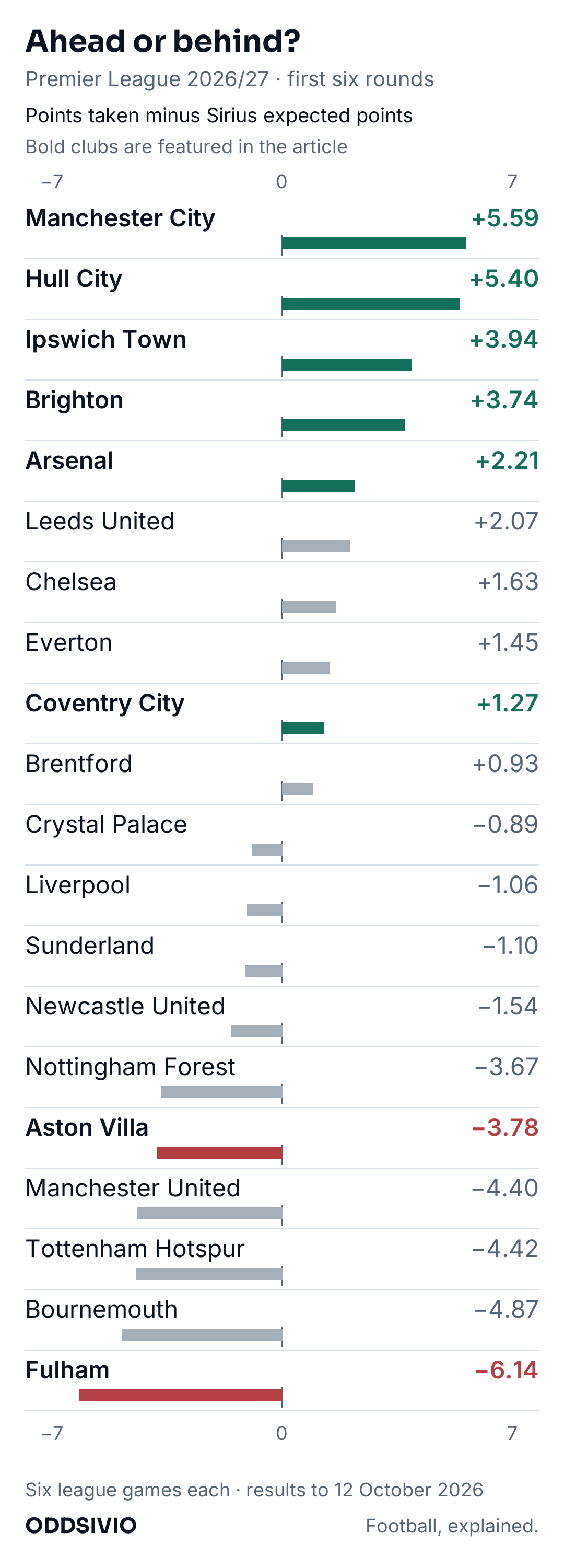
The list gives the figures behind the chart. Each line shows points taken, Sirius expected points, the difference between them and the Elo change across league games only.
- Manchester City: 18 points · 12.41 expected · +5.59 · Elo +46.2
- Hull City: 9 points · 3.60 expected · +5.40 · Elo +76.3
- Ipswich Town: 9 points · 5.06 expected · +3.94 · Elo +27.2
- Brighton: 13 points · 9.26 expected · +3.74 · Elo +75.1
- Arsenal: 15 points · 12.79 expected · +2.21 · Elo −10.2
- Leeds United: 9 points · 6.93 expected · +2.07 · Elo +30.5
- Chelsea: 10 points · 8.37 expected · +1.63 · Elo +13.9
- Everton: 10 points · 8.55 expected · +1.45 · Elo +19.3
- Coventry City: 6 points · 4.73 expected · +1.27 · Elo +15.1
- Brentford: 10 points · 9.07 expected · +0.93 · Elo +33.7
- Crystal Palace: 7 points · 7.89 expected · −0.89 · Elo −10.6
- Liverpool: 9 points · 10.06 expected · −1.06 · Elo −9.2
- Sunderland: 4 points · 5.10 expected · −1.10 · Elo −14.4
- Newcastle United: 8 points · 9.54 expected · −1.54 · Elo −39.7
- Nottingham Forest: 5 points · 8.67 expected · −3.67 · Elo −32.7
- Aston Villa: 5 points · 8.78 expected · −3.78 · Elo −58.3
- Manchester United: 6 points · 10.40 expected · −4.40 · Elo −46.5
- Tottenham Hotspur: 3 points · 7.42 expected · −4.42 · Elo −25.0
- Bournemouth: 3 points · 7.87 expected · −4.87 · Elo −49.9
- Fulham: 2 points · 8.14 expected · −6.14 · Elo −40.9
What six games can't tell us yet
Coventry show how quickly this list can change: they went from behind our forecasts to ahead of them in one game. Six matches aren't enough to tell us how much comes from chance, skill or a lasting change in a team. Sirius expected points aren't expected goals, and they don't tell us how many points a team should have taken from its chances on the pitch. They're worked out before kick-off, and the reports tell us what happened afterwards, including things those forecasts couldn't know were coming.
The next round brings four of our featured clubs together on Saturday 17 October at 15:00 UK time, when Fulham host Hull at Craven Cottage and Manchester City host Ipswich at the Etihad Stadium. Later that Saturday, Aston Villa visit Newcastle at St. James' Park at 17:30.
On Sunday 18 October, Brighton host Crystal Palace at the American Express Stadium at 14:00, before Arsenal visit Nottingham Forest at the City Ground at 16:30. Coventry visit Tottenham at Tottenham Hotspur Stadium on Monday 19 October at 20:00. All these kick-off times are UK time.
On our list, Saturday's Fulham v Hull is the club furthest behind our forecasts against the club second furthest ahead. Manchester City v Ipswich is first against third on that same list.
How we measured it
This note is dated 14 October 2026 and covers results through 12 October. We checked all 60 results against the Premier League's own data. For each club, we multiply its chance of winning by three, add its chance of a draw, and then add up those expected points across the six games.
These are the forecasts that stood at kick-off, from nine versions of Sirius between 21 August and 12 October. Of those, 45 were made at 06:45 UTC on the day of the game, and the other 15 within the hour before kick-off. We haven't rerun the games through a single version. On our match pages these chances are shown as whole numbers that add up to 100, so a page can show 20% where this article says 20.6%.
The Elo changes add up league games only. The Elo history was rebuilt on 7 October 2026, and that's the history used here. Elo is one input to Sirius, so the two measures aren't independent evidence. We add up the full figures before rounding the totals shown here.