What has Klopp actually changed in Germany?
Kimmich is back in midfield and the attacking roles are taking shape. Klopp’s first two games show how much still depends on the movements around them.
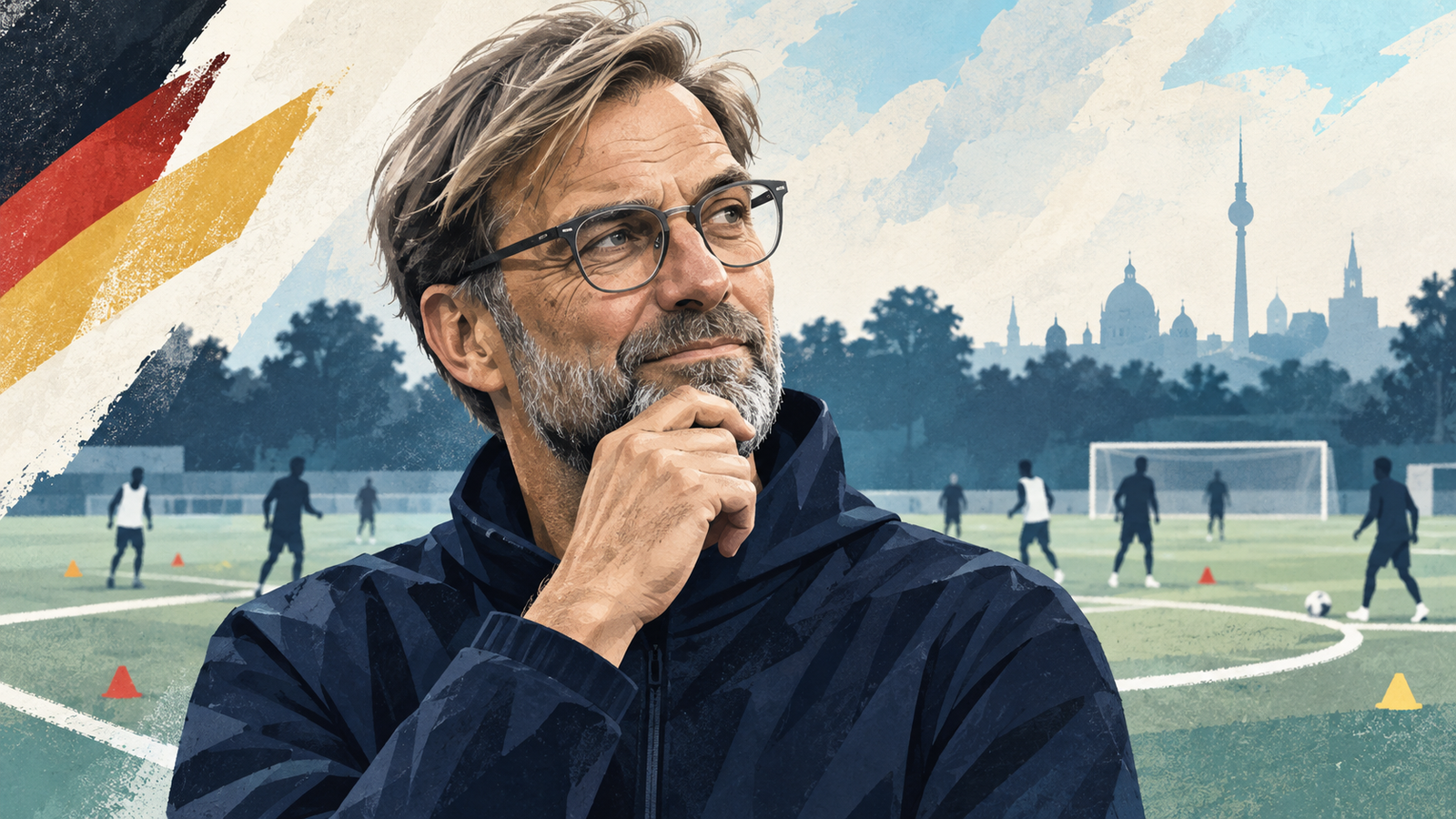
The clearest early change in Jürgen Klopp’s Germany is where the captain plays. Joshua Kimmich has moved from right-back into midfield. That changes who starts attacks, who supplies width and who must protect the space in front of the defence.
Whether it makes Germany better is a separate question. Klopp’s opening games brought a 1–1 draw in the Netherlands on 24 September and a 1–0 home defeat by Greece three days later. The written accounts reveal recognisable ideas, but also a team struggling to connect them.
Kimmich is the first clear change
There is a concrete comparison with Julian Nagelsmann’s last tournament side. In the World Cup knockout match against Paraguay, Kimmich started at fullback, with Aleksandar Pavlovic and Felix Nmecha in central midfield. Nmecha was already part of the midfield; Klopp has changed his partner and the responsibilities around them. DFB’s Paraguay report provides a recent baseline.
Klopp announced his preference before a ball was kicked: he sees Kimmich as a midfielder. Philipp Treu started at right-back in Amsterdam; Josha Vagnoman took that position against Greece. Kimmich and Nmecha started both games centrally. The Netherlands and Greece match reports confirm the selections.
The attraction is straightforward. A central Kimmich can receive from either centre-back and choose which side to attack. But the useful question is where his next pass takes the team. Dropping towards the defenders may help Germany keep the ball; it can also leave one fewer midfielder available beyond the opponent’s first line of pressure.
That distinction matters against a team willing to let Germany pass at the back. The new position is a fact. Its benefit depends on the passing options and movement ahead of him.
Width outside, runners inside
Tobias Escher’s analysis of the Netherlands game describes Karim Adeyemi and Kevin Schade moving narrowly, looking to run beyond a centre-forward who could drop towards the ball. The fullbacks were important providers of width. In Escher’s account, Kai Havertz’s movement offered a way to connect an early forward pass with those runs behind the defence.
The logic is to give defenders two problems at once. Follow the striker away from goal and a runner can attack the space left behind. Stay deep and the striker may have room to receive and connect play. A fullback outside that traffic offers a different passing route.
Germany’s goal supplied a concrete example of contributions from different lines: Treu crossed and Nmecha finished in the 32nd minute. DFB’s account shows the value of having a midfielder in the box to meet the wide delivery. Germany now need that connection more consistently.
There is also a difference between giving fullbacks responsibility for width and getting enough attacking movement from them. Reporting from Amsterdam, Sportschau’s Marcus Bark judged the overlapping insufficient. The role can be clear before its execution is convincing.
Pressing needs the players behind the press
Bark reported an early Dutch goal-kick with four German players near the penalty area and the defence pushed towards halfway. That is a specific glimpse of collective aggression. His account also describes the Netherlands finding space either side of Kimmich. His analysis presents both the ambition and its vulnerability.
The shape is less settled than a formation graphic might suggest. Bark describes a 4-1-2-3; Escher describes Nmecha as a second holding midfielder and Amiri dropping deeper after the break. Their accounts converge on a more useful concern: Germany did not consistently protect the central space behind their pressure.
A press succeeds when the first runner’s teammates remove the easy escape passes. If the opponent gets through while the midfield is still moving forward, the space behind it becomes an invitation. Asking Kimmich to step towards the ball and cover the area he leaves requires help from the players around him.
Jonathan Tah’s pre-Greece explanation was about recognising when to press and acting together. The emphasis was on shared timing: the players behind the first challenge need to recognise the same opportunity.
Klopp also connected defending to possession. After Amsterdam, he said Germany had played too little football when the Netherlands became dominant and could have conceded fewer chances with clearer use of the ball. His assessment points to another part of the job: keeping an escape route after winning possession, so the next defensive wave does not arrive immediately.
Greece exposed the other half of the job
A defence that stays close to its own goal gives those fast runners less space to attack. Germany then need to move opponents before exploiting the gap: a player receiving between the lines, a run that draws someone away, or a quick switch that reaches the far side before the defence can shuffle across.
Bark’s written assessment of Kimmich against Greece describes him repeatedly dropping between Jonathan Tah and Yann Aurel Bisseck, exchanging short passes without enough penetration. Bark also singles out a forward pass that released Adeyemi for a first-half chance. The issue was producing that kind of progress often enough, rather than treating safe circulation as an achievement in itself.
Kimmich’s own complaint was that Germany were too static. In Bark’s broader report from Augsburg, Klopp praised the first 15 minutes after the interval, when the team attacked spaces discussed at half-time, but questioned why it stopped doing so.
There were chances. DFB records opportunities for Younes Ebnoutalib and Nmecha early in the second half before Klopp introduced Florian Wirtz and Jonathan Burkardt at 65 minutes. The promising spell produced no goal; Dimitrios Kourbelis decided the game at 74.
Klopp’s post-match explanation stressed the routines needed against a deep defence and the limited time available to practise them. It is a plausible diagnosis. The next evidence has to be more players offering useful options at the same time.
The selection experiment has a cost
The scale of Klopp’s first call-up matters. Sebastian Stafford-Bloor reported 44 players across two groups, including 16 uncapped players. Klopp said the groups were not an A team and a B team.
That lets him assess more players at close quarters. The tradeoff is less continuity for combinations that need rehearsal. Finding out who can perform a role and teaching several players to perform their roles together compete for the same training time.
Injuries further interrupted the plan. Musiala withdrew during the Amsterdam warm-up; Havertz came off after 30 minutes. Wirtz and Burkardt then joined earlier than planned from the second group. The Bundesliga’s availability report is a reminder that these first selections were partly improvised.
Kimmich is absent from the second group confirmed by the DFB, so the next two games will test those midfield responsibilities with different players.
What would count as progress?
Across the coming windows, the useful signs are specific: Germany’s central midfielders receiving with options beyond the opposing midfield; pressure on the ball supported by cover behind it; and attacks that keep threatening after the first forward pass is unavailable.
Klopp has changed Germany’s allocation of jobs. The first two games have not established that the connections between those jobs work reliably. That is the task now: turning a midfielder’s new position, a winger’s run and a defender’s decision to step forward into actions that help one another.
Reporting note: this article draws on official match records, published coach and player comments, and the original written analysis linked above. No match footage was used. Tactical observations are attributed; explanations of their implications are Oddsivio’s synthesis. Assessment covers Klopp’s first two games, through 28 September 2026.