Why are long throws so dangerous? Kayode’s weapon, explained.
The throw gets the ball into a crowded area. The danger comes from who meets it, where the next touch goes and who is ready when it comes loose.
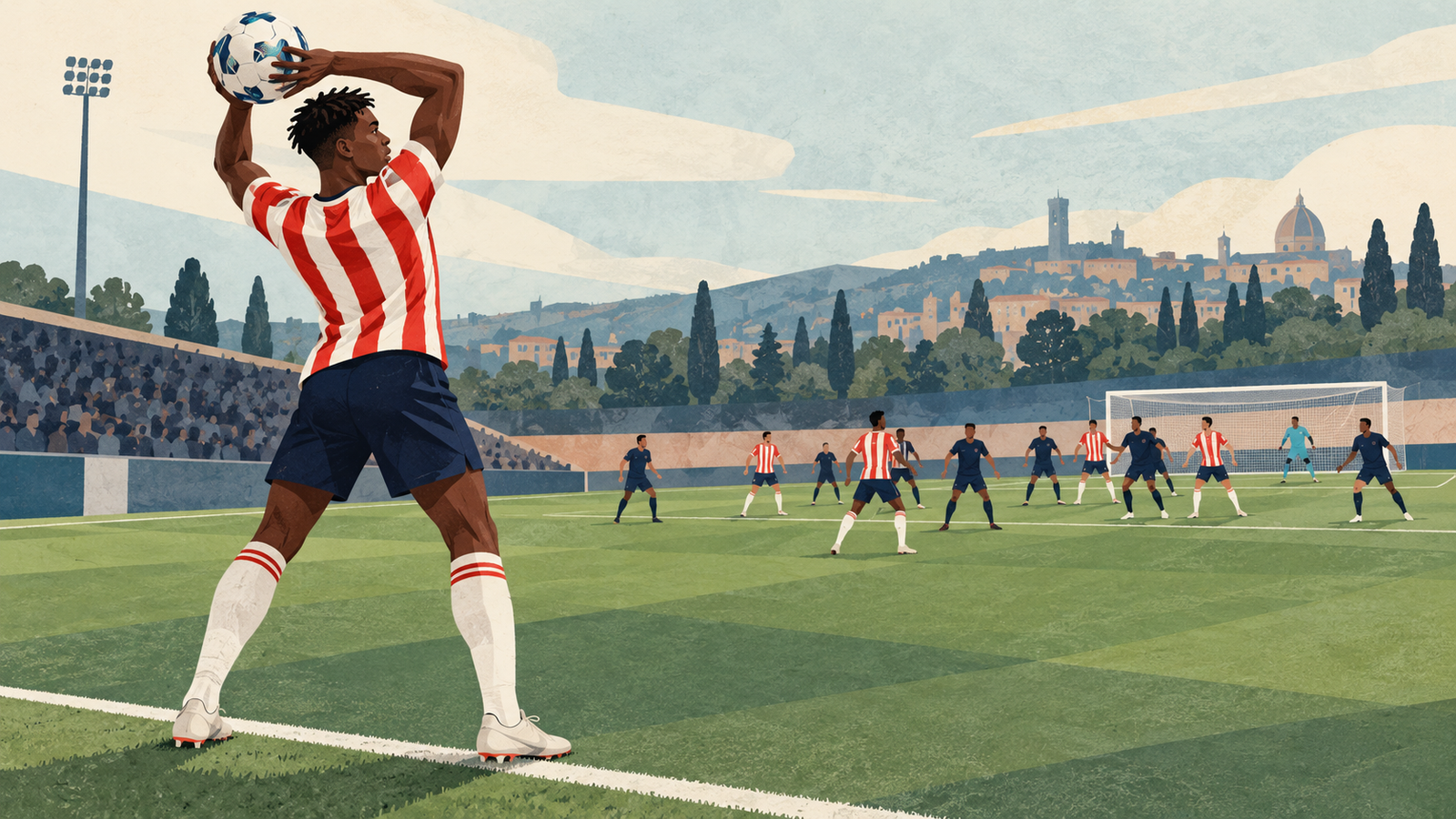
A long throw can turn a routine restart near the touchline into a contest close to goal. The delivery matters, but the thrower is only the beginning of the move. One attacker challenges for the first touch, another waits beyond that challenge, and others prepare for whatever drops out of it.
Michael Kayode makes that sequence easy to see. Two Brentford goals from 2025 show different routes to a chance: a teammate’s flick to a far-post finisher against Liverpool, and a loose defensive touch that leaves Kevin Schade a header against Newcastle. They are useful examples of how the danger develops, without telling us how often the routine succeeds.
Why Kayode is in the conversation now
Kayode is a 22-year-old Brentford defender, born on 10 July 2004. His first senior Italy call-up came in September 2026. In his FIGC interview on 22 September, he described working on throw-in patterns in England with a dedicated coach. His current club profile confirms his club and date of birth.
There is a distinction between joining Italy and demonstrating the same routine for Italy. Kayode was an unused substitute in the 0–2 defeat by Belgium on 25 September. He then started on his senior debut in the 4–1 win away to Türkiye on 28 September, scoring in the 27th minute after a Pio Esposito assist in open play.
Those are Italy’s two completed matches in this Nations League window at the 1 October cutoff; France–Italy is scheduled for 2 October. The accessible evidence does not let us verify a senior Italy long-throw sequence. The tactical examples below therefore come from inspected Brentford footage.
The first touch is a target, not necessarily a shot
Kayode described his preferred delivery to Brentford as “Flat and strong. All I need is a dry ball.” That is his description, not a measured speed or distance.
The useful question is where the delivery puts the next contest. A throw that reaches a crowded area near goal lets an attacker challenge for a header or redirect the ball without first controlling it on the ground. The receiver does not have to win the whole attack in one action. A small touch can send the ball to someone with a clearer route to goal.
Brentford’s opener against Liverpool on 25 October 2025 shows this. Kayode throws from the left, Kristoffer Ajer makes the first contact and Dango Ouattara volleys in at the far post. You can follow the delivery and replays in Brentford’s official extended highlights, from 00:26. Liverpool’s match report also records the flick-on and far-post finish, five minutes into the game.
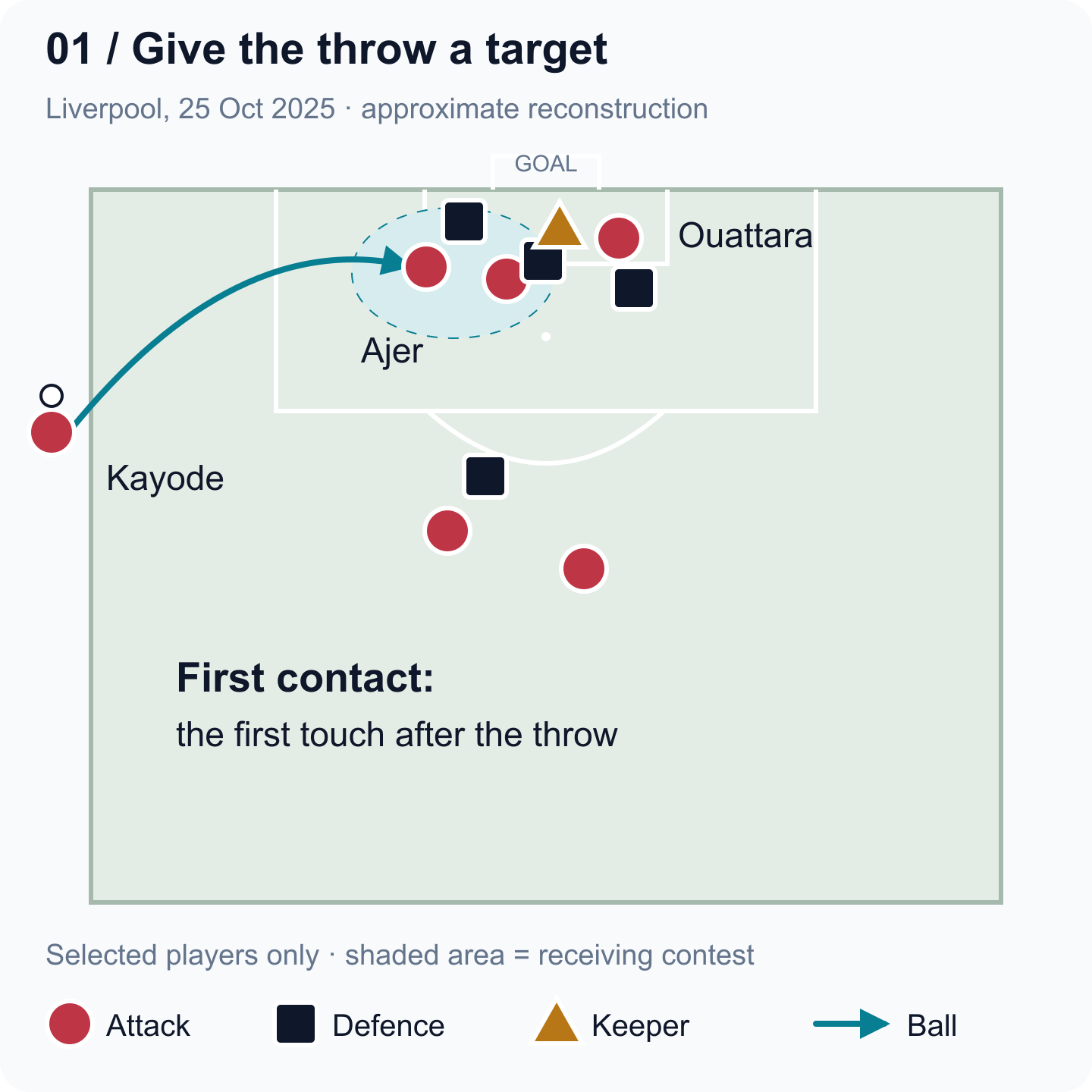
Watch Ouattara as well as Ajer. Ajer competes for the arriving ball; Ouattara is available beyond the contest. If everyone attacks the same landing point, a successful flick may have nobody to find. Separating those jobs gives the first touch a purpose.
The flick makes the defence solve a new problem
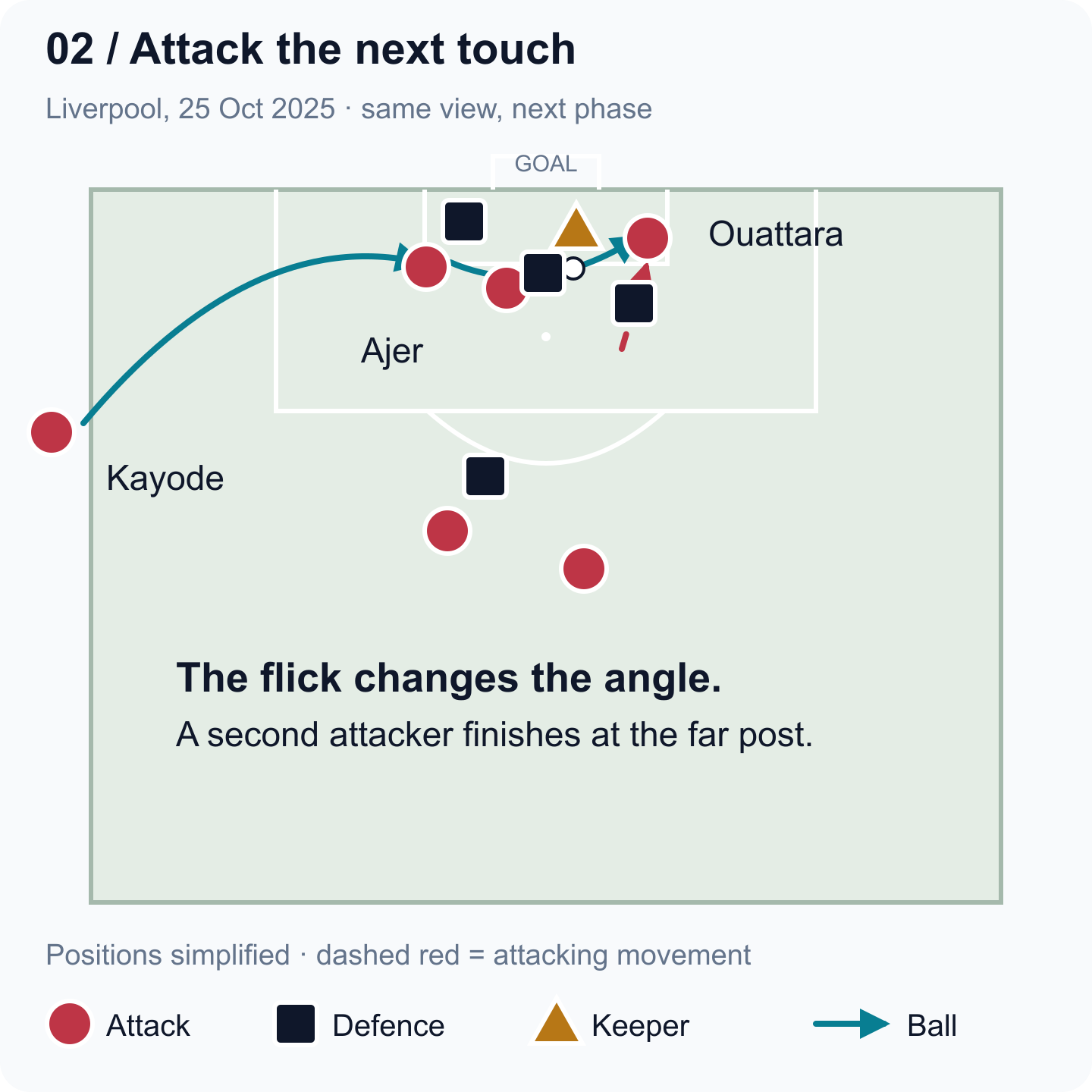
Before Ajer’s contact, the defenders and goalkeeper are following a delivery from the touchline. After it, the ball is travelling across the goalmouth towards Ouattara. They must adjust to a new direction while the next attacker is already close enough to finish.
That is the interpretation the replay supports: the threat comes from the relationship between the first contact and the far-post receiver. It does not establish the exact instructions Brentford rehearsed, or prove that every movement happened as intended.
A deliberate flick-on can act as a pass, even if it is made under pressure. A second ball means something different: a ball left loose after a challenge, clearance, punch or block. The attack needs players ready for both. One player may receive a planned redirection; another may have to react to a bounce nobody fully controls.
A defender can touch it first and leave the danger alive
Against Newcastle on 9 November 2025, Brentford’s equaliser came through a different chain. Nick Pope came for Kayode’s throw but did not secure it. Brentford’s official match report identifies a defensive flick by Sven Botman before Schade headed in from close range in the 56th minute. The decisive passage is in the club’s official highlights, from 00:52.
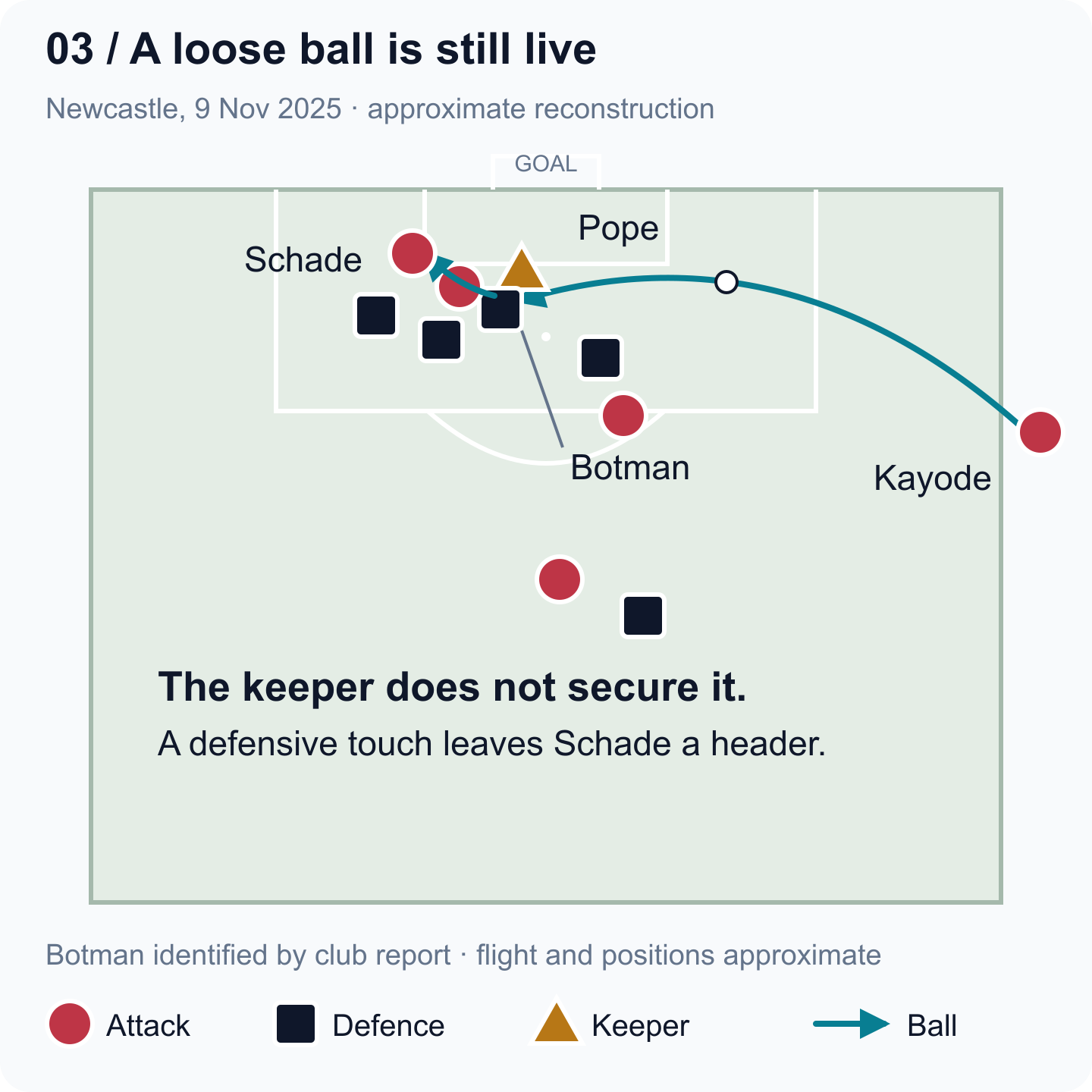
The distinction matters for defending. Making contact is not the same as making the area safe. A short touch can leave the ball near goal, with an attacker able to react before the defender or goalkeeper recovers.
There was another route to a chance in that match, although it is recorded in the reports rather than the footage inspected here. Both Brentford and Newcastle describe an earlier Pope punch falling to Aaron Hickey outside the area; his shot was blocked. A punch can remove the immediate aerial danger and still leave the next phase to defend.
The goalkeeper’s choice changes the contest
Coming to claim the throw offers a way to end the attack: if the goalkeeper catches it, there is no loose ball to fight for. But the route to the ball may run through several bodies. A failed claim or an incomplete punch can leave both the ball and part of the goal exposed.
Staying closer to the line protects the goal while teammates challenge for the delivery. The tradeoff is that the goalkeeper may then have to react to a header, a redirection or a close-range finish.
These are choices created by the situation, not a universal instruction to stay or come. Delivery, traffic, starting position and communication all matter. The Newcastle example shows what followed one unsuccessful intervention; it does not tell us which choice would have worked on every throw.
Crowding also has limits. Attackers can occupy space, but holding an opponent or impeding them with contact is a foul. A goalkeeper controlling the ball with the hands or arms cannot be challenged. Those protections come from IFAB Law 12.
Why the offside line does not solve the first delivery
There is no offside offence when a player receives the ball directly from a throw-in. A defence cannot catch that initial receiver offside simply by stepping forward. That makes it possible for an attacker to start very close to goal, beyond the defensive line, while waiting for the throw. IFAB Law 11
The exemption applies to the direct receipt. If an attacking teammate flicks or otherwise touches the ball, that touch creates a new moment at which ordinary offside conditions are assessed. A defender’s mere deflection of the original throw does not, by itself, create a teammate-touch offside test. The whole move is not exempt from offside.
There is another useful rule: a goal cannot be scored directly from a throw-in. If an untouched throw goes into the opponents’ goal, the restart is a goal kick. The thrower must face the field, use both hands from behind and over the head, and have part of each foot on the touchline or on the ground outside it. Opponents must remain at least two metres from the point on the touchline where the throw is taken. IFAB Law 15
Defend the next touch, then find an exit
A useful defensive plan has to account for more than the tallest attacker. Following a particular opponent helps track their run; protecting a zone helps guard the landing area. Either approach still needs someone to deal with the receiver beyond the duel and someone to react outside the main crowd. These are general options, not claims about Liverpool’s or Newcastle’s marking instructions.
A clearance towards the middle can invite another shot or delivery if an attacker is waiting there. Where the defender has a choice, a wider clearance can move the next contest away from goal. A teammate available outside the crowd can then offer an outlet, giving the defending team a chance to keep the ball and move up the pitch.
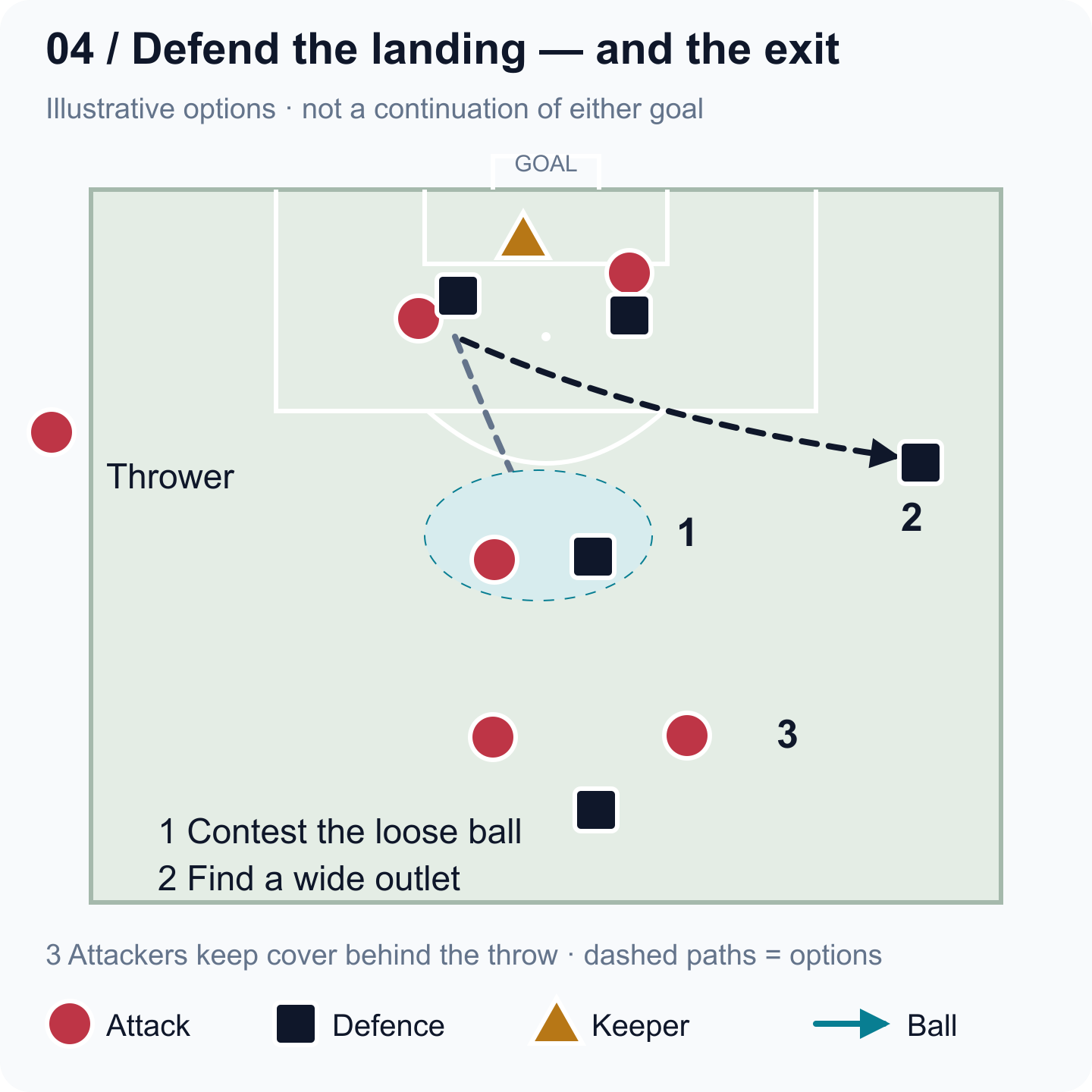
The attacking team has a balancing job too. Sending everyone towards goal leaves space if the throw is caught or cleared. Players outside the crowd can collect a loose ball, but they also need to protect against the opponent’s first pass. The thrower, who starts on or outside the touchline, can rejoin the play to help with that balance.
The next time Kayode takes a long throw, follow the sequence: who challenges for the delivery, who waits beyond them, where a clearance could land and who remains behind the attack. The distance gets the ball into the area. Those positions help determine what the team can do with it.
Watch the two examples
- Liverpool, 25 October 2025: Brentford’s extended highlights, 00:26–01:17. Follow the throw, Ajer’s flick and Ouattara’s finish. The replay commentary initially names Collins, then corrects the first-contact player to Ajer.
- Newcastle, 9 November 2025: Brentford’s highlights, roughly 00:52–01:03. Follow Pope’s intervention and the ball left for Schade. For Botman’s identity and the earlier Hickey chance, use the linked match reports.
Viewing note: these two club clips were playable during research on 1 October 2026; availability can vary by country. RaiPlay’s official Türkiye–Italy full replay displayed an Italy-only restriction, and the Sky highlights player could not be played through the available controls. No Italy throw sequence is claimed as viewed. Selected highlights explain mechanisms; they are not a count of all throws, chances or failures.