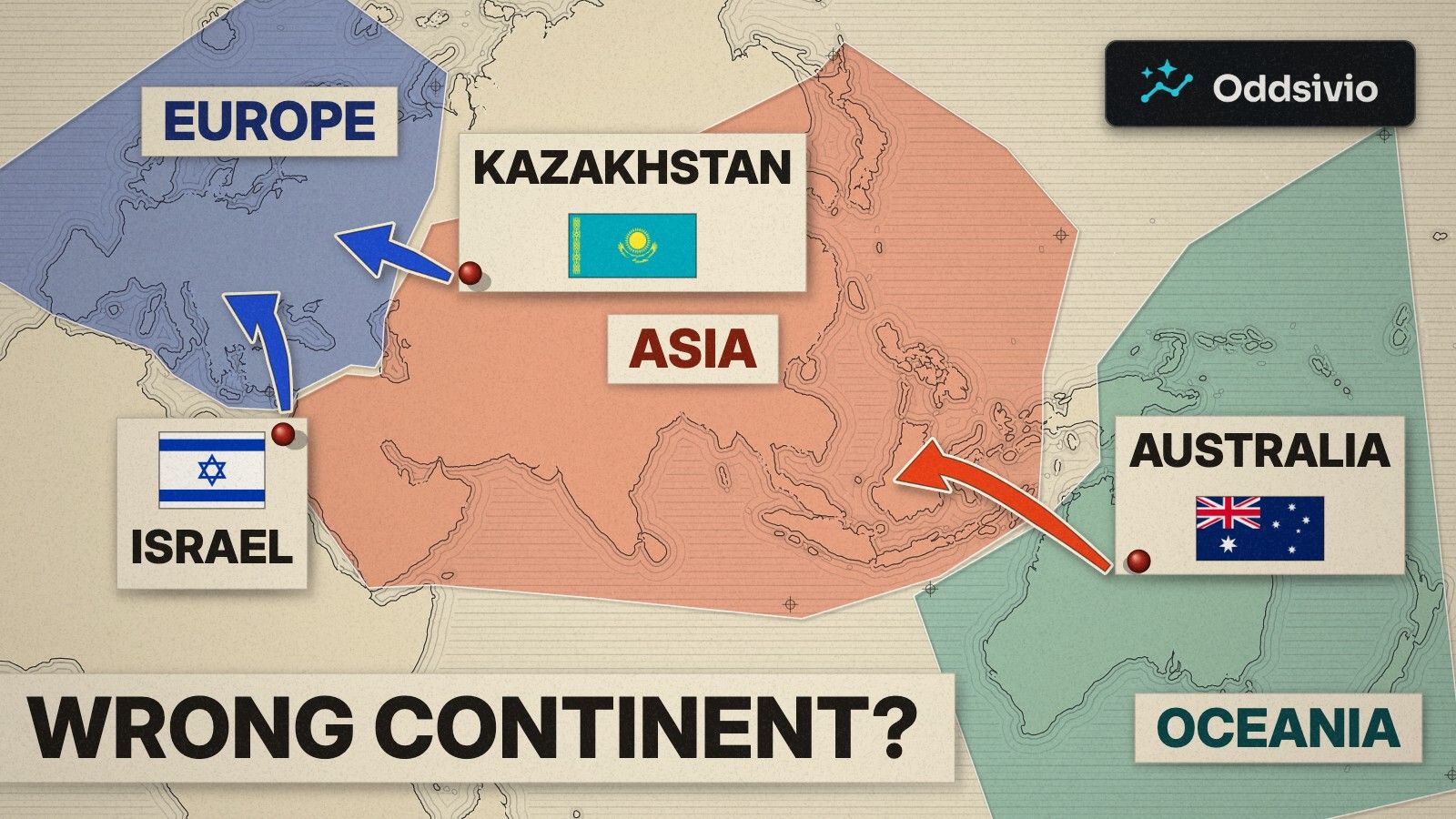
Why does Australia play in Asia, and Israel and Kazakhstan in Europe?
Australia left Oceania for Asia in 2006. Israel and Kazakhstan left Asia for UEFA. Why each moved, and what it means for them today.
The short answer
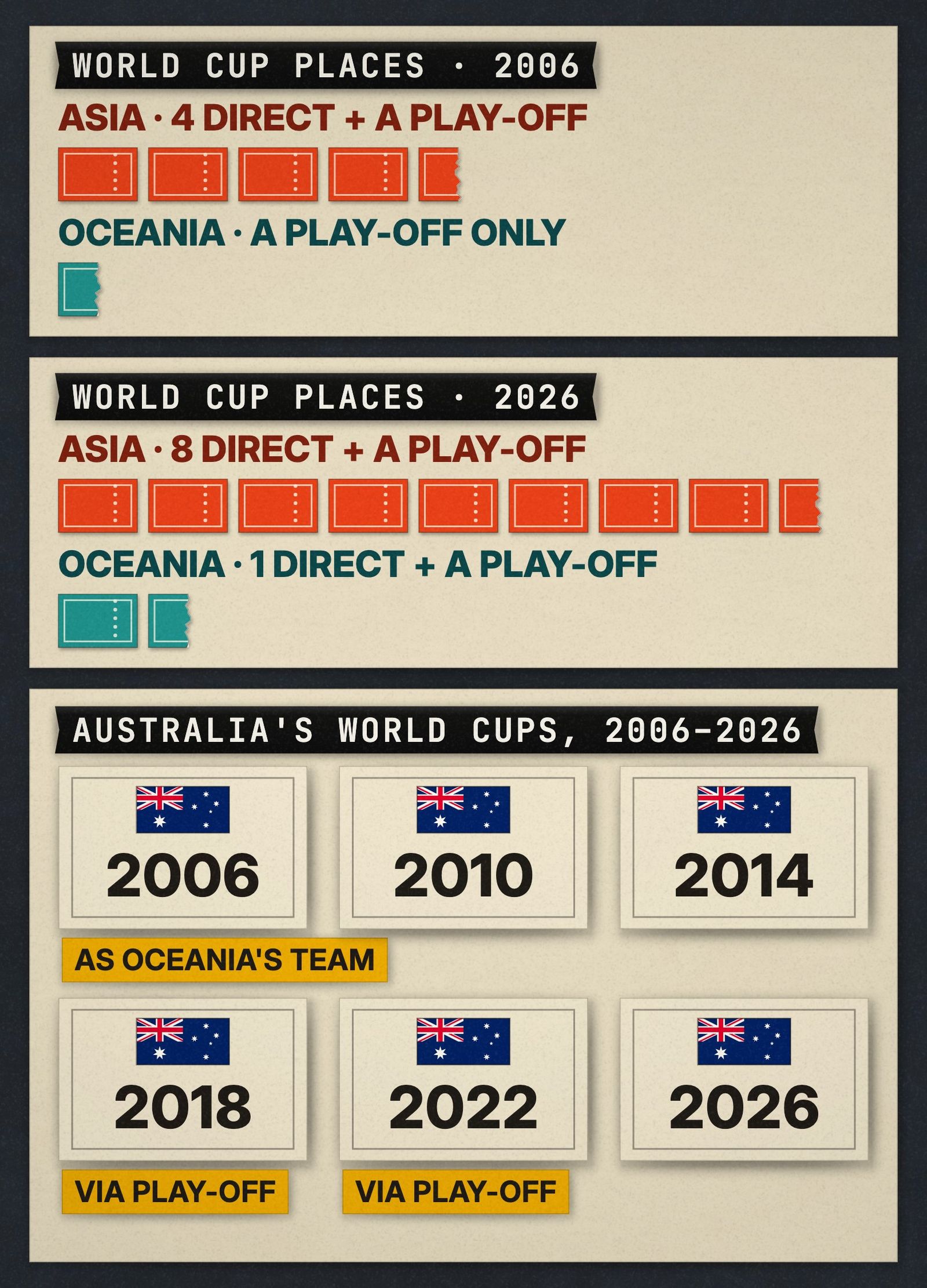
Australia moved from Oceania’s football confederation to Asia’s in 2006. Back then, winning Oceania never earned a World Cup place, only a play-off against a team from another continent, and Australia lost four of them. In Asia, the best teams qualify directly.
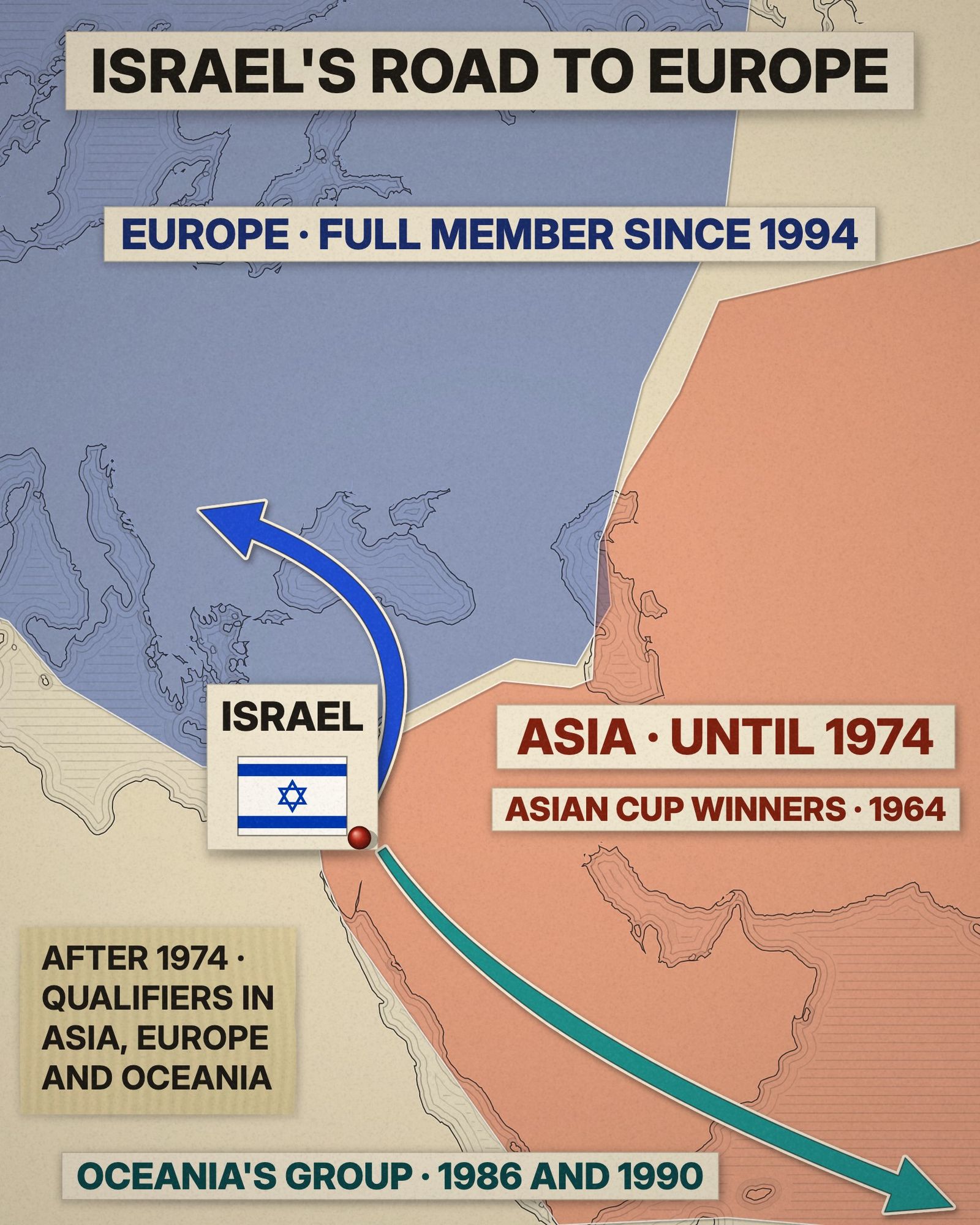
Israel played in Asia’s confederation from its first years. In 1974, that confederation voted to bar Israel from its competitions, and Israel was formally out by 1976. For almost two decades it had no confederation, and FIFA placed its World Cup qualifiers in Asia’s, Europe’s or Oceania’s sections. UEFA then changed its rules to admit it, and Israel became a full member in 1994.
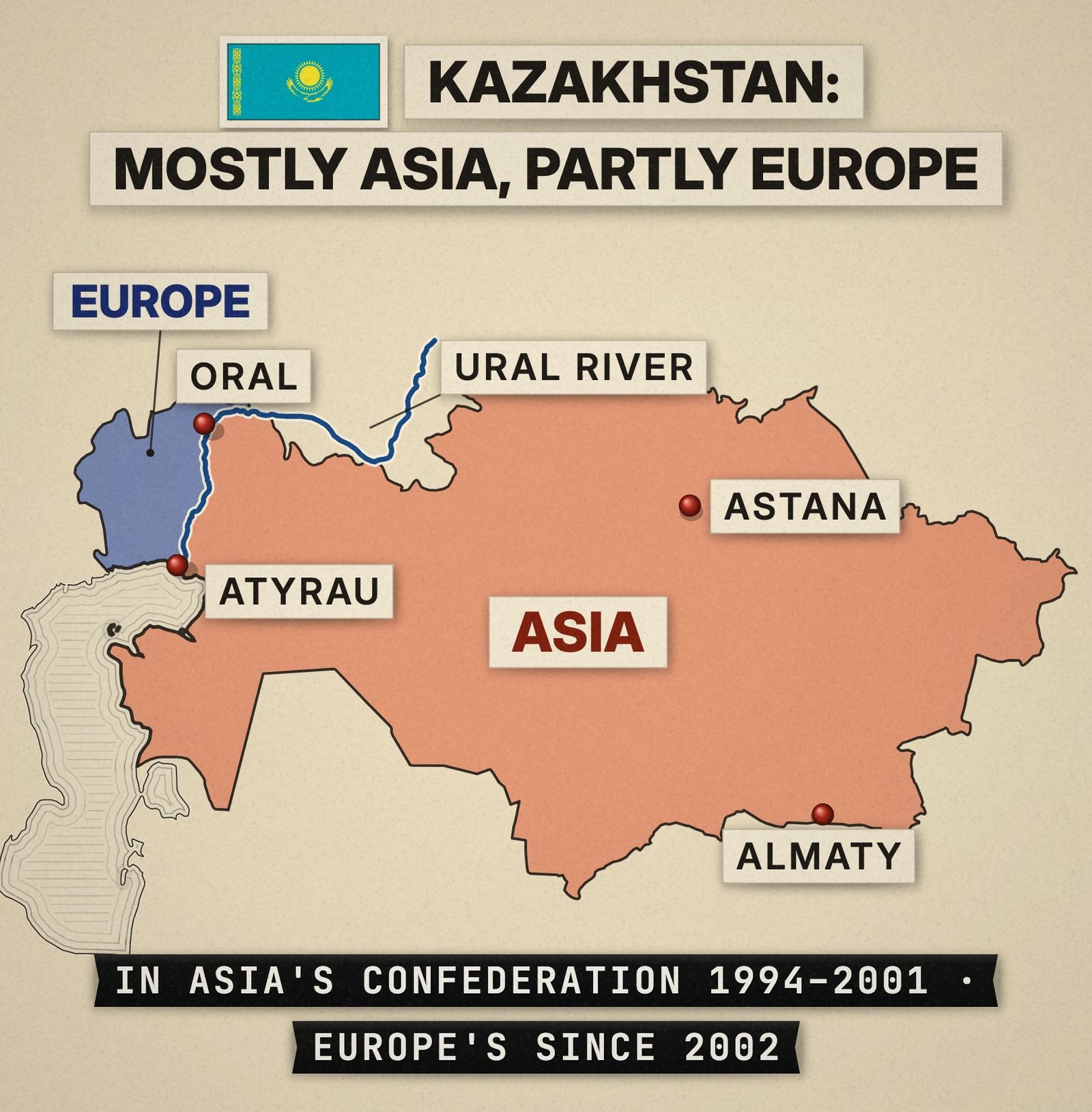
Kazakhstan joined Asia’s confederation in 1994, after independence, and left it in 2001 to join UEFA, which admitted it in April 2002. Its federation said Kazakh football “grew up in the European tradition”. UEFA pointed to the part of the country that lies in Europe, west of the Ural River.
So none of the three is in the “wrong” place by mistake. National teams play in the confederation they are members of, and FIFA’s six confederations follow continents only roughly: Asia’s is the AFC, Europe’s is UEFA and Oceania’s is the OFC. Membership is decided by votes, and some of those votes have changed.
Australia’s story is also told in our short video:
Why is Australia in the AFC and the Asian Cup?
31–0, and still no World Cup
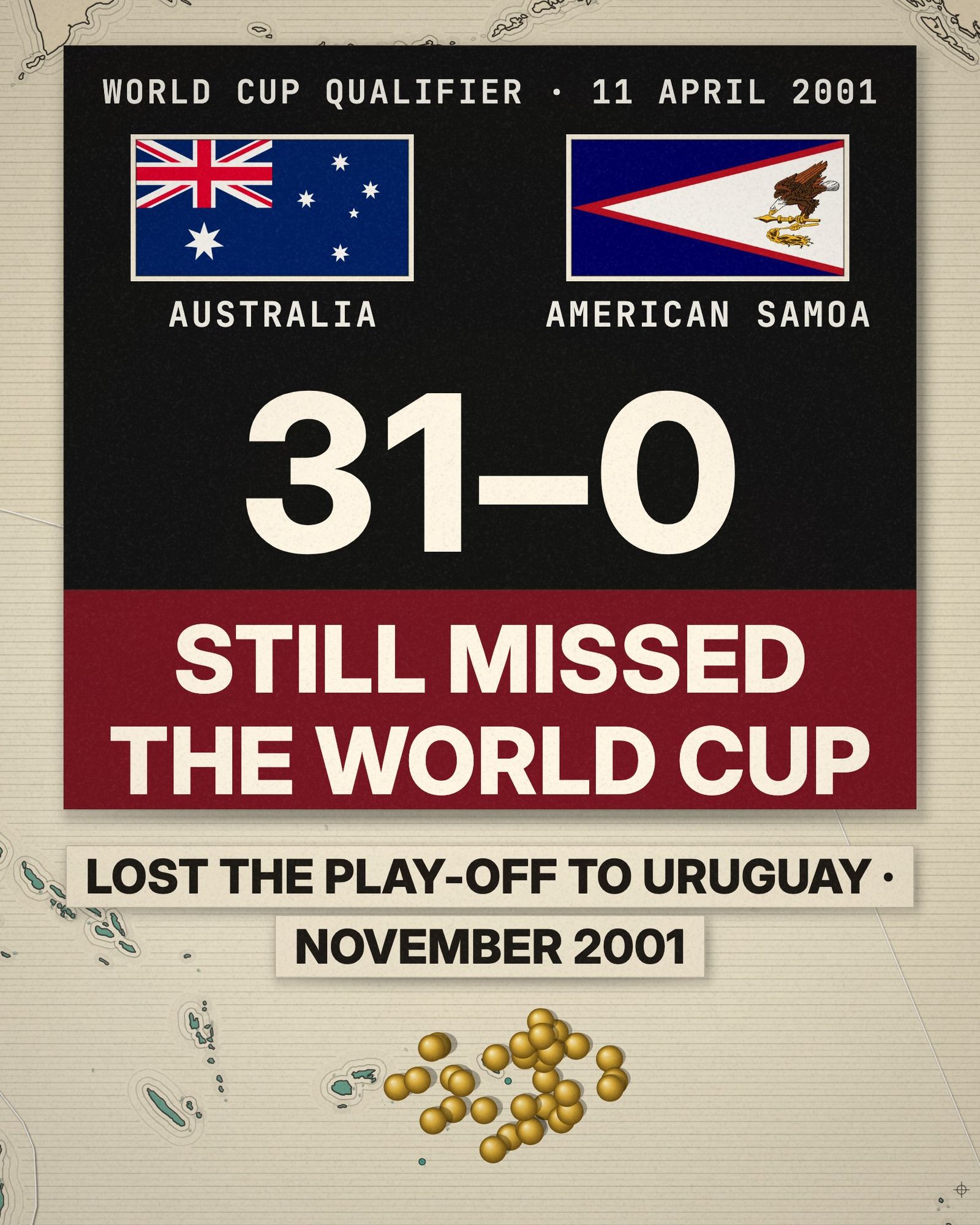
On 11 April 2001, Australia beat American Samoa 31–0 in a World Cup qualifier at Coffs Harbour, in New South Wales. It is a world record for an international match, and Archie Thompson’s 13 goals that day are another (FIFA). American Samoa were missing most of their usual squad: a change in FIFA’s eligibility rules, along with work and school commitments, left goalkeeper Nicky Salapu as the only regular in the side (Socceroos).
Australia won Oceania’s qualifying and still missed the 2002 World Cup. Winning Oceania earned only a two-legged play-off against Uruguay, from South America. Australia won 1–0 in Melbourne and lost 3–0 in Montevideo (OFC; Dawn).
Four times Oceania’s winner, four times out
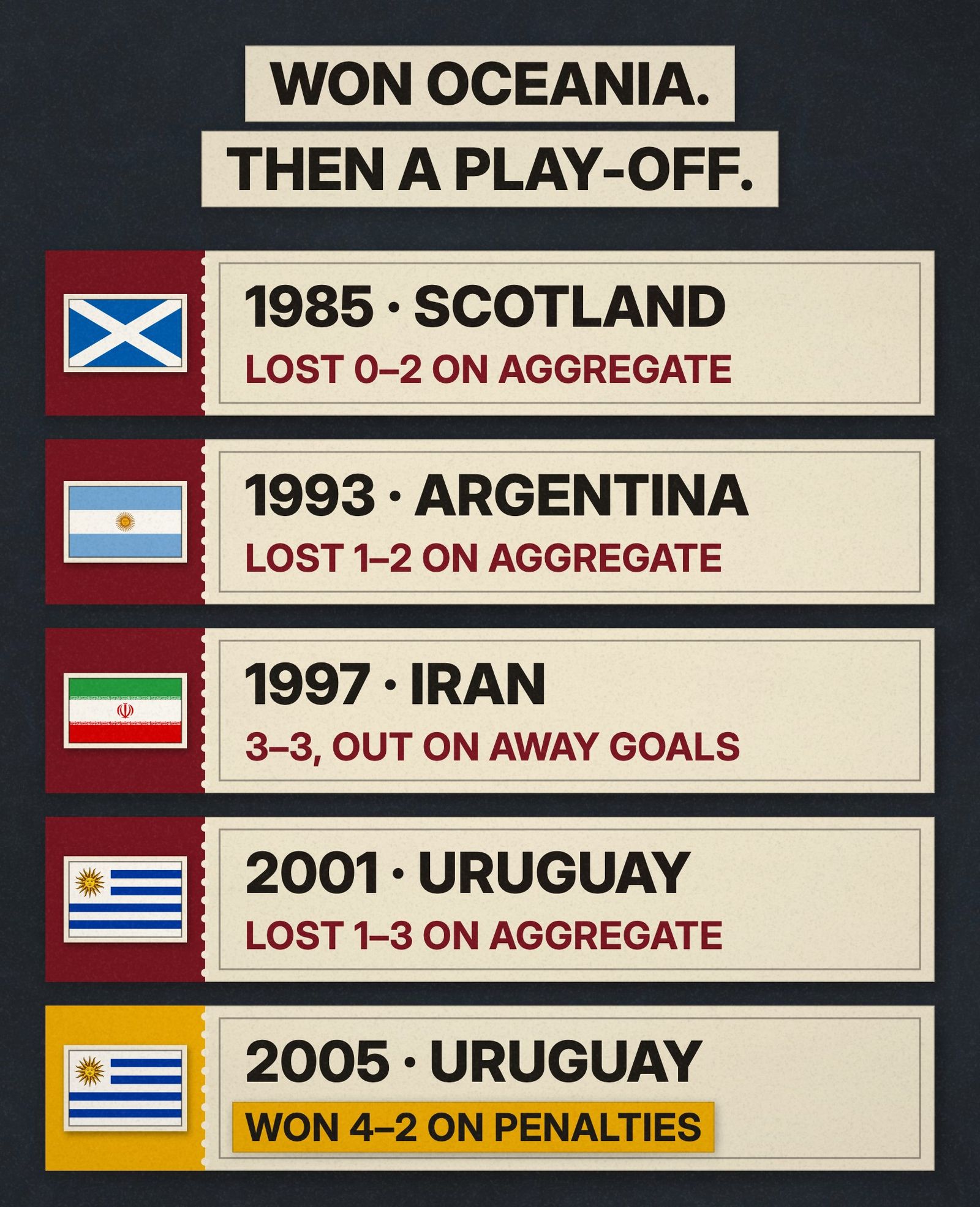
Back then, Oceania had no World Cup place of its own. From the 1986 World Cup to the 2006 one, its winner got a play-off against a team from another continent: in the words of a 2005 report, “only half a place” (Eurosport). Australia won Oceania and then lost that play-off four times:
- 1985, Scotland: 2–0 to Scotland at Hampden Park, 0–0 in Melbourne.
- 1993, Argentina: 1–1 in Sydney, 1–0 to Argentina in Buenos Aires, after Australia had first beaten Canada.
- 1997, Iran: 1–1 in Tehran, then 2–2 in Melbourne after Australia led 2–0 until the 71st minute. Iran went through on away goals (FIFA).
- 2001, Uruguay: 1–0 to Australia in Melbourne, 3–0 to Uruguay in Montevideo.
Graham Arnold, who later coached Australia, was part of the story from Scotland in 1985 to Iran in 1997. “I had the privilege, if you can call it that, of missing out each time,” he told FIFA in 2022. In the one cycle in between that Australia did not win Oceania, for the 1990 World Cup, the group was won by Israel (OFC). That is part of the second story below.
The players felt the gap between the two stages. “In the Oceania qualifying zone we were never really tested,” Australia’s captain Craig Moore said in June 2005 (ABC News). And in 2003, FIFA went back on a promise to give Oceania a full World Cup place of its own (The Star).
The move: March to June 2005
Asia had turned Australia away before. Oceania’s confederation was founded in 1966, with Australia among its founders, after the AFC had declined to take Australia or New Zealand (OFC), and Australia’s later applications to join Asia were refused too (Football Australia).
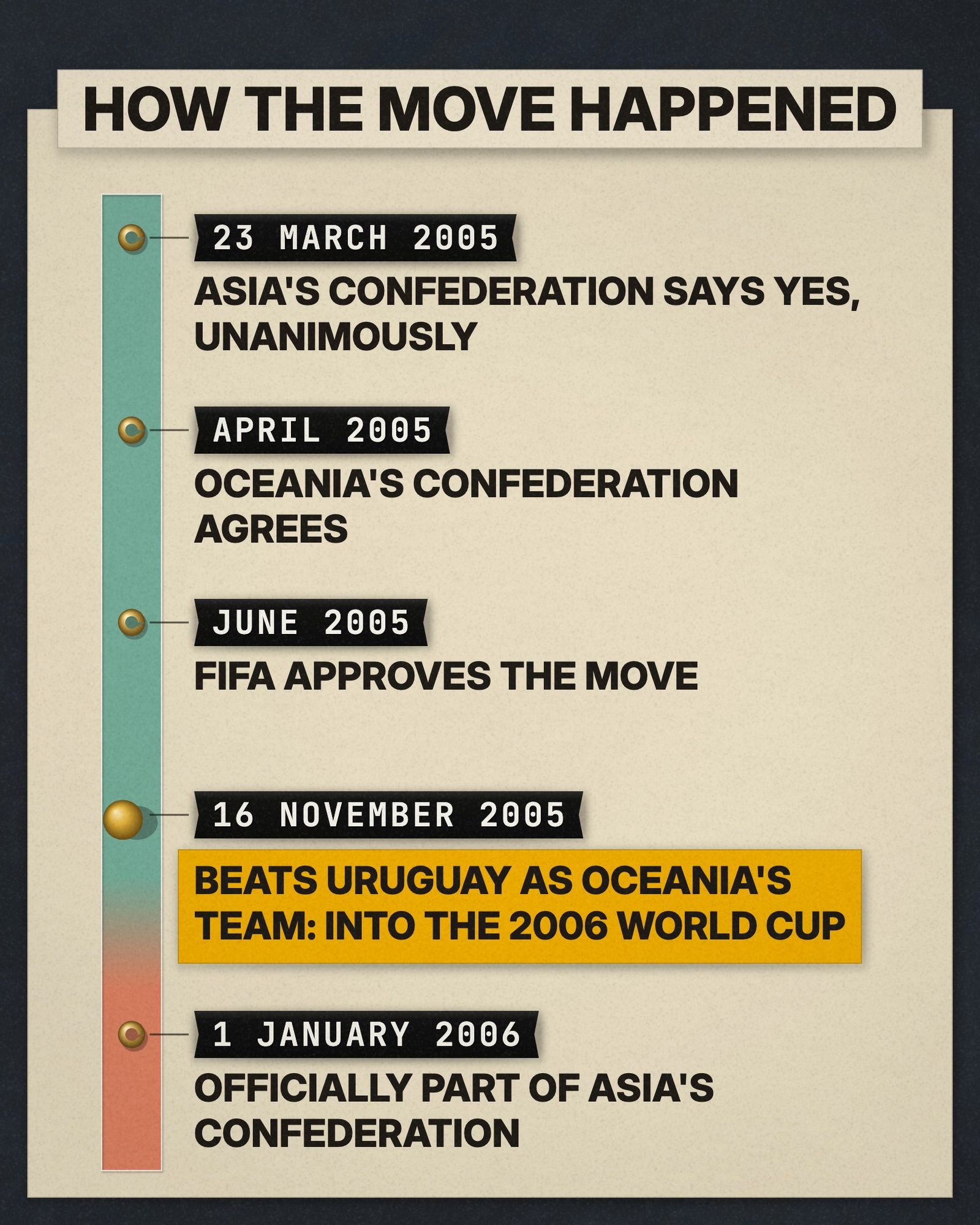
In 2005 the answer changed. On 23 March, the AFC’s executive committee, meeting in Kuala Lumpur, accepted Australia unanimously (Eurosport; EFE, via El Mercurio). Oceania’s executive committee agreed in April (OFC). In June, FIFA’s executive committee approved the move, effective from 1 January 2006. Because every side agreed, it did not need a vote at the FIFA Congress (Football Federation Australia’s release, via the OFC).
Each side said why. “It is the fulfilment of our dream to move in to Asia,” said Frank Lowy, chairman of Australia’s federation (OFC). Spanish news agency EFE reported that the main aim was to compete for a direct World Cup place without a play-off against a South American side (EFE, via El Mercurio). For Asia, AFC president Mohamed bin Hammam said: “Australia will bring to us one more developed football nation and a strong economic nation” (When Saturday Comes).
The twist: the last play-off
The move was approved in June 2005 but took effect only on 1 January 2006. In between, Australia still had to qualify for the 2006 World Cup the old way, as Oceania’s team, through one more play-off against Uruguay. It lost 1–0 in Montevideo, then won 1–0 in Sydney on 16 November 2005 with Mark Bresciano’s goal. Mark Schwarzer saved two penalties in the shoot-out and John Aloisi scored the last kick: 4–2 (Socceroos). It sent Australia to its first World Cup in 32 years (FIFA).
Since then
Australia has not missed a World Cup since. It has qualified five times in a row through Asia (2010, 2014, 2018, 2022 and 2026): six in a row counting 2006, and seven in all with 1974 (Socceroos). Three of the five were direct. The other two came through play-offs: Syria and then Honduras in 2017 (FIFA; FIFA), and the United Arab Emirates and then Peru, on penalties, in Doha in 2022 (FIFA; Al Jazeera). The difference: in Asia, a play-off is a second chance for teams that miss the direct places. In Oceania, it was the only way through, even for the winner.
Being in Asia’s confederation is also why Australia plays in the Asian Cup, Asia’s championship. It hosted and won it in 2015, beating South Korea 2–1 after extra time in the final in Sydney (Football Australia).
The other side
Asia’s World Cup places did not grow when Australia arrived: there were four direct places and a play-off before and after (ABC News; Reuters, via SBS). Australia joined the race for the same places, and in 2010 and 2014, while it qualified, no Gulf Arab team reached the World Cup (Reuters, via Al Jazeera).
In January 2015, the AFC’s president, Sheikh Salman bin Ebrahim Al Khalifa, was quoted by the UAE newspaper Al-Ittihad as saying there was “a desire among west Asian federations to remove Australia from the AFC” (same report). The same day he said his comments had been “manipulated”, and in a statement said that “Australia is a full member of AFC like any other” (AFP, via The42). No federation went on record, and no vote followed.
For Oceania, the move opened a door. “The Oceania delegates have thought for many years that Australia was too powerful and blocked the way,” FIFA’s president Sepp Blatter said when the move was approved (RTÉ). New Zealand reached the 2010 World Cup through a play-off against Bahrain. And for 2026, with the finals grown to 48 teams, Oceania got its first guaranteed place, which New Zealand took (OFC).
Why is Israel in UEFA and not the AFC?
Twenty years in Asia
Israel’s football association is older than the state. It joined FIFA in 1929, under the British Mandate (UEFA).
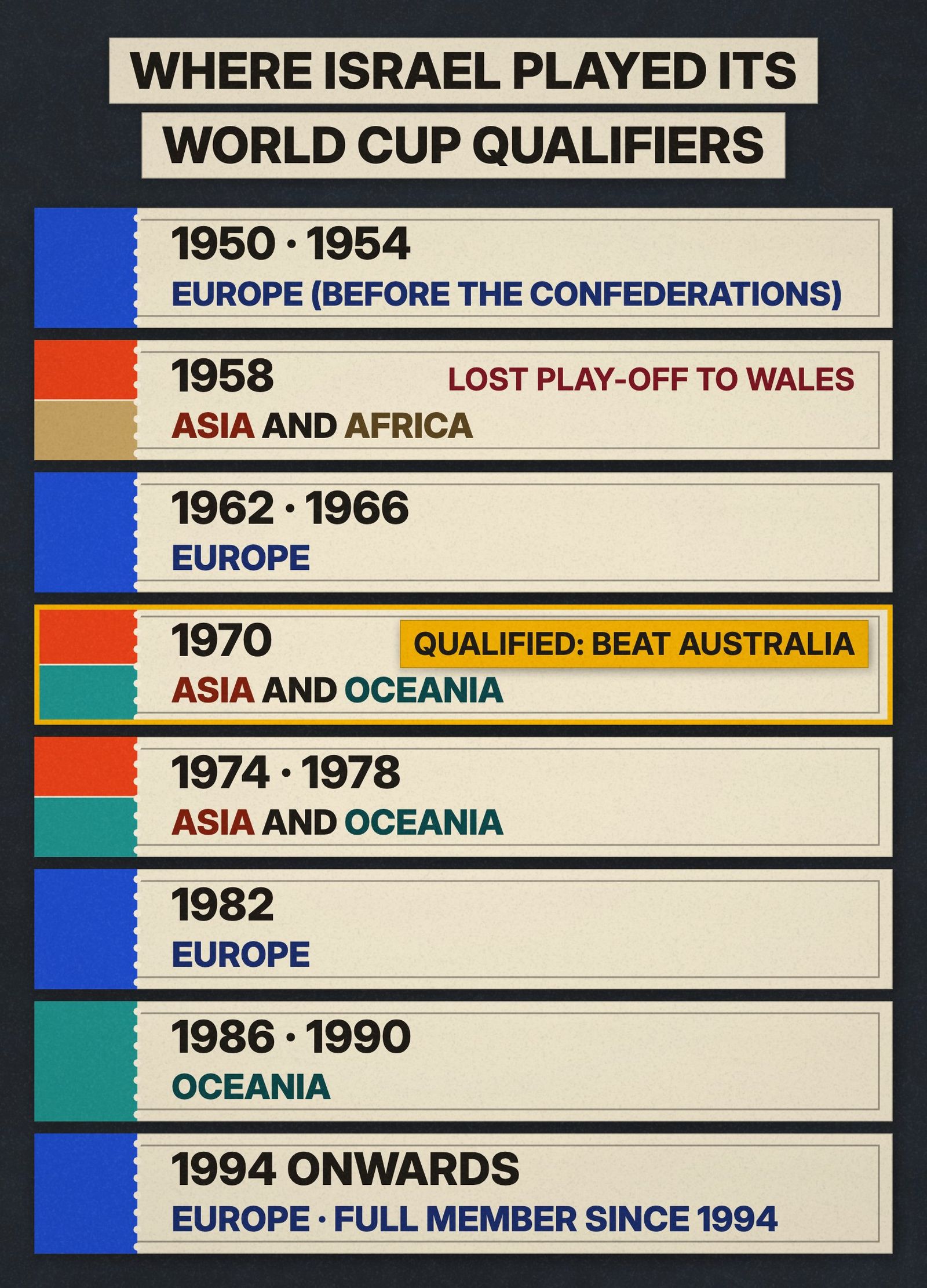
When the confederations were formed in 1954, Israel first applied to UEFA, which turned it down on geographic grounds. UEFA’s 1954 rejection said Israel belonged “de facto and de jure to the Asian continent”, as quoted by historian Daniel Mahla (Contemporary European History, 2026). So Israel played in Asia. The AFC counts it among its 13 founding members of 1954 (AFC); UEFA’s profile of Israel dates its AFC membership from 1956.
Israel did well there. It was runner-up at the first two Asian Cups, in 1956 and 1960, and won the tournament as hosts in 1964 (RSSSF; AFC). It reached its only World Cup, in 1970, through the Asia and Oceania section, and the team it beat in the final round was Australia: 1–0 at home and 1–1 in Sydney (RSSSF; FIFA).
Opponents who would not play
Throughout those years, some opponents refused to play Israel. Before the 1958 World Cup, its opponents in the Asia and Africa section withdrew one after another. Turkey refused to play in that section; Indonesia asked to play on neutral ground and withdrew when that was refused; Sudan refused to play Israel (Football Association of Wales; RSSSF). FIFA ruled that no team other than the hosts and the holders could qualify “without kicking a ball”, so Israel had to play a European runner-up drawn by lot. Wales won 2–0 in Israel and 2–0 in Cardiff, and went to the World Cup instead (Football Association of Wales). Before 1970, North Korea withdrew rather than play Israel (OFC). At the 1974 Asian Games in Tehran, North Korea and Kuwait declined to play their matches against Israel, and Israel was awarded both (RSSSF).
The 1974 vote
At those same Asian Games, in September 1974, the AFC adopted a resolution introduced by Kuwait. It “stated that Israel can never serve as host to Asian Football Association tournaments and will never be invited to any”, the Jewish Telegraphic Agency reported at the time. The vote was 17–13, with six abstentions, short of the two-thirds majority the association’s rules required to expel a member. Israel’s federation said it would appeal to FIFA on the grounds that the Asian body had exceeded its powers (JTA). Later accounts date Israel’s formal expulsion from the AFC to 1976 (Contemporary European History).
Two decades without a confederation
For the next World Cups, FIFA placed Israel in a different section almost every time: the Asia and Oceania section for 1978, Europe’s for 1982, and Oceania’s for 1986 and 1990 (RSSSF: 1978, 1982, 1986, 1990). For 1990 it won Oceania’s final group, ahead of Australia and New Zealand, and then lost the play-off to Colombia, 1–0 over two legs (OFC).
Europe opened the door in the early 1990s. Israel was placed in UEFA’s section for the 1994 World Cup qualifiers, which began in 1992, and won 3–2 against France in Paris in October 1993 (RSSSF). Israeli clubs entered UEFA competitions in 1992/93 (Maccabi Tel Aviv). In 1993, an extraordinary UEFA Congress in Geneva changed UEFA’s statutes so it could admit associations from outside European territory that belonged to no other confederation, a change that, in UEFA’s words, “paved the way for Israel to join the European football family” (UEFA). Israel became a full UEFA member in 1994 (UEFA).
Why does Israel play in the Nations League?
Because it is a UEFA member. The Nations League was designed so that all of UEFA’s member associations play in it, against opponents of a similar level (UEFA). The one member left out of the 2026/27 edition is Russia, which has been suspended from UEFA competitions since 2022 (Euronews). Israel is in League B, Group 3, with Austria, the Republic of Ireland and Kosovo (UEFA), and it plays its World Cup and European Championship qualifiers in UEFA’s section too.
Where things stand (14 November 2026)
- No UEFA matches in Israel. Since October 2023, UEFA has not played competition matches in Israel, citing safety and security. Israel’s national team and clubs play their home UEFA matches in other countries, such as Hungary and Serbia (RTÉ; Reuters, via Al Jazeera; AP, via Fox Sports).
- At FIFA. In May 2024 the Palestinian Football Association asked FIFA to suspend Israel’s federation, raising alleged violations of international law in Gaza, discrimination, and Israeli league clubs based in the West Bank (AP, via ESPN). In March 2026, FIFA’s Council decided to take no action on the West Bank question, because “the final legal status of the West Bank remains an unresolved and highly complex matter under public international law” (FIFA). Israel’s federation welcomed the decision (Jewish News). At the same time, FIFA announced that its disciplinary committee had fined Israel’s federation 150,000 Swiss francs for breaches of its rules on discrimination and fair play, in a verdict reached in August 2025 (AP, via WTOP). The Palestinian association appealed to the Court of Arbitration for Sport in April 2026 (Reuters, via New Straits Times). No ruling had been announced by the time of writing.
- At UEFA. In September 2025, AP reported that UEFA was moving towards a vote on suspending Israel over the war in Gaza; Israeli officials lobbied against it (AP). The vote was not held after a US-brokered ceasefire in Gaza took effect on 10 October 2025 (Al Jazeera). In November 2025 the Football Association of Ireland voted to ask UEFA to suspend Israel. UEFA replied in December that the matter “has been duly noted”, the FAI’s president told members in January 2026 (Irish Examiner).
- Today, Israel is a full UEFA member, and its national team and clubs play in UEFA competitions.
Why is Kazakhstan in UEFA and not the AFC?
Seven years in Asia
Kazakhstan became independent in 1991, as the Soviet Union broke up. Its football federation joined FIFA and the Asian Football Confederation in 1994 (UEFA). It played two World Cup qualifying campaigns in Asia. For 1998 it reached the final round and finished fifth of five, in a group with South Korea, Japan, the United Arab Emirates and Uzbekistan (RSSSF). For 2002 it went out in the first round, unbeaten and level on points with Iraq, on goal difference (UEFA).
The move to Europe
In June 2001, Kazakhstan resigned from the AFC “in the hope of joining UEFA”, the Tehran Times reported at the time. The federation’s president, Rakhat Aliyev, said: “Football competition grew up in Kazakhstan in the European tradition.” He added: “It should come as no surprise that we regard ourselves as part of European football” (Tehran Times).
UEFA’s executive committee recommended accepting the application in December 2001 (UEFA), and on 25 April 2002 the UEFA Congress in Stockholm admitted Kazakhstan as its 52nd member (UEFA; Kazakhstan Football Federation). UEFA’s own account names the main argument: “part of Kazakhstan’s territory is in Europe” (UEFA). That part is a small slice of the west of the country, beyond the Ural River, which is conventionally counted as Europe. Most of Kazakhstan, including the capital, Astana, and the biggest city, Almaty, lies in Asia.
What Europe has meant
Kazakhstan has had its big nights in Europe. In March 2023 it came from 2–0 down to beat Denmark 3–2 in Astana, in qualifying for Euro 2024 (Kazakhstan Football Federation), and it reached that tournament’s play-offs through the Nations League before losing 5–0 to Greece (Kazakhstan Football Federation; Reuters, via The Star). In 2026/27 it plays in the Nations League’s League C, Group 3, with the Faroe Islands, Slovakia and Moldova (UEFA).
Its clubs have gone furthest. FC Astana became the first Kazakh club in the Champions League group stage in 2015/16, against Benfica, Atlético Madrid and Galatasaray (UEFA; UEFA). Kairat Almaty reached the league phase in 2025/26 and hosted Real Madrid in Almaty, a trip of roughly 3,989 miles (about 6,400 km) for the Spanish club, CNN reported (CNN).
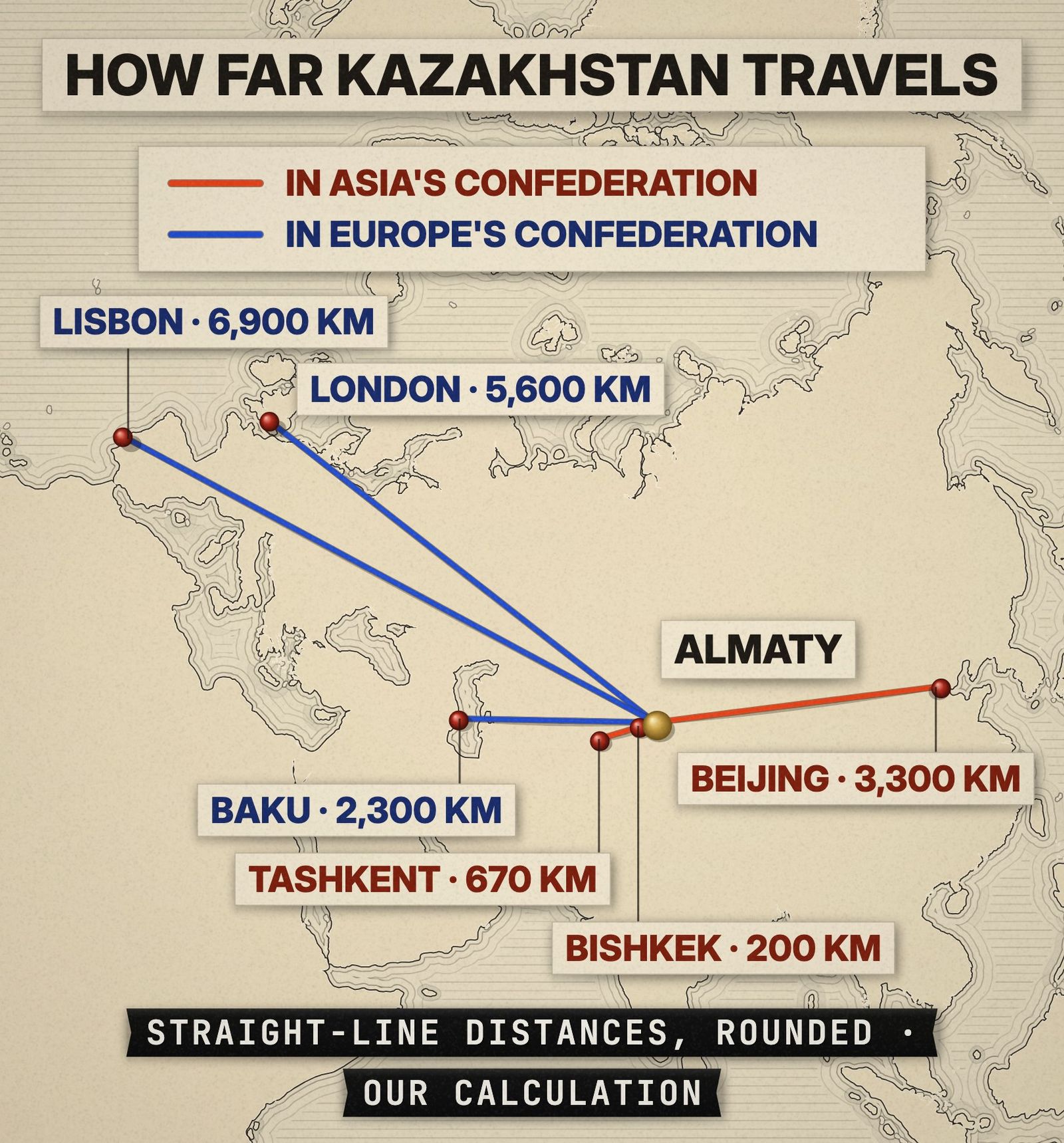
The price is distance. Almaty to Lisbon, where Kairat played Sporting, is about 6,900 km in a straight line; Almaty to London is about 5,600 km. Almaty to Tashkent, the capital of neighbouring Uzbekistan, is about 670 km, and to Bishkek in Kyrgyzstan about 200 km (our calculations, from city-centre coordinates).
Who else plays outside its continent?
Australia, Israel and Kazakhstan are the best-known cases, but not the only ones:
- Guyana and Suriname are in South America but play in CONCACAF, the confederation of North and Central America and the Caribbean (FIFA; FIFA). So does French Guiana, which, as part of France, is not a FIFA member (CONCACAF).
- Guam, an island in the western Pacific, plays in Asia’s confederation (FIFA). The nearby Northern Mariana Islands left Oceania’s confederation, where it was an associate member, joined Asia’s as an associate in 2009, and became the AFC’s 47th full member in December 2020 (Play the Game; Inside World Football). It is not a FIFA member.
- Türkiye and Cyprus lie mostly or wholly in Asia by geography, and have been UEFA members since 1962 (UEFA; UEFA).
- Armenia, Azerbaijan and Georgia, in the South Caucasus, count as Europe or Asia depending on where the line is drawn. All three joined UEFA after independence: Armenia and Georgia in 1992, Azerbaijan in 1994 (UEFA: Armenia, Georgia, Azerbaijan).
- Russia has most of its land in Asia and most of its people in Europe. It is a UEFA member, suspended from UEFA competitions since February 2022 (Euronews).
Could Australia go back?
The old problem is gone. For the 2026 World Cup, Oceania had one direct place and one play-off place, and Asia had eight direct places and a play-off (FIFA). Going back would mean fighting New Zealand for that one direct place, instead of competing for one of Asia’s eight. It would also mean fewer matches against strong opponents, one of the reasons Australia gave for leaving. Staying means long trips: Sydney to Doha is about 12,400 km, more than five times as far as Sydney to Auckland (about 2,200 km, our calculation from city-centre coordinates).
A move back would need the same steps as in 2005: both confederations and FIFA would have to agree.
Should Australia go back, or stay? That is the question our Short ends on.