Has the offside rule changed? Current law and the daylight trial explained
Has offside changed? Compare current IFAB Law 11 with the daylight trial: clear diagrams, Wenger’s proposal, Canadian testing and what the evidence shows.
Research checked: 28 September 2026.
Daylight offside has not replaced football’s standard offside law. The 2026 Canadian Premier League is testing an alternative that gives attackers more room: an overlapping part of the body that can legally score can keep a player onside. Outside authorised trials, the usual positional test in IFAB’s Law 11 remains in place. IFAB: current Law 11; FIFA: Canadian trial.
That distinction explains why two apparently identical runs can receive different decisions. One competition is applying the ordinary law; another is testing a different boundary. Calling it a new “interpretation” can obscure the size of the experiment: the Canadian trial actually changes the definition of an offside position.
The most useful question is therefore more specific than “Has offside changed?” It is: which positional test applies in this match?
What is the current offside rule?
Under standard Law 11, a player is in an offside position when a relevant part of their head, body or feet is in the opponents’ half and nearer the opponents’ goal line than both the ball and the second-last opponent. Level is onside. Hands and arms do not count; the arm boundary is the bottom of the armpit.
Position is assessed when a teammate plays or touches the ball, normally at first contact. Being in an offside position is not itself an offence: the player must become actively involved, for example by playing the ball or interfering with an opponent. A player can interfere without touching it, such as by obstructing a goalkeeper’s view. An offence brings an indirect free kick.
There is no offside offence when receiving directly from a goal kick, throw-in or corner. A subsequent teammate’s touch starts a fresh assessment. IFAB: Law 11.
The diagrams below label the last outfield player “Last defender”, with the goalkeeper closer to the goal line. IFAB’s formal term is “second-last opponent” because the goalkeeper also counts as an opponent. If the goalkeeper comes off their line, a different player can become the reference; the law counts opponents by position, not by their playing role. IFAB: Law 11.
How does the daylight offside rule work?
The Canadian trial changes the positional threshold from any eligible part ahead to the whole eligible body ahead. If a forward’s trailing boot still overlaps the second-last opponent’s relevant position, the forward can remain onside even with their head and torso beyond it. FIFA: daylight principle.
The complete wording matters. The CPL says an offside position requires the player’s head, body and feet to be:
- Wholly inside the opponents’ half, excluding the halfway line.
- Wholly nearer the opponents’ goal line than both the ball and the second-last opponent.
Arms and hands are excluded. So the familiar attacker-versus-defender illustration is only part of the test: the ball and the halfway line still matter. A trailing foot on the halfway line, for example, means the player is not wholly in the opponents’ half. CPL: published alternative definition.
“Daylight” is a nickname for that separation towards the goal line. It does not mean looking for a patch of grass between two players in a diagonal television picture. They can be several metres apart across the pitch and still be level in the direction that matters.
Three illustrated examples: same run, different verdict
Original illustrated teaching examples, not reconstructions of real incidents. Each uses a flattened side-on view: the two player lanes share the same left-to-right position scale. Attack is to the right. The navy player labelled “Last defender” is the last outfield defender, with the goalkeeper closer to the goal line. The ball is behind the forward and that defender, and all players are shown in the attacking half. Verdicts describe position at the teammate’s touch; an offence additionally requires active involvement.
1. The trailing boot still overlaps
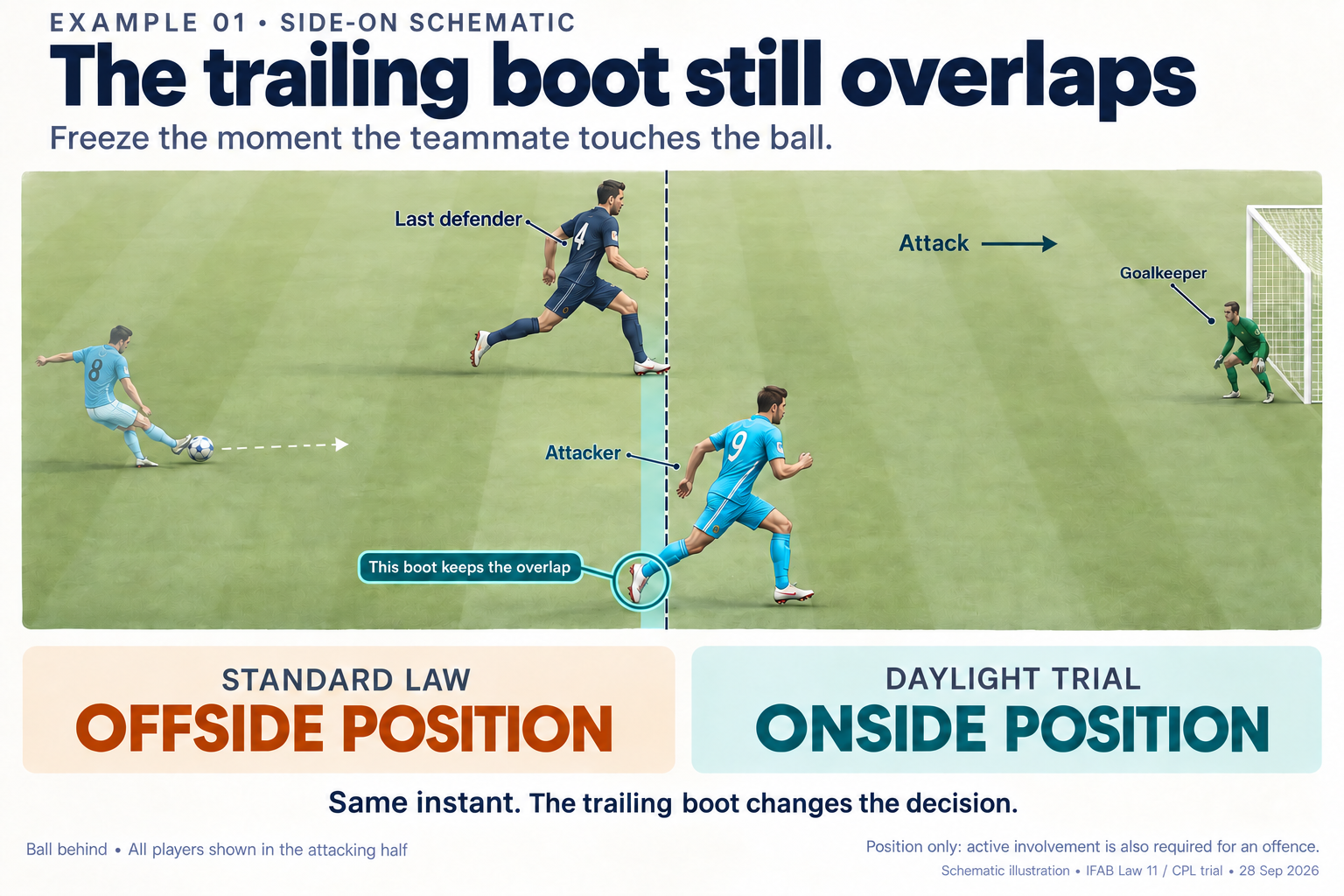
The attacker leans and strides beyond the last defender, but their back boot remains behind the reference line.
Standard law: offside position. Daylight trial: onside position. This is the central change. The same freeze-frame gives two different answers because the boundary is being tested differently.
2. The attacker has completely cleared the line
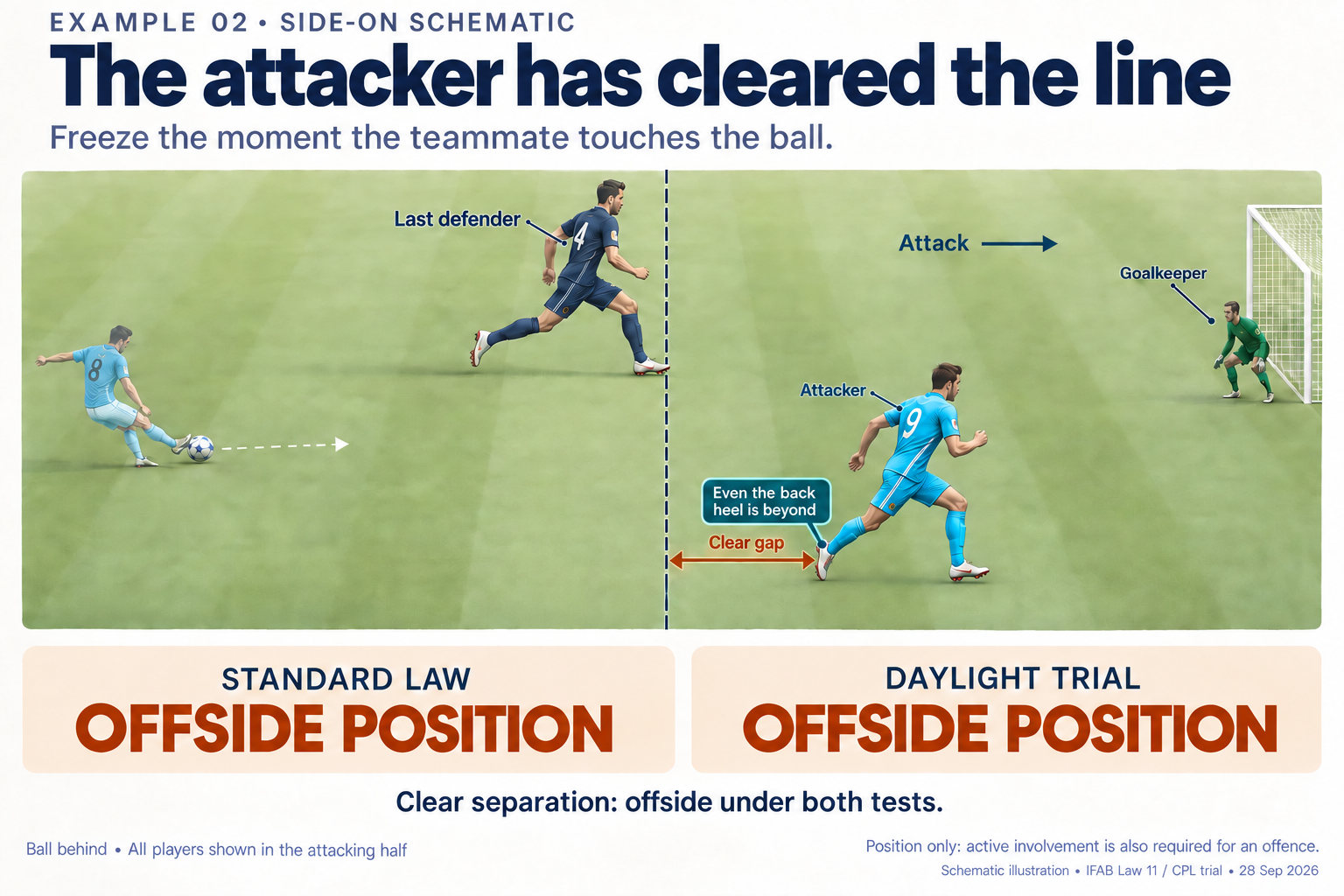
Even the attacker’s back heel has moved beyond the last defender’s relevant position. There is separation along the direction of attack.
Standard law: offside position. Daylight trial: offside position. The proposal gives a runner more room; it does not remove offside or permit unrestricted waiting behind the defence.
3. Only an arm overlaps
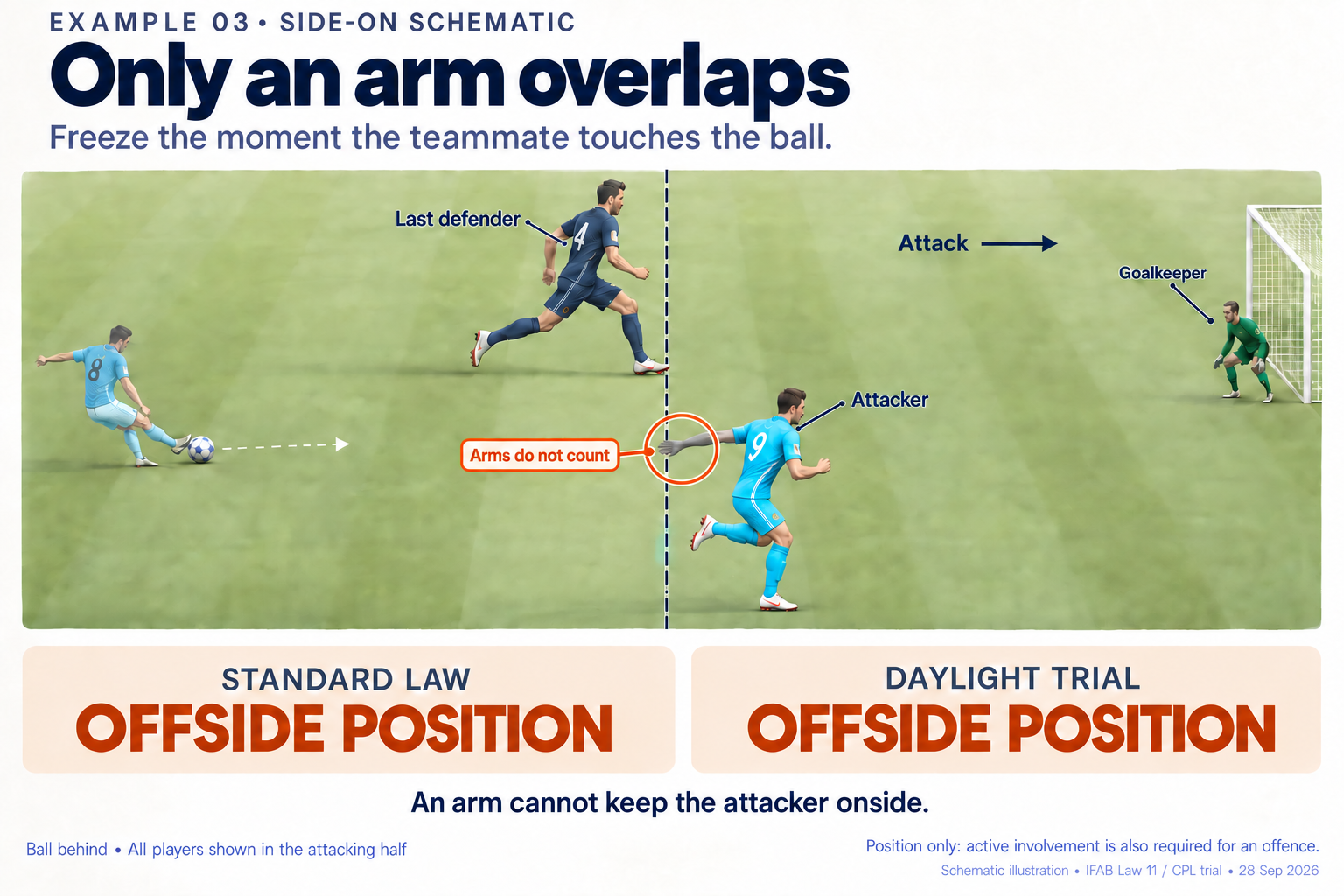
The attacker reaches an arm backwards, but all of their head, torso, legs and feet are beyond the line.
Standard law: offside position. Daylight trial: offside position. The arm cannot rescue the run. Likewise, a defender’s outstretched hand cannot extend the relevant line.
These are worked applications of the standard position test and the CPL trial definition, with the other conditions held constant. The diagrams deliberately use clear margins; real decisions can be much closer.
Who proposed daylight offside—and who can approve it?
The proposal is associated with Arsène Wenger, the former Arsenal manager whom FIFA appointed Chief of Global Football Development on 13 November 2019. His remit included technical matters and participation in the advisory process around possible law changes. That made him an influential advocate, not someone who could rewrite football’s laws alone. FIFA: Wenger’s appointment.
There are three distinct roles in the Canadian experiment. Wenger is the proposal’s prominent champion; FIFA leads the trial; IFAB authorises it, with the CPL supplying the competition and Canada Soccer supporting the pilot. FIFA: trial announcement.
That distinction was present from the start. After discussing possible offside reforms at the Laureus awards in Berlin on 17 February 2020, Wenger issued a clarification through FIFA two days later: ideas still had to pass through consultation, potential tests and IFAB’s established process. A public proposal was not an enacted law. FIFA: February 2020 clarification.
Where has it been tested?
The Canadian experiment follows several years of youth-level work. The documented sequence is more useful than a list of countries stripped of dates and competition levels:
- April 2022 — Italy and the Netherlands. FIGC’s account says Italy began testing in its national professional-club Under-18 competition. It describes an initial phase across Italy and the Netherlands covering 35 matches. That is evidence of youth trials, not adoption by Serie A or the Eredivisie.
- September 2022 — Sweden. The Swedish FA announced an elite-youth pilot, with a planned analysis of 50 matches using the alternative rule and 50 using the existing rule, plus feedback from coaches, players and officials.
- February 2023 — Italy resumes. FIGC announced that its Under-18 trial would resume on 12 February, building on the earlier experiment.
- October 2025 — further testing still needed. IFAB’s advisory panels said more analysis and trials were required before a decision.
- February–April 2026 — the professional pilot. IFAB’s AGM agreed that offside trials should continue. FIFA then confirmed the CPL experiment would begin with the season on 4 April 2026.
Sources: FIGC: Italy and Netherlands history, SvFF: Swedish study design, IFAB: October 2025 discussion, IFAB: February 2026 decisions, FIFA: April launch.
The confirmed professional scope is the 2026 Canadian Premier League season, described by the league as the first professional-league trial of this alternative. It is not a Canada-wide rule for every competition. A CPL club appearing in another tournament does not establish that tournament’s rules. CPL: trial scope.
Why test a more generous offside boundary?
The organisers want to learn whether the change produces more attacking football, clearer decisions and better match flow. CPL vice-president Costa Smyrniotis framed it around entertainment and the experience of fans, while explaining that FIFA recommended supporting review technology to help conduct the trial properly. CPL: organisers explain the purpose.
The attacking argument is easy to see in example one. A forward could start the same run slightly earlier or lean further ahead while retaining an eligible overlap. That expands the space in which a run can be legal.
But a more favourable starting position does not automatically produce a more open match. Our tactical reading: defenders may retreat earlier to protect the space behind them. That could create more room in front of the back line, or encourage teams to defend closer to their own goal. Which response dominates needs evidence from matches after coaches have had time to adapt.
There is also a precision problem the nickname can hide. Move the attacker a tiny distance forward from the last legal overlap and the decision can still flip. The trial changes the location of the boundary; it cannot eliminate the existence of a boundary. Whether officials find the new judgment easier is something to measure, not assume.
A real goal that shows the difference
On 18 April 2026, Alejandro Díaz opened the scoring for Pacific FC in a 2–2 draw with Halifax Wanderers. The CPL identified it as its first goal awarded because of the daylight trial that would have been disallowed under the standard rule.
During the second phase of a corner, Matthew Baldisimo sent a shot towards goal. Marco Carducci saved it and Díaz finished the rebound. The decisive position was Díaz’s at Baldisimo’s shot: his eligible body still overlapped the second-last opponent, so he was onside under the trial. CPL: the incident and review image.
This is a particularly helpful example because it involves a rebound. The goalkeeper’s save did not wipe the earlier position clean; the trial meant Díaz’s starting position passed the test in the first place. Nor does the direct-corner exception explain it: a teammate had already played the subsequent shot.
The account above follows the league’s explanation. The schematic infographic illustrates the principle; it does not claim to reproduce calibrated coordinates from that goal.
Has the trial actually produced more goals?
There are interesting early observations, but the sources reviewed do not establish a final causal answer.
On 21 April 2026, after the first 11 CPL matches, the league reported 0.73 non-penalty set-piece goals per game, compared with 0.54 in 2025. It also described teams adjusting their defensive positions at set plays. Those are set-piece figures from an early window—not all goals, and not a completed-season verdict. CPL: early set-piece analysis.
The earlier Italian federation report was similarly narrower than some online claims: it described positive participant feedback and more scoring opportunities in the initial 35-match Italy/Netherlands phase. It did not provide a controlled estimate proving how many extra goals the rule caused. FIGC: reported early findings.
A useful evaluation would examine chances, goals, offside stoppages, review times and officiating accuracy, alongside tactical changes. It would also account for different teams, opponents and other rule or technology changes. A rise in scoring during a trial can be real without all of it being caused by offside reform.
As of this article’s research check, we have not located a published final FIFA/IFAB assessment of the CPL pilot. Early numbers should remain dated observations until stronger evidence is available.
Is this the same as VAR or semi-automated offside?
No. They answer different questions.
The law defines the position. Daylight changes which body configuration qualifies as offside.
Semi-automated offside technology helps measure it. FIFA describes a system using player and ball data to identify the relevant moment and positions, providing information to officials. A new tracking system or a different broadcast animation does not, by itself, change the law. FIFA: how SAOT works.
Football Video Support helps review decisions. The CPL introduced FVS alongside its trial. It has no dedicated video officials continuously checking incidents as VAR does. Coaches receive two review requests, retaining a request if the decision is overturned, and the fourth official also checks goals. CPL: FVS process.
The distinction also matters when looking back at the 2026 World Cup: FIFA’s announced offside innovation was advanced SAOT, including direct alerts to on-field officials for clear positional offsides. It was a technology development, not an announcement adopting daylight. FIFA: World Cup technology.
Which offside interpretations really have changed?
Two separate developments can add to the confusion.
Goalkeeper throws: the 2025/26 amendment specified that offside position is assessed at the goalkeeper’s final contact when throwing the ball—at release. This is a genuine timing change, distinct from giving an attacker more positional leeway. IFAB: 2025/26 changes.
Deliberate play versus a deflection: IFAB clarified this distinction in July 2022. An opponent’s controlled attempt to pass, gain possession or clear can count as deliberate play even if poorly executed. A deflection or a deliberate save does not have the same offside effect. A defender simply touching the ball therefore does not automatically put a previously offside attacker onside. Premier League: IFAB clarification explained.
Neither development is the daylight proposal. Keeping timing, involvement and position separate makes the whole subject easier to follow.
When could daylight become the worldwide rule?
There is no confirmed worldwide start date in the official sources reviewed for this article. IFAB’s 2026/27 guidance continues to describe alternative offside concepts as trials, which require its permission and exist to examine intended and unintended effects. Its February 2026 AGM agreed to continue testing. IFAB: trials framework; IFAB: AGM decisions.
Approval to experiment in a competition is one decision. Approval to change the general Laws of the Game is another. A headline promising universal implementation in 2027/28 needs an actual adoption decision behind it; the Canadian trial announcement does not supply one.
Quick questions
Does a trailing foot keep an attacker onside?
In the daylight trial, an eligible overlap can. Under the ordinary law, a head or torso already beyond the relevant line can still put the attacker in an offside position. See example one above.
Does daylight mean a player must touch the defender?
No. Compare positions towards the goal line, not physical contact or the horizontal distance between players across the pitch.
Is the new offside rule in the Premier League?
The daylight pilot confirmed here is the Canadian Premier League. England’s published 2026/27 changes discuss improved use of SAOT, not adoption of that pilot’s positional definition. Premier League: 2026/27 changes.
Will it end marginal offside decisions?
It changes which marginal position matters. A tiny gap after the last eligible overlap can still separate onside from offside. The unresolved question is whether this boundary produces football that works better for players, officials and fans.
Source note: this explainer uses IFAB’s current law and decisions, FIFA’s announcements, the CPL’s published trial wording and reporting, and Italian and Swedish federation records. Italian and Swedish material was read in the original and paraphrased in English. Illustrations are original teaching examples. Law and trial status checked on 28 September 2026.