Why September’s international break is suddenly so long
Two autumn breaks have become one. Here is how the new calendar works, what to watch and when the leagues restart.
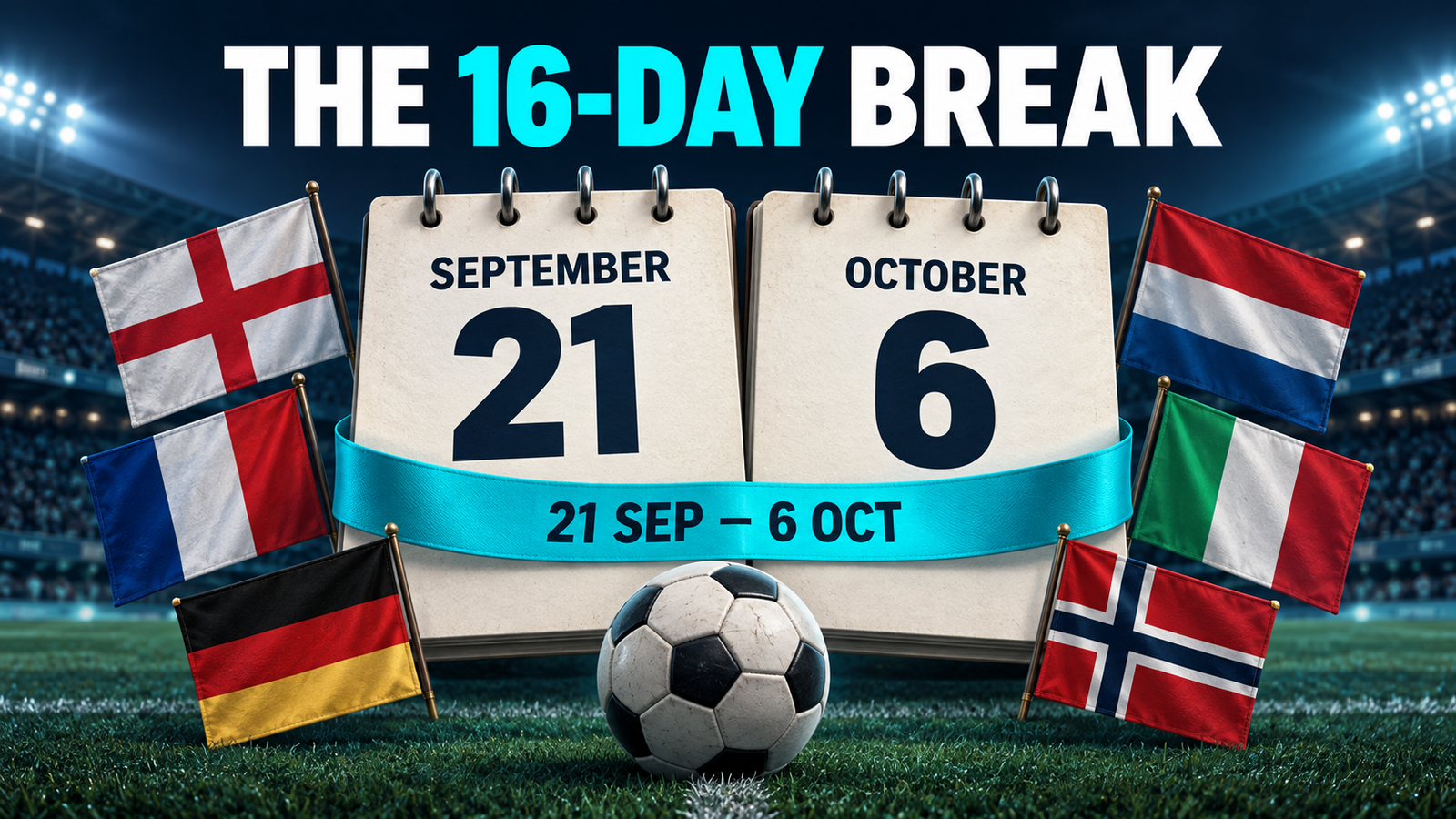
Just as the club season starts to find its rhythm, supporters will have to get used to a longer pause. The Premier League finishes its fifth round on 20 September and begins its sixth on 10 October. Two consecutive weekends will pass without a Premier League game. Premier League calendar.
That longer wait is the most visible effect of a change to men’s international football. From 2026, the September and October windows become one continuous period, allowing national teams to play up to four matches in 16 days. This year it runs from Monday 21 September to Tuesday 6 October. FIFA’s calendar announcement, 2026 international dates.
Previously, September and October each had a nine-day window with room for two matches. Put those together and the old arrangement offered four matches across 18 days, split between two gatherings. The new arrangement fits the same maximum number into 16 consecutive days. The break is longer in one stretch, while the combined allocation is actually two days shorter.
FIFA approved the change in March 2023 as part of its calendar through 2030. It is only now becoming part of the autumn routine. March, June and November retain their nine-day, two-match windows. FIFA’s decision.
The appeal for clubs is continuity: the autumn now has two international interruptions, including November, instead of three. For an international based a long way from home, combining the September and October camps can also mean one fewer round trip between club and country. Reducing those repeated journeys is part of the rationale. Premier League explanation.
The football itself is more concentrated. Four matches can now sit inside one camp, making the management of minutes and recovery a central part of the schedule. There may still be travel between venues, too. Whether players return fresher will depend on what happens during the break.
Here is the September–October calendar at a glance. The Nations League dates below follow UEFA’s published fixtures; the international window itself starts three days before the first of those games.
- 19–20 September — Final Premier League weekend before the break
- 21 September — The 16-day international window opens
- 24–26 September — Nations League: first round of group games
- 27–29 September — Nations League: second round
- 1–3 October — Nations League: third round
- 4–6 October — Nations League: fourth round; the window ends on Tuesday 6 October
- 9 October — Bundesliga, La Liga and Ligue 1 resume
- 10 October — Premier League and Serie A resume
Calendar sources: UEFA’s match schedule, Premier League, Bundesliga, La Liga, Ligue 1, Serie A.
Those dates explain why a 16-day window feels closer to a three-week break. The count ends on 6 October, but league football does not restart the following morning. There are 20 days between the Premier League’s last date before the pause and its first date afterwards.
The viewing calendar, meanwhile, has plenty in it. In Europe, the 2026/27 Nations League supplies competitive matches throughout much of the break. Most teams will play four of their six group games in this one spell, so the promotion, relegation and qualification contests will develop quickly. UEFA’s competition guide.
Five fixtures to put in the diary:
- Thursday 24 September — Netherlands vs Germany
- Saturday 26 September — England vs Spain
- Friday 2 October — France vs Italy
- Saturday 3 October — Croatia vs England
- Sunday 4 October — Portugal vs Norway
All five are on UEFA’s official fixture list. Dates are those at the match venues.
Portugal and Norway offer a neat illustration of the new rhythm: they also meet in Norway on 27 September, then play the return fixture in Portugal a week later. England’s camp includes Spain at home, Czechia away, Croatia away and Czechia at home, all before the players return to their clubs. UEFA fixtures, England’s schedule.
For UK viewers, ITV holds the rights to England’s Nations League games under its agreement through June 2028. Check local listings for individual channels and coverage times; rights to the other matches vary by territory. ITV’s rights announcement.
There is international football beyond Europe, too. The group stage of AFCON 2027 qualifying begins during this window, with two qualifying matches per team on CAF’s schedule. That distinction matters: FIFA has made space for four matches, but each country’s programme determines how much of that space it uses. CAF’s qualifying schedule.
And the pause does not cover every club competition. The Women’s Champions League has its opening two league rounds on 22–23 September and 30 September–1 October. Its calendar runs separately from the men’s international window. UEFA’s 2026 calendar.
For supporters waiting for the men’s club schedule to fill up again, the weekend of 9–12 October is the turning point. The Champions League follows on 13–14 October, with the Europa League and Conference League in action on 15 October. The return to domestic football leads straight into a European week. UEFA’s club competition dates.
The next men’s international break after this one is 9–17 November, back to the familiar nine days. Until then, October’s weekends belong to the clubs again. FIFA’s 2026 calendar.