Zidane’s France: what has changed before the Italy reunion?
Two wins offer an early glimpse of the attacking support Zidane wants. The fullbacks help explain the idea; the defensive passages show how much remains to be tested.
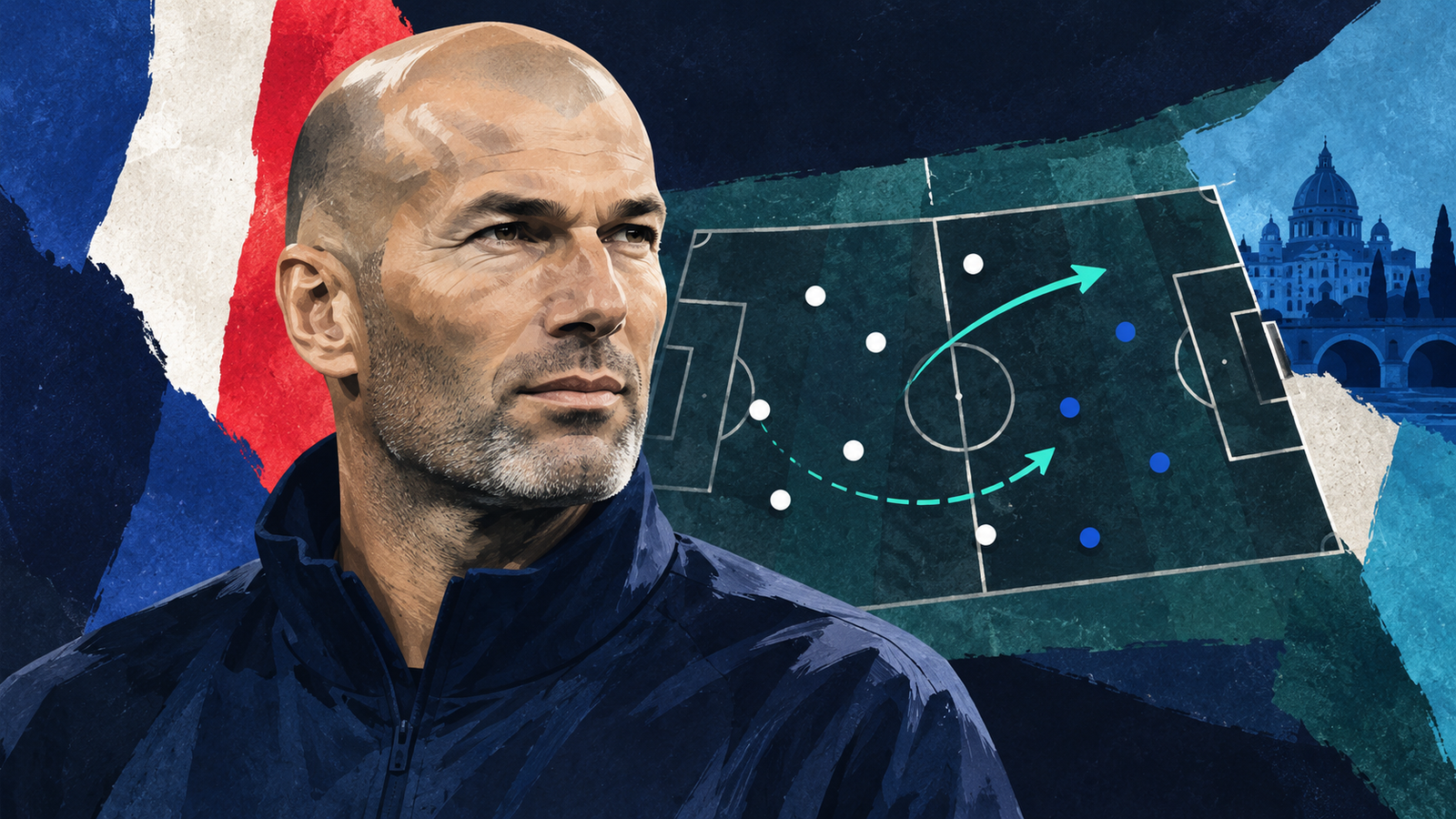
France have started Zinédine Zidane’s tenure with two away wins, both 1–0. Kylian Mbappé scored in Türkiye on 25 September; Michael Olise supplied the late winner in Belgium three days later. The scores look identical. The attacks that matter for understanding this team do not. FFF match records: Türkiye, Belgium.
Before Italy arrive at the Stade de France on Friday 2 October, the most useful place to look is the relationship between a winger and the fullback behind him. Pierre Kalulu supplying a cross and Jules Koundé receiving a pass inside the box are different ways of giving an attack another option. Neither requires us to declare a revolution after two matches.
The reunion carries its own history: Italy were the opponents in Zidane’s final appearance for France in the 2006 World Cup final. This time he meets them from the bench, with a team whose habits are only beginning to emerge. Kickoff is 20:45 in France, 21:45 in Bucharest. FFF’s pre-window account, fixture confirmation.
The clearest evidence is the brief
Zidane’s appointment was announced on 28 July, with his role formally beginning on 1 August. He succeeded Didier Deschamps on a contract running through the 2030 World Cup. That is a change we can date precisely. A change in how often France attack through their fullbacks needs a different kind of evidence. FFF appointment announcement.
Before the first match, Adrien Rabiot described a coach who wanted attacking football and fullbacks high on both sides, while preserving balance. That gives us a stated intention. It does not establish that Koundé and Adrien Truffert spend more time forward than they did under Deschamps. There were only three and a half training sessions before Türkiye. FFF reporting from Clairefontaine.
The early question is therefore practical: when a fullback goes forward, does he give the player on the ball something useful?
Two ways for a fullback to help
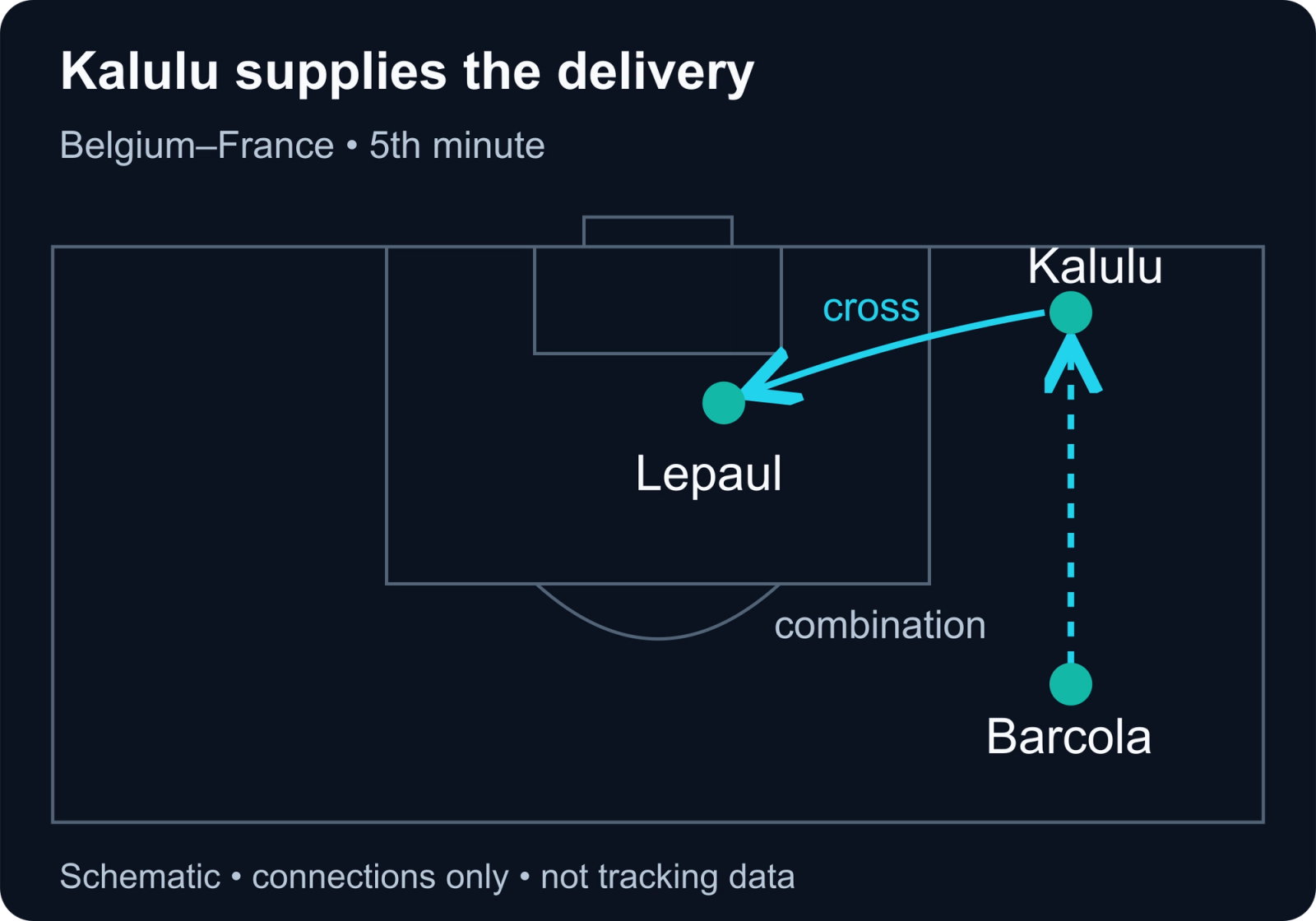
Belgium provide the first example. In the fifth minute, Kalulu combines with Bradley Barcola on the right and delivers toward Estéban Lepaul at the near post. The opening passage of the FFF highlights, around 0:16–0:22, shows the delivery from near the byline and runners arriving centrally. The official match report identifies the combination and Lepaul’s unsuccessful finish.
Here, the fullback is the supplier. The winger has help on his side of the pitch, and the forward has a ball to attack. That matters because attacking support is about creating a next action: a pass, a crossing angle, a run a defender must follow. Simply having another player stand high would achieve much less.
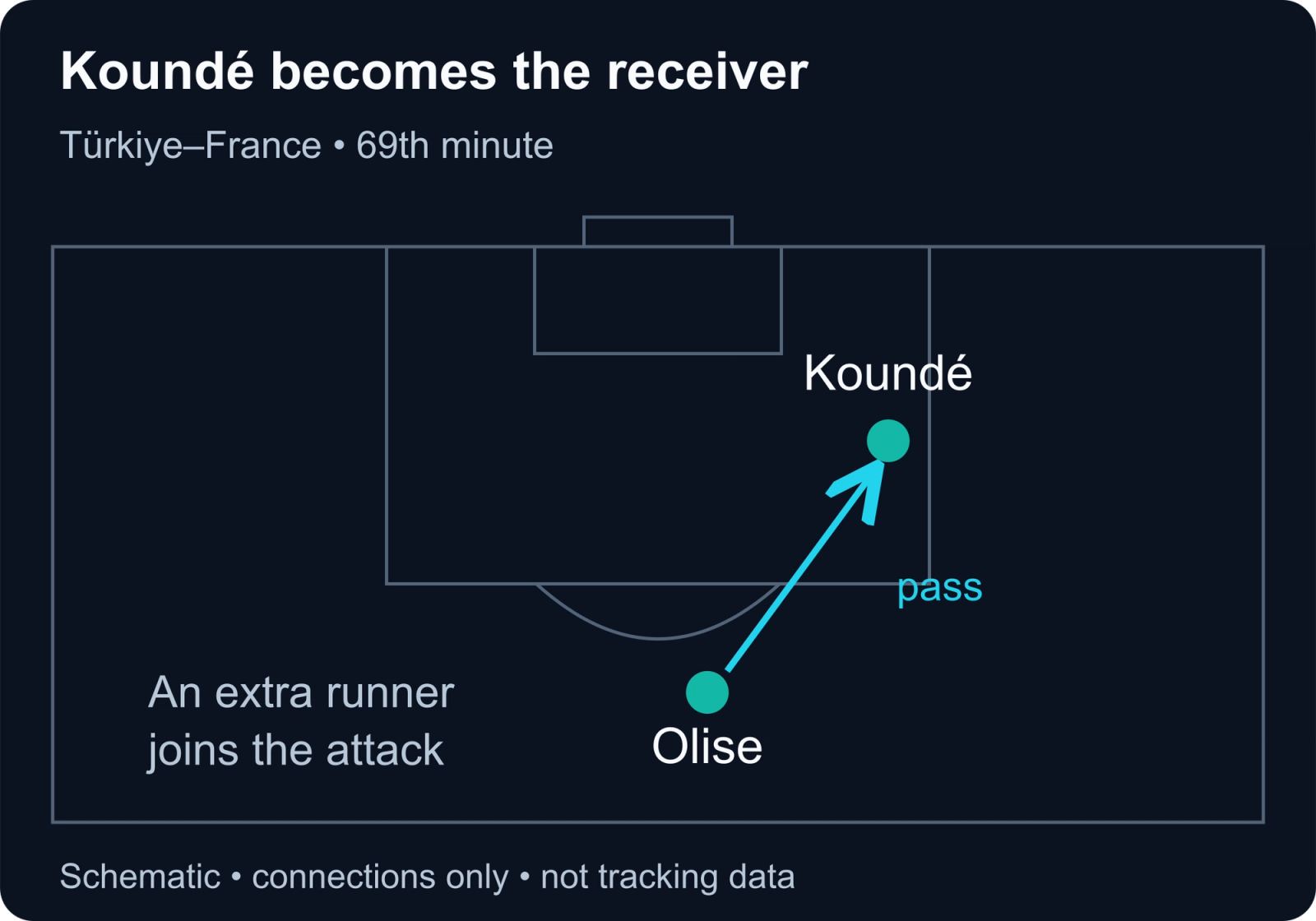
Koundé’s chance in Türkiye shows another job. The FFF edit around 5:47–5:57 shows France attacking into space. Koundé receives inside the right of Türkiye’s penalty area, with Olise behind him nearer the centre. The Turkish federation’s report identifies the 69th-minute pass from Olise and Koundé’s shot across goal, narrowly wide.
This time the fullback becomes the receiver. His run gives Olise an option beyond the ball, rather than leaving the winger to carry the attack alone. The quick attack gives the fullback room to arrive beyond the ball; the edit does not establish where his run began. Calling it France’s permanent possession shape would miss what makes the passage useful.
These examples fit the attacking brief. They do not show that both fullbacks always advance together, or that either has a fixed instruction to move into midfield. These selected passages do not keep the far-side fullback continuously in view. What we can see is the right-back contributing in two distinct ways.
Pressure needs support too
The same idea applies without the ball. An attacker chasing a goalkeeper is only the start of a press. Teammates need to be close enough to challenge the next pass or collect the loose ball.
The Türkiye goal passage, around 4:02–4:20 in the FFF highlights, begins with pressure around Çakır’s short buildup. As the ball becomes contested, France have several players near the receiving area outside the box. Olise then finds Mbappé, who scores in the 54th minute. The FFF report also traces the goal to the pressure before Olise’s pass.
That is a concrete example of support turning a chase into an attacking opportunity. It cannot tell us how consistently France reproduced the press across the whole match. Nor does the camera show every defender behind it.
Belgium adds another complication to any claim of rapid improvement: Zidane changed nine starters. Only Mike Maignan and Maxence Lacroix remained from the Türkiye XI; Kalulu and Andy Diouf replaced Koundé and Truffert at fullback. Jérémy Jacquet, Diouf and Lucas Da Cunha made their debuts. This was a different group learning the brief, rather than the same eleven providing a clean before-and-after test. FFF selection record.
The decisive Belgian goal also came after changes. Olise and Rayan Cherki entered in the 77th minute; Cherki supplied Olise before his solo run and finish in the 88th. Fresh personnel and individual execution belong in the explanation alongside the coach’s ideas. FFF report.
The defensive balance is still a question
Two clean sheets are a good start. They are not evidence that France have already solved the cost of sending players forward.
A Belgian break, around 5:43–5:50 in the FFF edit, makes the work visible. Belgium advance with the ball while France’s deepest players retreat and teammates recover behind them. Moments later, Maignan is down near his goal and France still have another ball to defend inside the box.
The edit does not show the origin of that break. It would be unfair to label it a fullback’s mistake or claim that Zidane’s attacking instructions caused it. It does show why the defensive half of the fullback role matters: getting back into position is part of the task, and the team must keep defending after the first intervention.
For a fullback who joins an attack, the danger begins if the opposition escape the nearest pressure. Someone must delay the counter, someone must protect the route toward goal, and the advancing player must recover. The players behind an attack are as important to its sustainability as the runner in front of the ball.
Türkiye also forced Maignan into important saves. UEFA’s account describes a win that remained uncomfortable before Çakır’s late dismissal. The opening results should encourage France without concealing those demands. UEFA’s first-round report.
What to watch against Italy
Italy lost 2–0 to Belgium before winning 4–1 in Türkiye. Those results give the fixture context; they do not tell us which French fullback movement will work on Friday. UEFA fixture and results list.
Four details will be more revealing than the formation shown before kickoff:
- The run’s purpose. Does the fullback supply a delivery, receive beyond the winger, or arrive where a teammate already has the space covered?
- The next player in the press. When an attacker closes the ball, is someone ready to challenge the next pass?
- The protection behind the attack. If one fullback advances, who can slow an Italian break before it reaches the centre-backs?
- The recovery after the first stop. Can France regain their positions and defend the next ball, rather than rely on Maignan to end the danger?
Mbappé’s knee injury in Türkiye took him out of the rest of the camp, adding another reason not to assume that the first two matches establish a settled attacking unit. FFF injury account, selection record confirming his withdrawal.
Zidane has given France an attacking direction. Kalulu’s delivery and Koundé’s run show what support can look like when it produces a useful next action. Against Italy, the evidence to look for is whether France can repeat those connections while keeping enough help behind them.
Method: this analysis uses official match records and reports, plus selected passages of official FFF highlights. It does not claim full-match tactical-camera coverage or a measured comparison with Deschamps’s France. Video links start at the cited elapsed time; match minutes are identified separately where verified.