Follow the 2026-27 season on Oddsivio: set up your whole season in ten minutes
The 2026-27 season arrives in waves from this weekend. Eight stops around Oddsivio — goal alerts, match pages, highlights, forecasts with a public record, transfer receipts and player values — and a ten-minute setup that pays off for nine months.
The 2026-27 season arrives in waves. La Liga opens this weekend, the Premier League follows on Friday 21 August — champions Arsenal against promoted Coventry, first up — Serie A and Ligue 1 land on the 22nd, and the Bundesliga completes the set on the 28th. A World Cup summer pushed kick-off later than usual, England's second tier is already running, and by the end of the month every big league in Europe will be in motion.
Which makes this the one week of the year when ten minutes of setup pays off for nine straight months. This guide is the tour: eight stops around Oddsivio, what each one does for your season, and the one action worth taking at each. Everything on it is free — no app to download, nothing to subscribe to.
First, the whole setup in four steps, for people who'd rather skip the tour:
- Create a free account and verify your email.
- Star your teams — open a team page, tap the star in the header.
- Turn on alerts — menu, Alert sounds, and Allow when your phone asks.
- Bookmark your league's hub page and today's matches.
That's the season set up. The rest of this guide is why each of those steps is worth it — and what else is here once the football starts.
Stop 1 — Star your teams, and the season comes to you
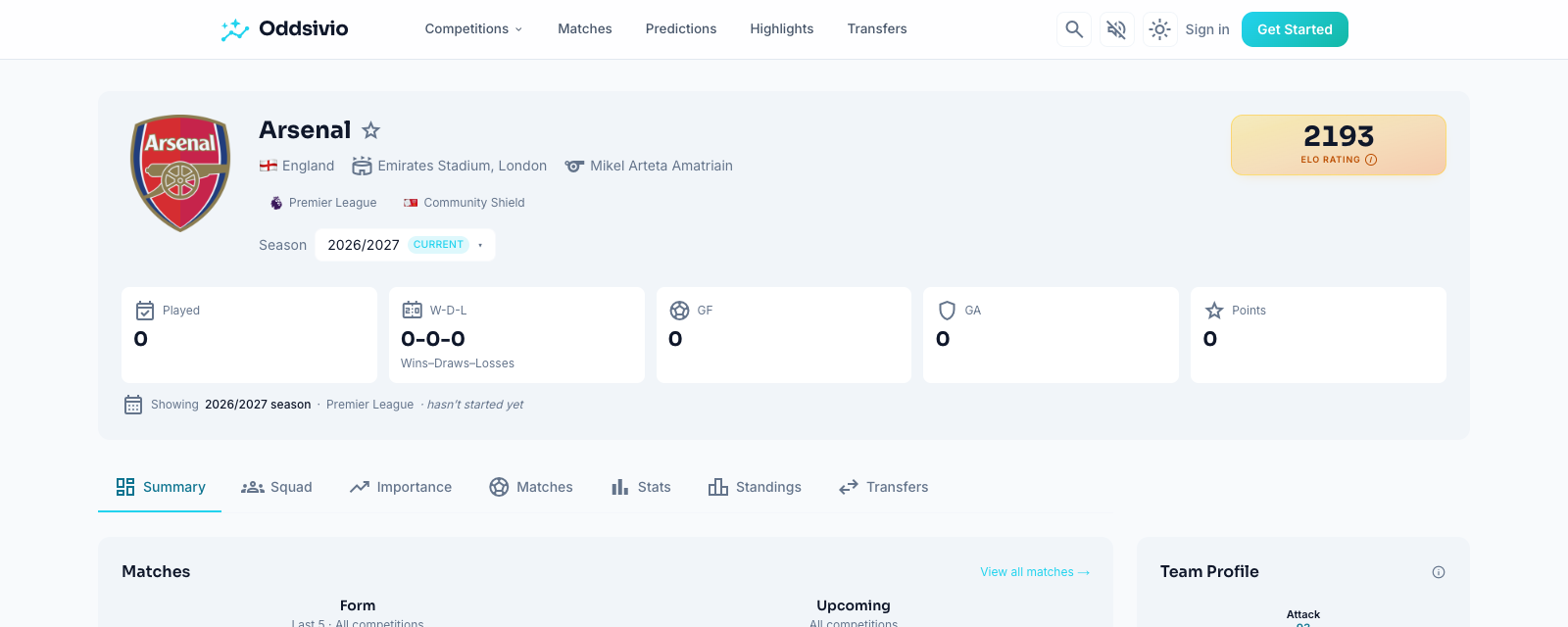
Everything personal on Oddsivio hangs off one gesture: the star. Star a team and every surface on the site quietly rearranges itself around your football — your matches float up the fixture lists, your teams get their own filter on the predictions page, and, most usefully, your phone learns to speak up when something actually happens.
Alerts are the part to set up before the weekend: a notification the moment one of your teams scores, plus kick-off, full-time, disallowed goals — and a ping when the goal clip is ready to watch, so the alert is never a dead end. They fire only for teams and matches you've starred. Browse whatever you like; Oddsivio never turns browsing into noise.
We've published a step-by-step alerts guide with every tap for iPhone and Android — including the one iPhone rule most people miss (notifications only work once the site lives on your Home Screen; a Safari tab can't ring your lock screen) and a troubleshooting list for everything that genuinely goes wrong. Ten minutes, once, and it works all season.
Stop 2 — Match pages: where your season actually lives
Every fixture across 50+ competitions has a match page: kick-off time in your timezone, live score, lineups, stats and the events timeline, with goal clips pinned to the match as they land.
The part that makes Oddsivio different sits above all that. Before a competitive match kicks off, we publish a plain-English read on it — who's likely to win, how the goals might come, and the evidence for and against, in sentences rather than a wall of stats. That read is written before the match, freezes the moment it kicks off, and is checked against the final score afterwards. It is a preview with consequences, not a report written in hindsight.
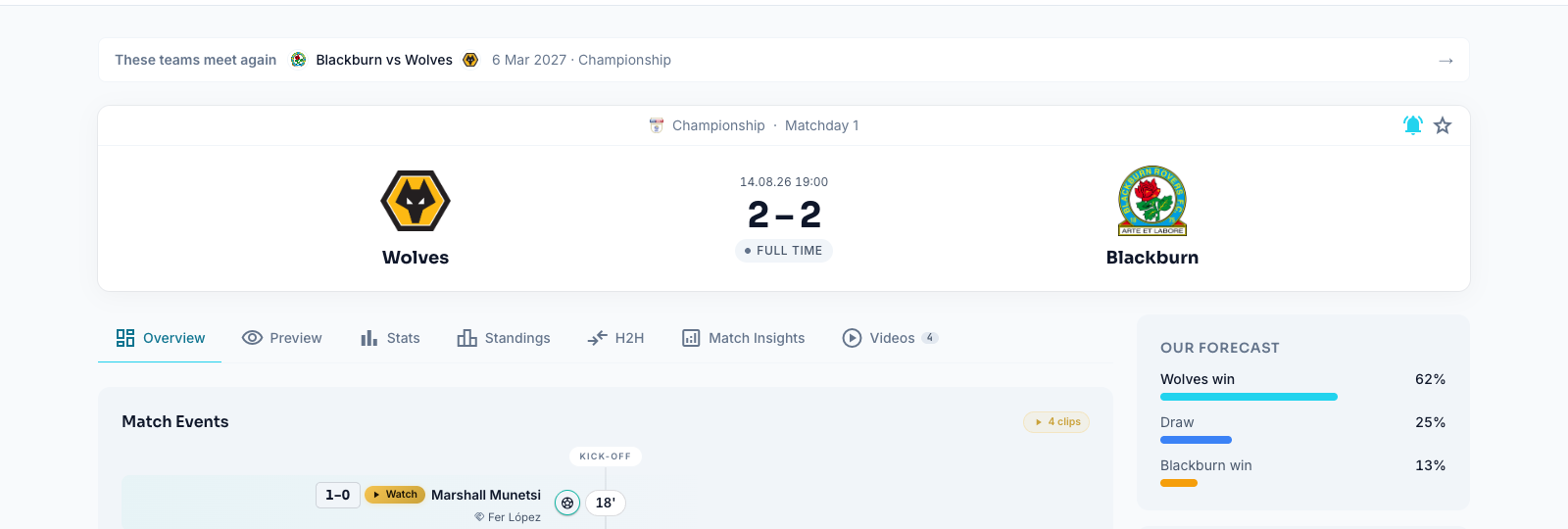
Start at today's matches — the date strip walks to any day, and every fixture links through to its page. If you want to squeeze the most out of a match page, the Match Insights walkthrough reads one slowly, panel by panel.
Stop 3 — Highlights: every goal worth watching, one place
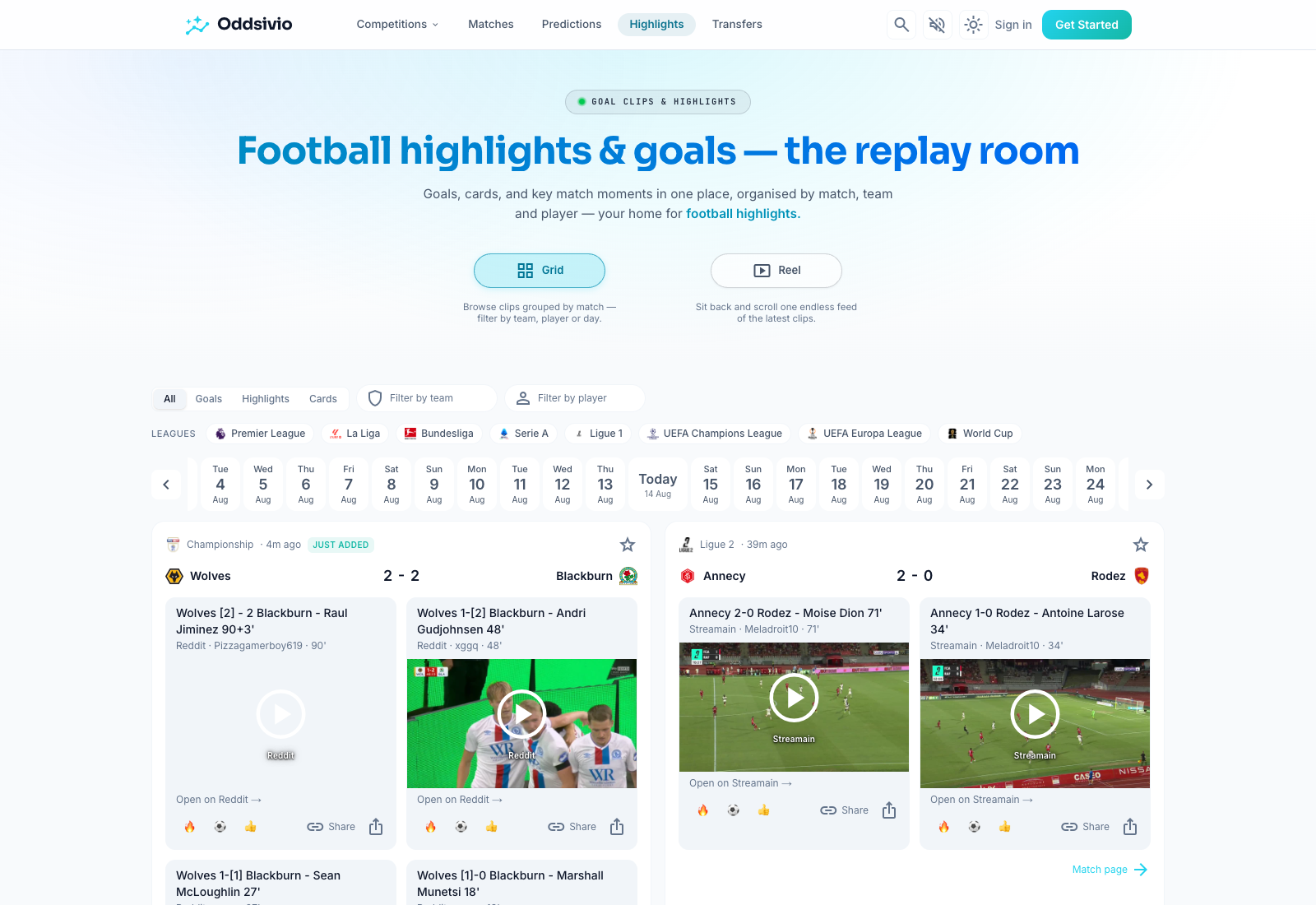
The highlights page is the replay room: goal clips and match highlights across the top leagues and cups, organised by match, team and player. Two ways to use it — a grid you can filter to your club, or a reel that just scrolls the newest clips while you drink your coffee.
Official sources come first: broadcaster, league and club clips wherever they exist, usually within minutes of the goal for covered competitions. And because every clip is anchored to its match page, the score, stats and pre-match read are always one tap from the video — no digging through social media for a link that works.
Stop 4 — Bookmark your league
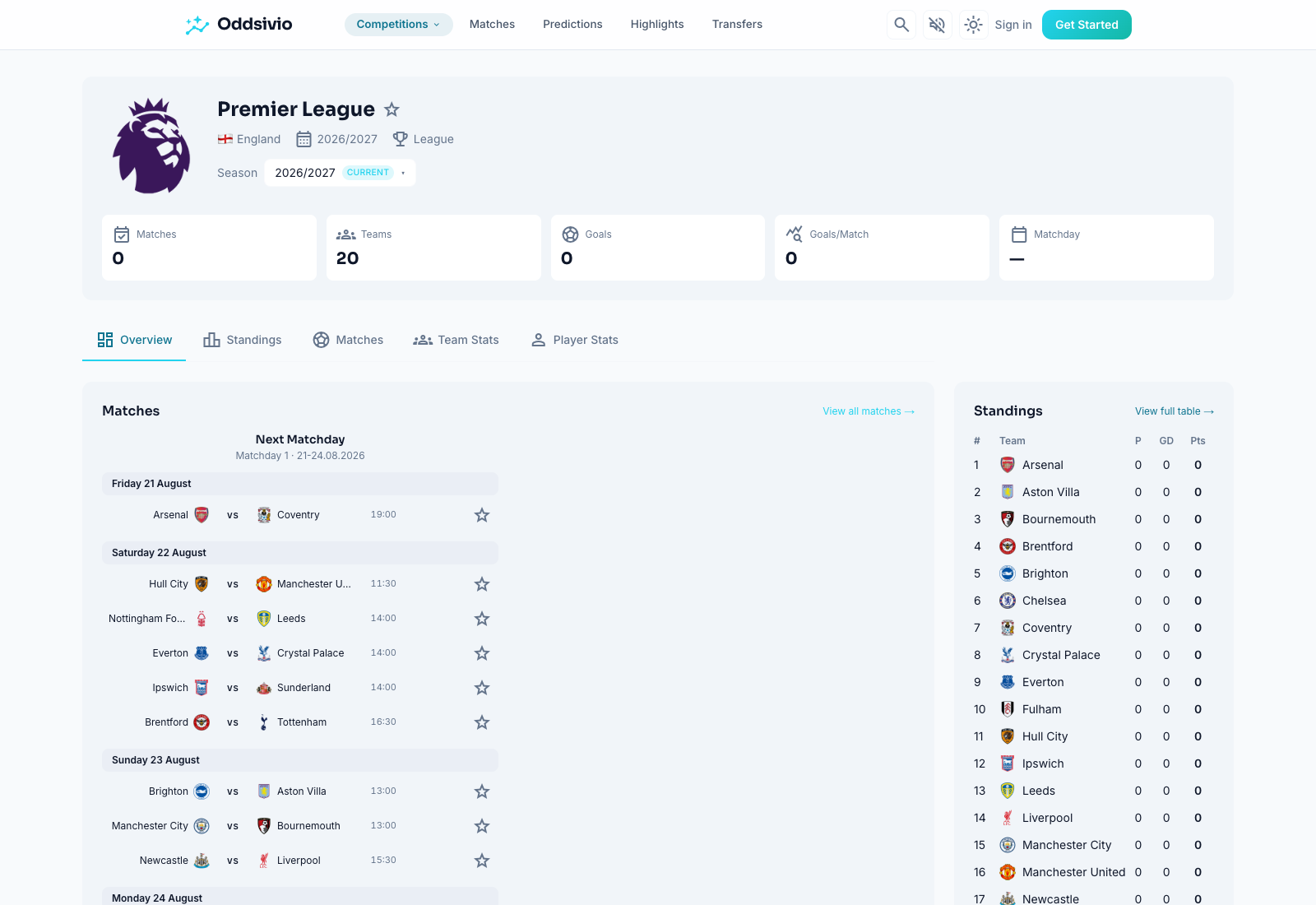
Every competition has a hub — table, fixtures, results, team and player stats, one page per league. Pick yours from the competitions index and bookmark it; on a phone it's the closest thing to a season-long home screen.
The big five, ready for opening day: the Premier League (starts 21 August), La Liga (16 August), Serie A (22 August), Ligue 1 (22 August) and the Bundesliga (28 August) — with the Champions League joining in September.
Stop 5 — Predictions with a public report card
The predictions page carries a forecast for every covered match: the chance of a home win, draw and away win, the most likely result, and the key factors behind it — including the evidence against. Two things make it worth trusting more than the usual preview column.
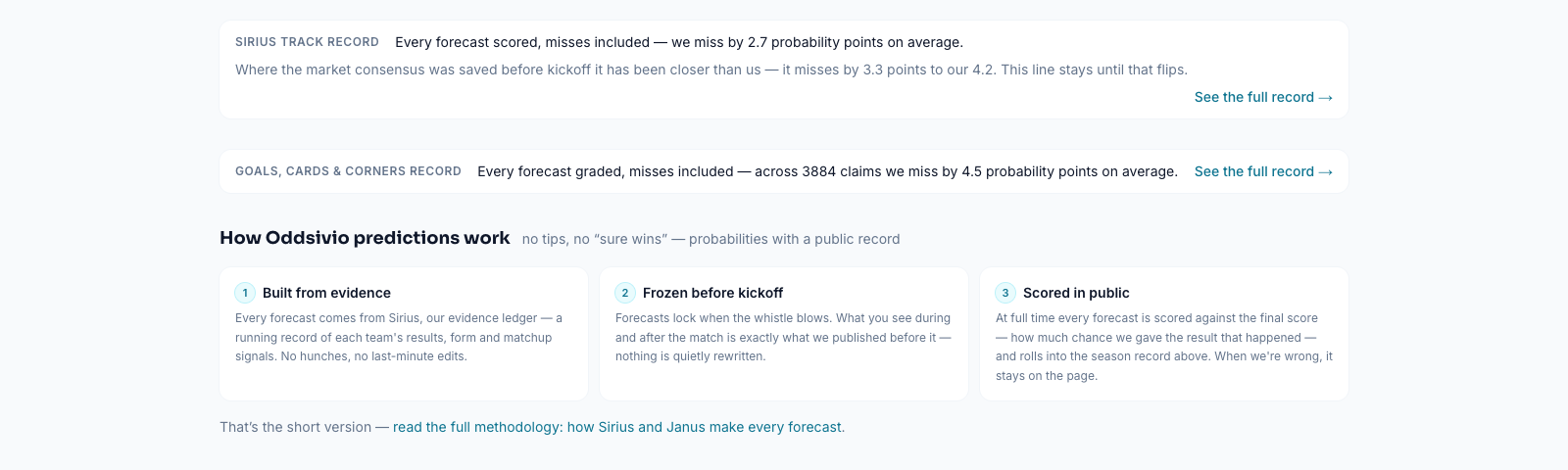
First, the honesty rules. Every forecast is built from measured evidence, frozen at kick-off, and scored in public against the final score — misses included. When the evidence is too thin, the model publishes no forecast rather than dressing up a guess, and the sit-outs stay on the record too.
Second, the record itself is on the page. Not a highlight reel — the complete ledger, updated as matches finish, with an honest comparison against the market consensus that says so whenever the market reads a match better than we do. You can judge our record before you trust our read on this weekend.
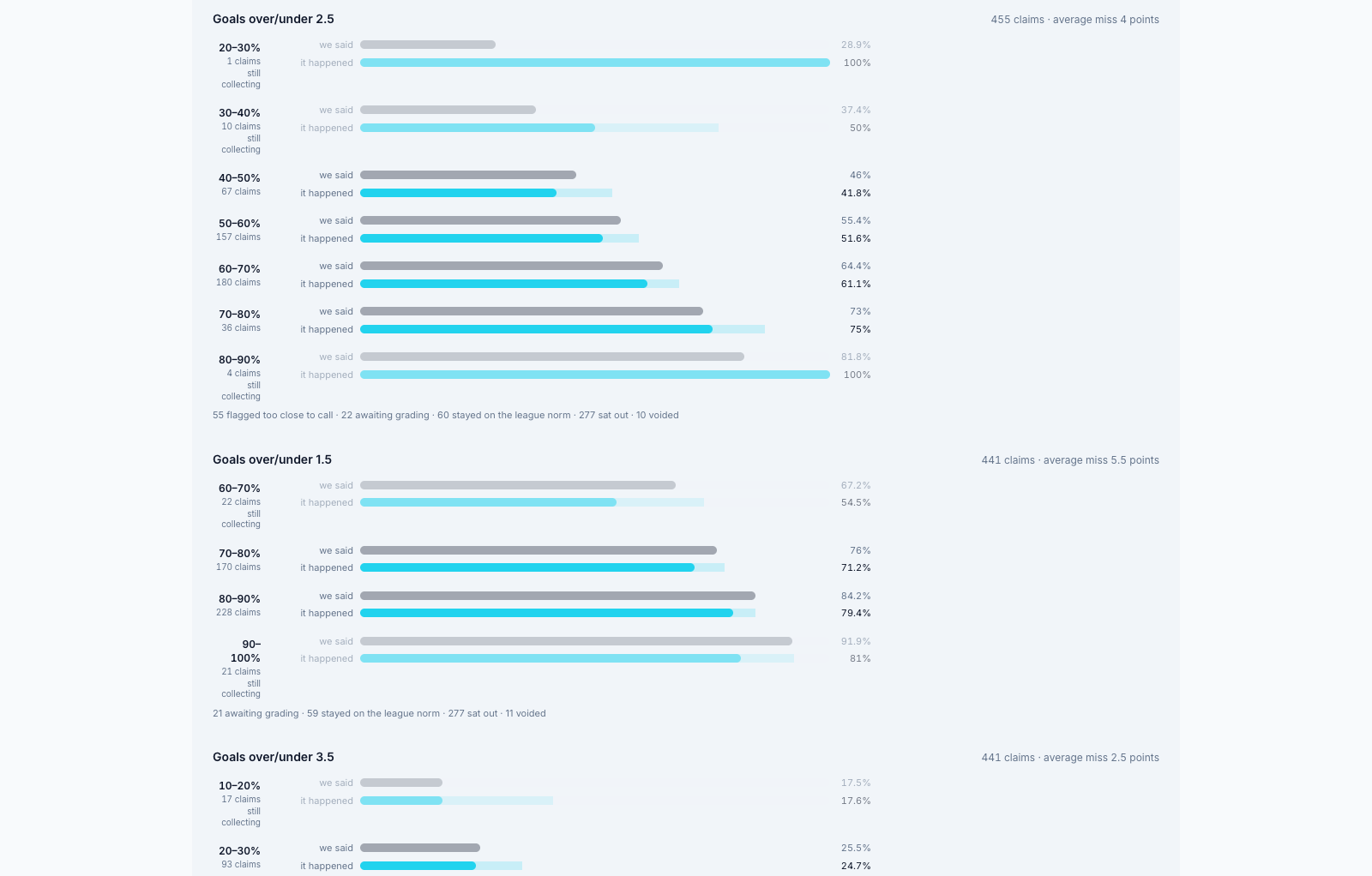
Alongside the match forecasts, a second engine covers what happens inside the game — goals, cards and corners, nine kinds of call per match — and grades itself the same way on its own record page: every claim next to what actually happened, band by band, since July 2026.
To be clear about what this is not: nothing here tells you what to do with your money, and you'll find no sure things and no promises of profit. These are probabilities with a public report card, published because a forecast you can grade is the only kind worth reading. The methodology page explains how both engines work and the five rules every forecast follows, and the prediction terms glossary defines every word of it with live examples.
Stop 6 — Transfers with receipts
The Transfer Centre follows the window the way the window actually behaves: every marquee rumour clustered from the reports behind it, with the source strength, deal stage and quoted fees — then tracked to an outcome. Done, off, or quietly gone; nothing is deleted when a rumour dies. Pick your club and see its whole window on one page — who's linked, who might leave, what's already signed.
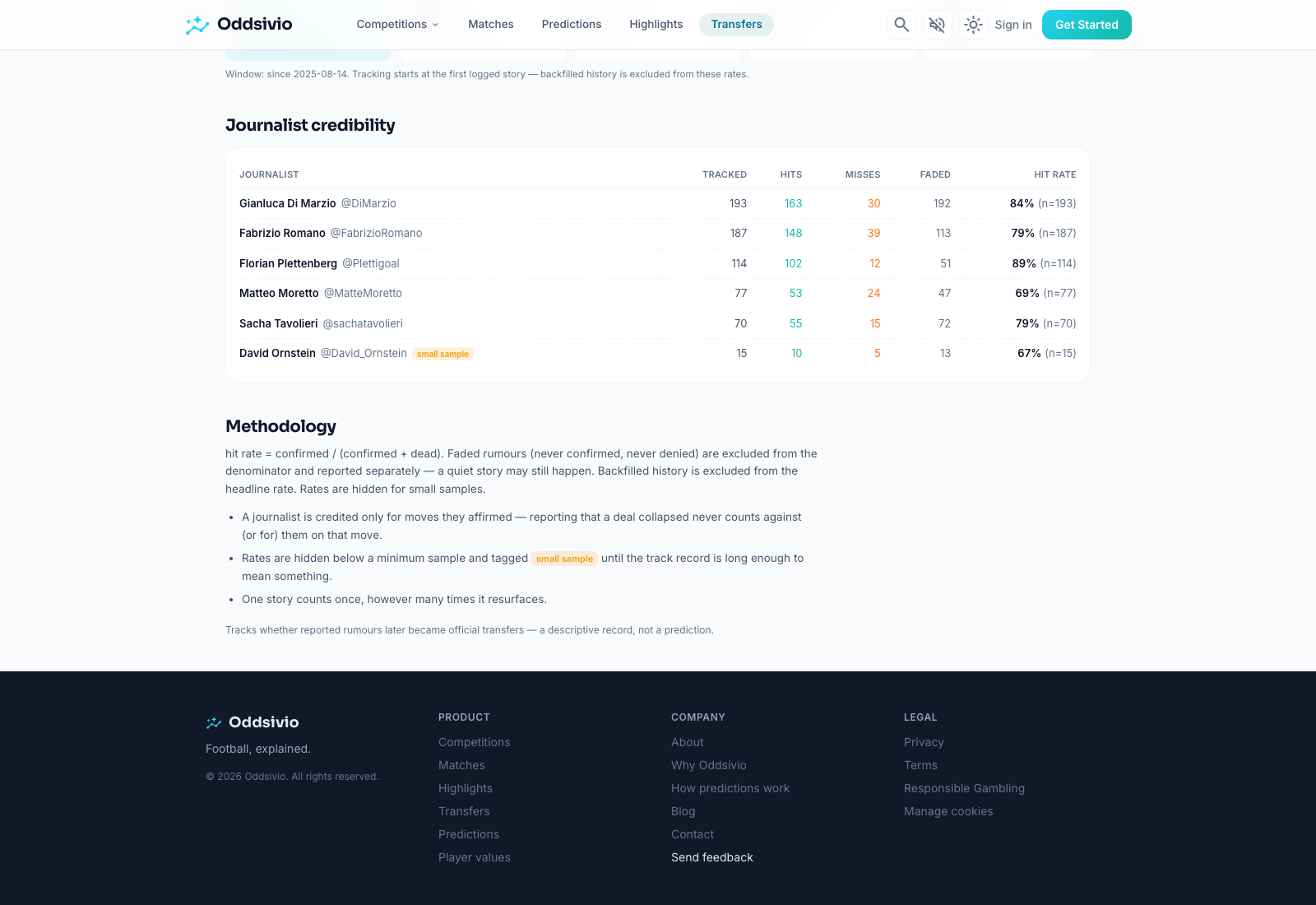
The accountability lives on the journalist accuracy tracker. Every tracked reporter carries a public hit rate — how often their stories became real transfers — with the misses counted and small samples flagged as exactly that. So when the next "here we go" lands mid-season, you'll know whose word counts before you get your hopes up.
Stop 7 — Players, valued and compared
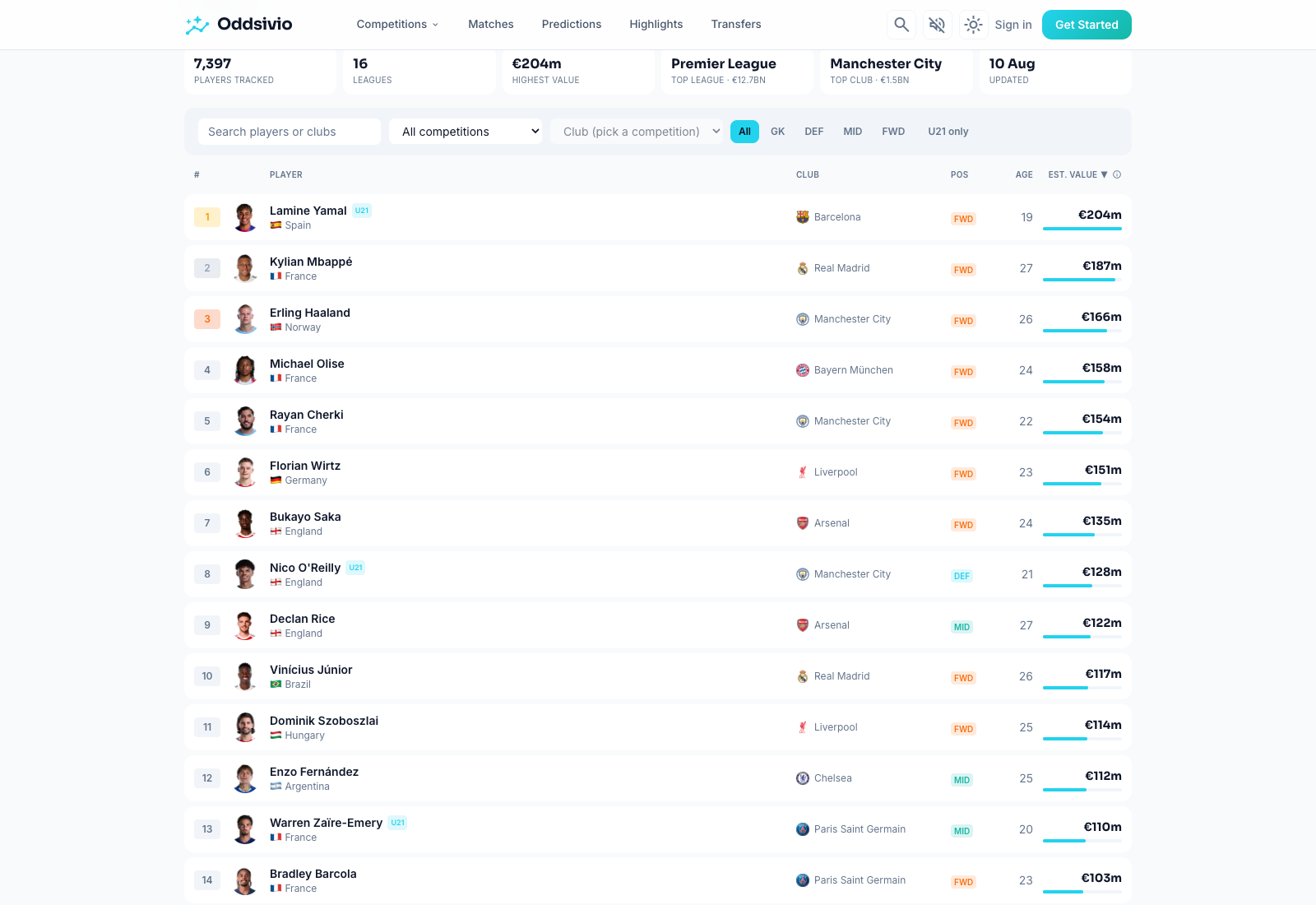
Every player has a page — stats, form, career, transfer history — and more than seven thousand of them carry an Oddsivio estimated value: a statistical estimate of what the player would be worth on the transfer market, recomputed weekly from around 90 performance signals. It is not a market price, and the site says so everywhere the number appears; how the value model works is public, including the numbers we refuse to publish.
Player values is the wide view: the full rankings, searchable by player or club, filterable by league, position and U21 only. When your club signs someone in the last week of the window, this is where you check what the model thinks in thirty seconds. The player page guide explains every number on the individual pages — percentiles, per-90 rates, the importance gauge.
For opening-day reading, we've ranked the top ten most valuable U21 players in each big league: the Premier League, La Liga, Serie A, the Bundesliga and Ligue 1 — the names you'll want to have known first.
Stop 8 — When you want the deep end
Everything above works without reading another word. But if you like knowing how the machine is built, the complete guide to Oddsivio tours every corner of the site in one long read, and the blog keeps field notes on the season as it goes — how the engines work, what the transfer window's data actually said, and guides like this one.
Kick off
The checklist again, now that you know what each step unlocks:
- A free account, email verified.
- Stars on your teams.
- Alerts on — send yourself the test notification to prove it.
- Your league hub bookmarked.
Do it before your league's first kick-off. Then put the phone back in your pocket — for the next nine months, when something happens to your team, you'll know within the minute, with the clip, the numbers and the why waiting one tap behind it.
Football, explained — from the first kick of 2026-27 to the last.