Summer signings 2026: seven arrivals already making a difference
Gutiérrez’s service, Frattesi’s runs and Aubameyang’s goals: seven new arrivals whose early contributions explain more than their transfer fees.

Miguel Gutiérrez supplied Leverkusen’s first goal against Leipzig from the left. After half-time, he scored the second himself. One afternoon offered a useful answer to a question every supporter asks after the transfer window: what has the new player actually added?
Across Europe’s five major leagues, Gutiérrez, Davide Frattesi, Lassine Sinayoko, Pierre-Emerick Aubameyang, Morgan Rogers, Jérémy Jacquet and Konstantinos Tzolakis have supplied seven persuasive early answers. Their contributions range from midfield goals to a goalkeeper helping a promoted side settle into the Premier League.
This is a selection of different kinds of impact, with no overall ranking. We use league matches through 20 September 2026 in the Premier League, LaLiga, Serie A, Bundesliga and Ligue 1, and require at least 270 league minutes for their new club for the main selections. Cups, European matches and internationals are excluded. Some teams have played four league games; others seven. The evidence is enough to identify promising changes, but much too early to settle who represents the best long-term business.
Miguel Gutiérrez, Leverkusen: a new source of goals from the left
From Napoli, August 2026. Bundesliga: 4 appearances, 4 starts, 353 minutes; 1 goal and 3 assists.
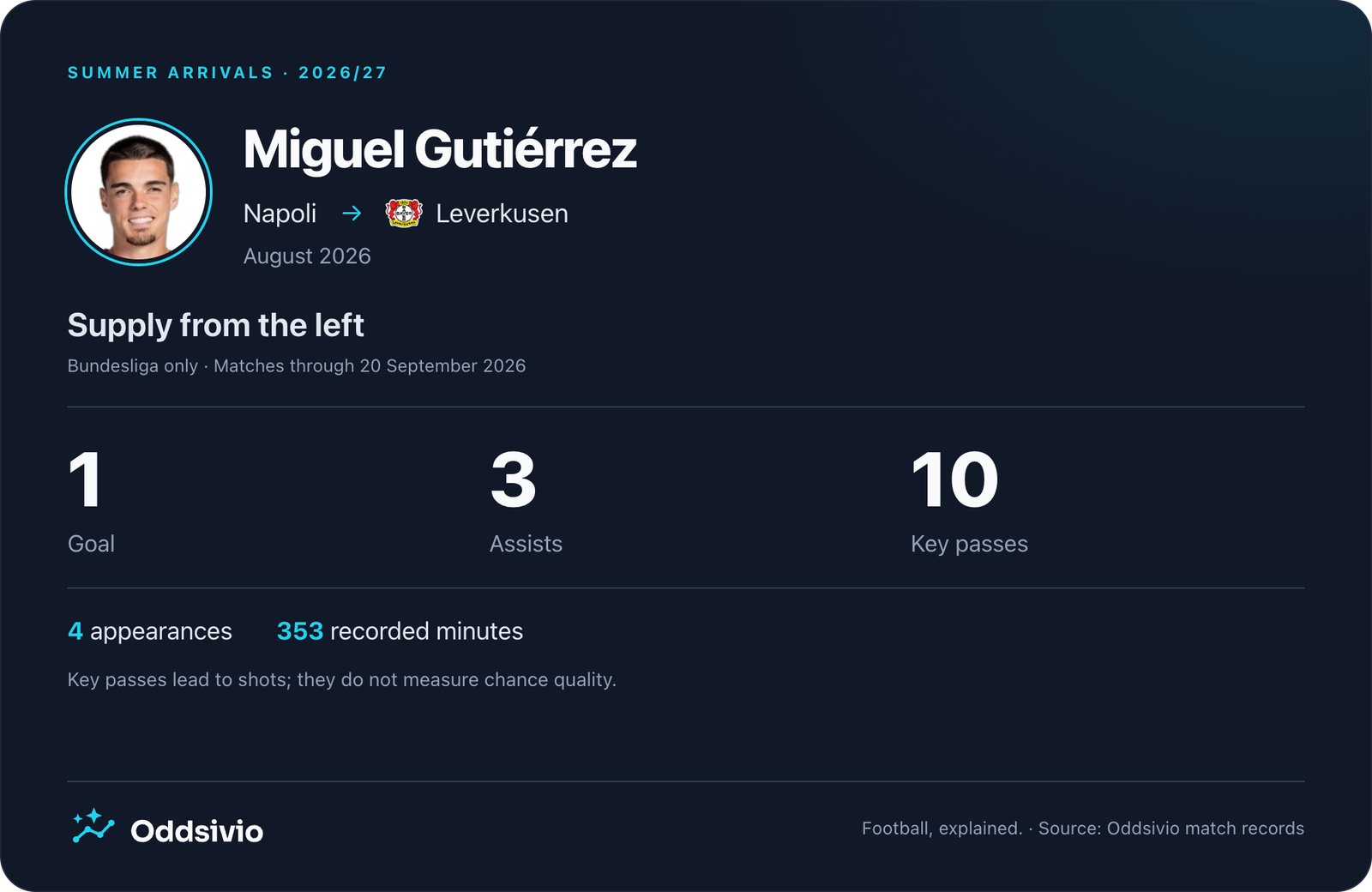
Replacing an attacking left-back creates a problem beyond filling a space on the team sheet. Someone still has to provide the service that used to come from that side. Leverkusen’s summer business included Alejandro Grimaldo’s departure and Gutiérrez’s arrival from Napoli.
The Spaniard has quickly given them a productive option. He supplied two goals in the 4–0 win over Union Berlin, then contributed directly to both goals in the 2–0 win over Leipzig. The club’s account describes his cross for Patrik Schick’s opener and his own finish after the interval.
His match record contains ten recorded key passes across four games. That matters because the supply extends beyond the three chances that became assists. He is giving Leverkusen another route to a shot, as well as arriving to finish himself.
The next test is balance. Four direct goal involvements establish an attacking contribution; they cannot establish how well Leverkusen defend the space around him or whether he has fully replaced Grimaldo. For now, the encouraging part is how quickly a summer vacancy has become a source of attacking variety.
Davide Frattesi, Lazio: midfield goals that changed tight games
On loan from Inter, August 2026. Serie A: 5 appearances, 4 starts, 386 minutes; 3 goals, all non-penalty.
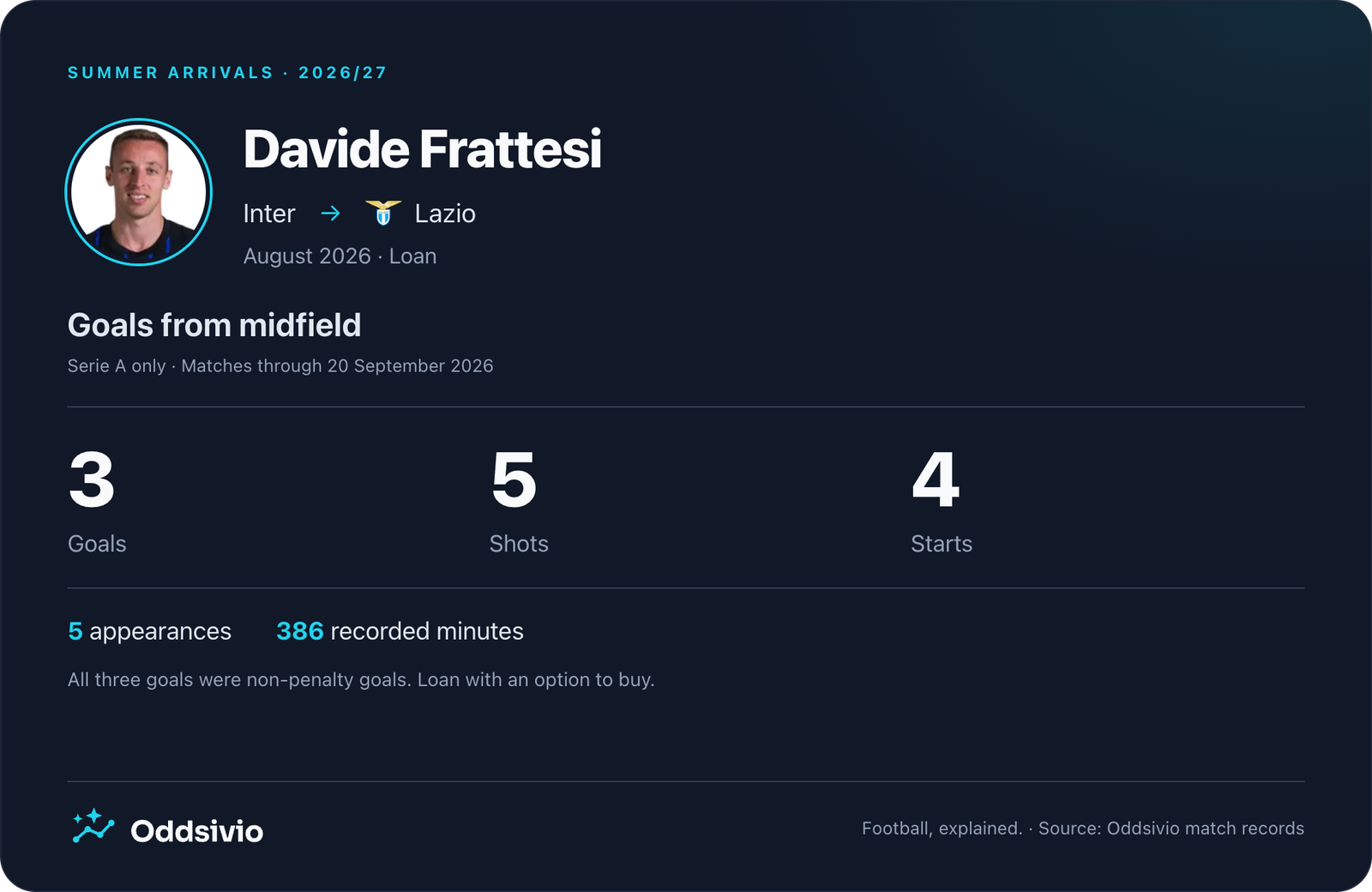
Frattesi scored the only goal against Bologna. He did it again against Genoa. At Udinese, his equaliser helped turn a losing position into a 2–1 victory. Those are concrete interventions in close matches, rather than a total padded by the final goals of comfortable wins.
Inter confirmed his loan to Lazio, with an option to buy, on 14 August. Before the season, Serie A’s guide highlighted the attacking threat of his runs from midfield. The opening games have shown why that quality matters: a player arriving from deeper can give defenders another runner to track beyond the forwards.
Lazio reached the break with 13 points from five games, and Frattesi scored three of their eight goals. It would be misleading to subtract those goals and award him a personal points total; matches would unfold differently without him. Their timing still makes his contribution easy to understand.
There is a reason to keep the praise measured. His saved league figures show three goals from five recorded shots. That is an exceptionally productive start to a small shooting sample. After the break, watch whether he keeps reaching scoring positions even when the finishes become less obliging.
Lassine Sinayoko, Paris FC: a focal point with more than one job
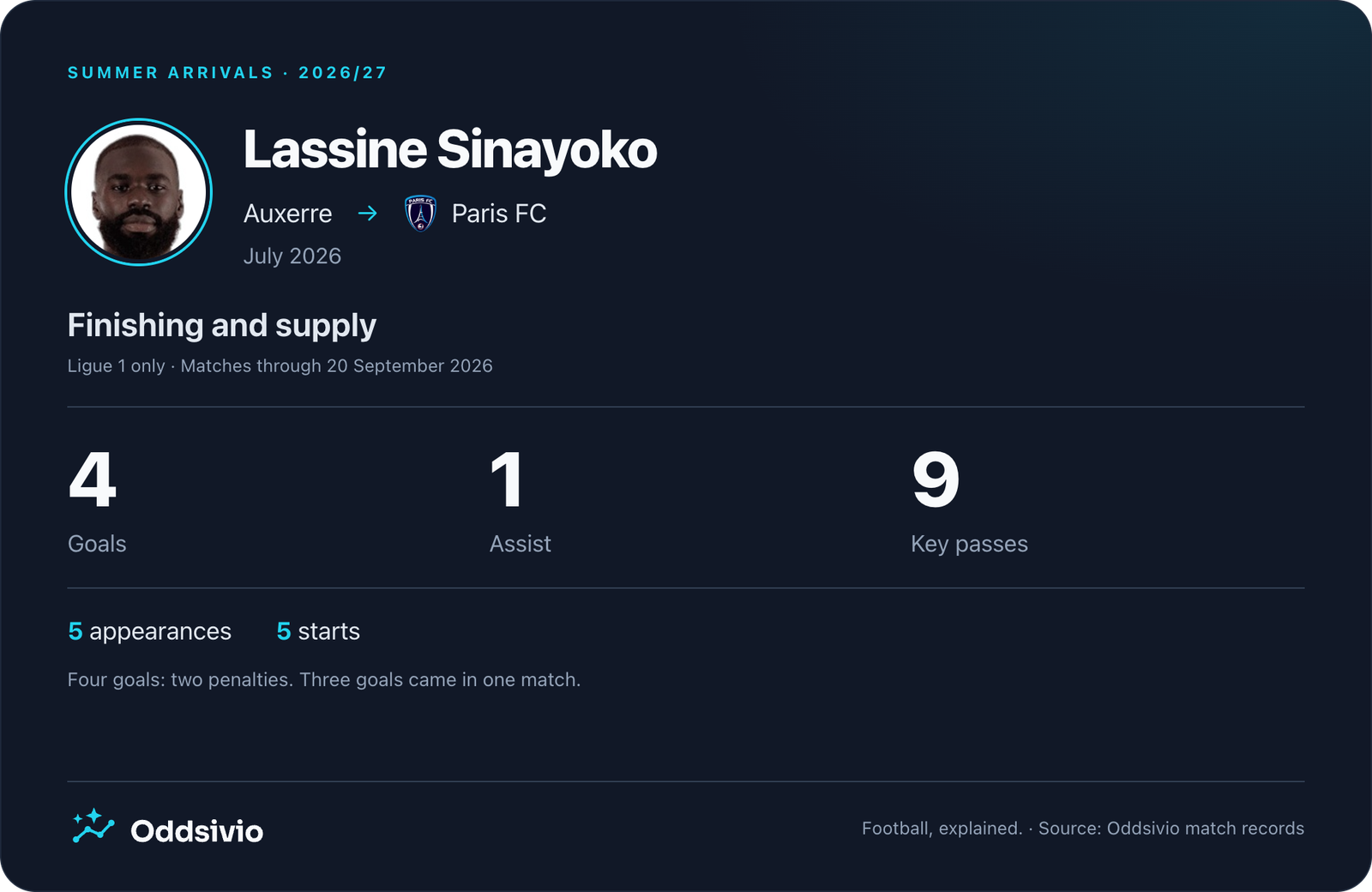
From Auxerre, July 2026. Ligue 1: 5 appearances, 5 starts; 4 goals, including 2 penalties, and 1 assist.
Paris FC did not have to imagine whether Sinayoko could contribute in Ligue 1. Their announcement of his arrival recorded 12 goals and four assists for Auxerre in the 2025/26 season. They were adding an attacker with recent experience of the competition.
His clearest early intervention was the hat-trick in the 3–2 win at Marseille. But the composition of his total is important: three of his four goals came that night, and two of the four were penalties. This is an influential start, not yet evidence of a goal arriving reliably every week.
There is more to follow in his player record. Nine recorded key passes and an assist against Strasbourg show him supplying team-mates as well as taking the final shot. Paris FC reached the break unbeaten, with 11 points and eight goals from five games. Sinayoko scored half of those goals.
The useful next question is whether that involvement survives quieter finishing days. A striker who keeps providing an outlet and creating shots can remain valuable between scoring bursts. Five starts already suggest he has become a regular part of Paris FC’s attack.
Pierre-Emerick Aubameyang, Deportivo: experience turning into immediate output
From Marseille, July 2026. LaLiga: 7 appearances, 6 starts, 560 minutes; 5 goals, all non-penalty, and 2 assists.
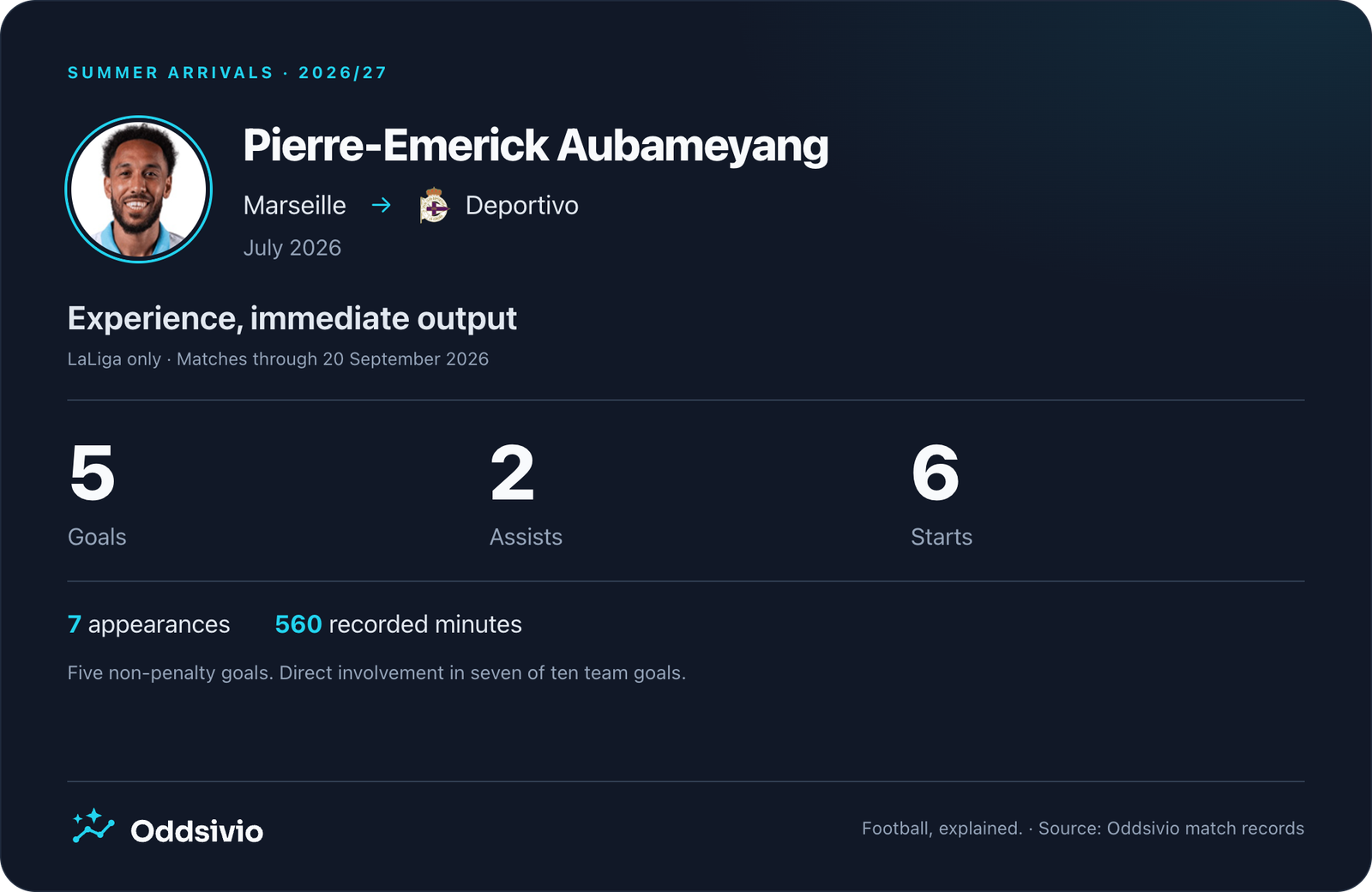
Deportivo’s return to the top division has included a familiar forward making a very immediate contribution. Aubameyang arrived from Marseille in July, aged 37, and scored in each of his first five league appearances for the club.
The standout example was the 3–2 win at Villarreal. His two assists helped Deportivo stay in the game before he scored the late winner. The club’s match report follows that progression from supplier to scorer.
Across seven games, his five goals and two assists account for direct involvement in seven of Deportivo’s ten goals. None of his goals came from the penalty spot. The size of that share explains his importance to the opening spell more clearly than his reputation does.
There is already a more immediate test for Deportivo. In a 23 September medical update, the club said Aubameyang was scheduled for right-knee surgery on 24 September after discomfort suffered against Betis, with his return to group training dependent on his recovery. That announcement did not give a fixed return date. His opening contribution remains significant, but sharing the attacking work is now an immediate question.
Morgan Rogers, Chelsea: an individual success inside an unsettled team
From Aston Villa, July 2026. Premier League: 5 appearances, 5 starts, 439 minutes; 3 goals, all non-penalty, and 1 assist.
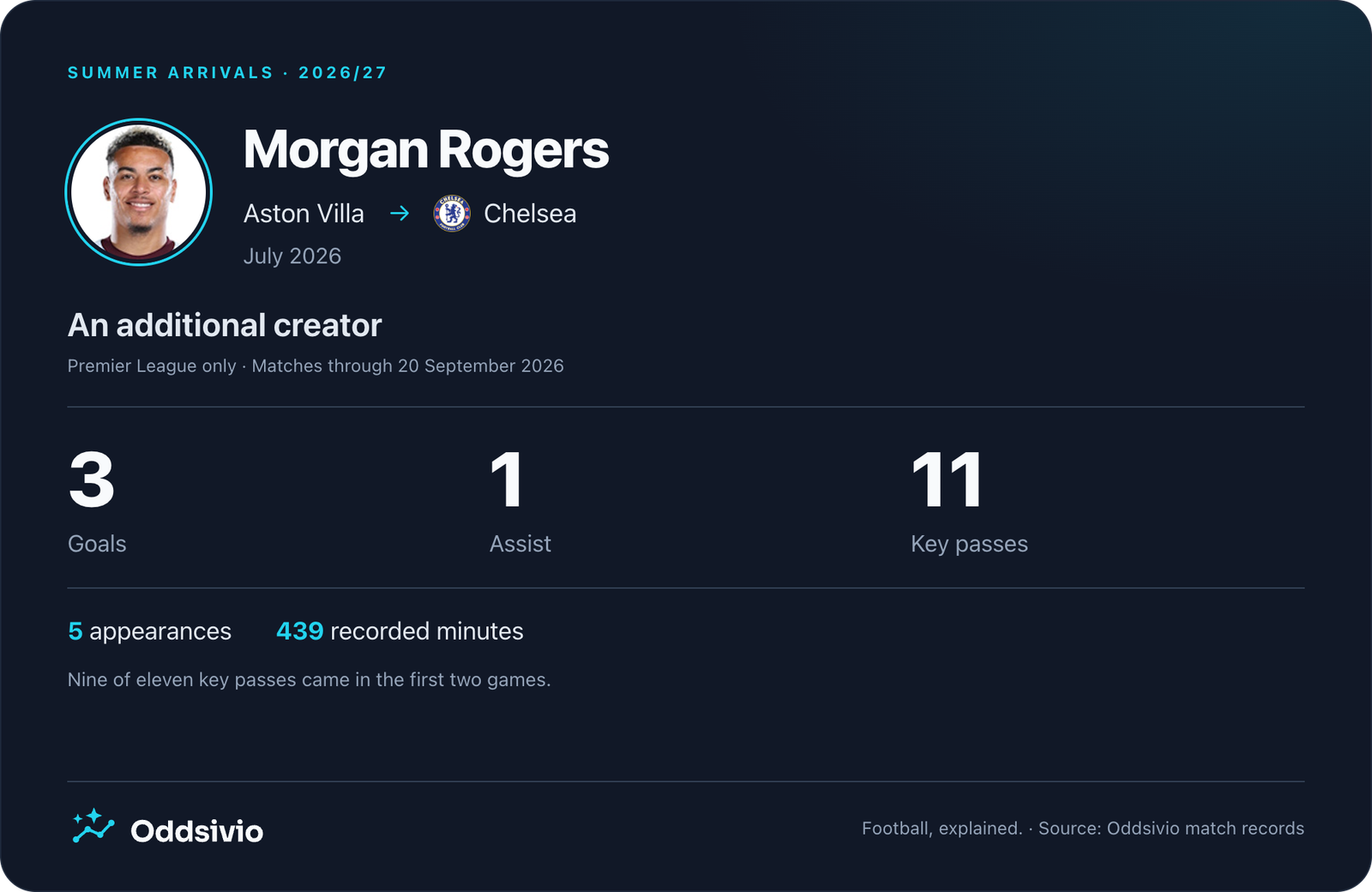
Rogers scored on his league debut at Fulham, then supplied an assist against Brighton. Chelsea’s account of his integration notes that he had played only one preseason match for the club before Chelsea’s Premier League campaign began.
He has added goals against Arsenal and Hull. Alongside those finishes, his league record contains eleven key passes, with nine coming in the opening two games. That distribution is worth keeping in view: the creative start was especially strong, rather than equally productive in every match.
The football benefit is an additional player who can both supply a chance and finish an attack. It helps explain the early excitement around an attack containing Rogers, Cole Palmer and João Pedro. It does not explain away Chelsea’s wider difficulties.
They have taken seven points from five games and conceded 12 goals, ending the opening spell with a 3–0 defeat at Brentford. Rogers is a useful reminder that a new signing can contribute while the team remains unconvincing. The next test is whether his threat becomes part of a more stable collective performance.
Jérémy Jacquet, Liverpool: defending the lead and starting the next attack
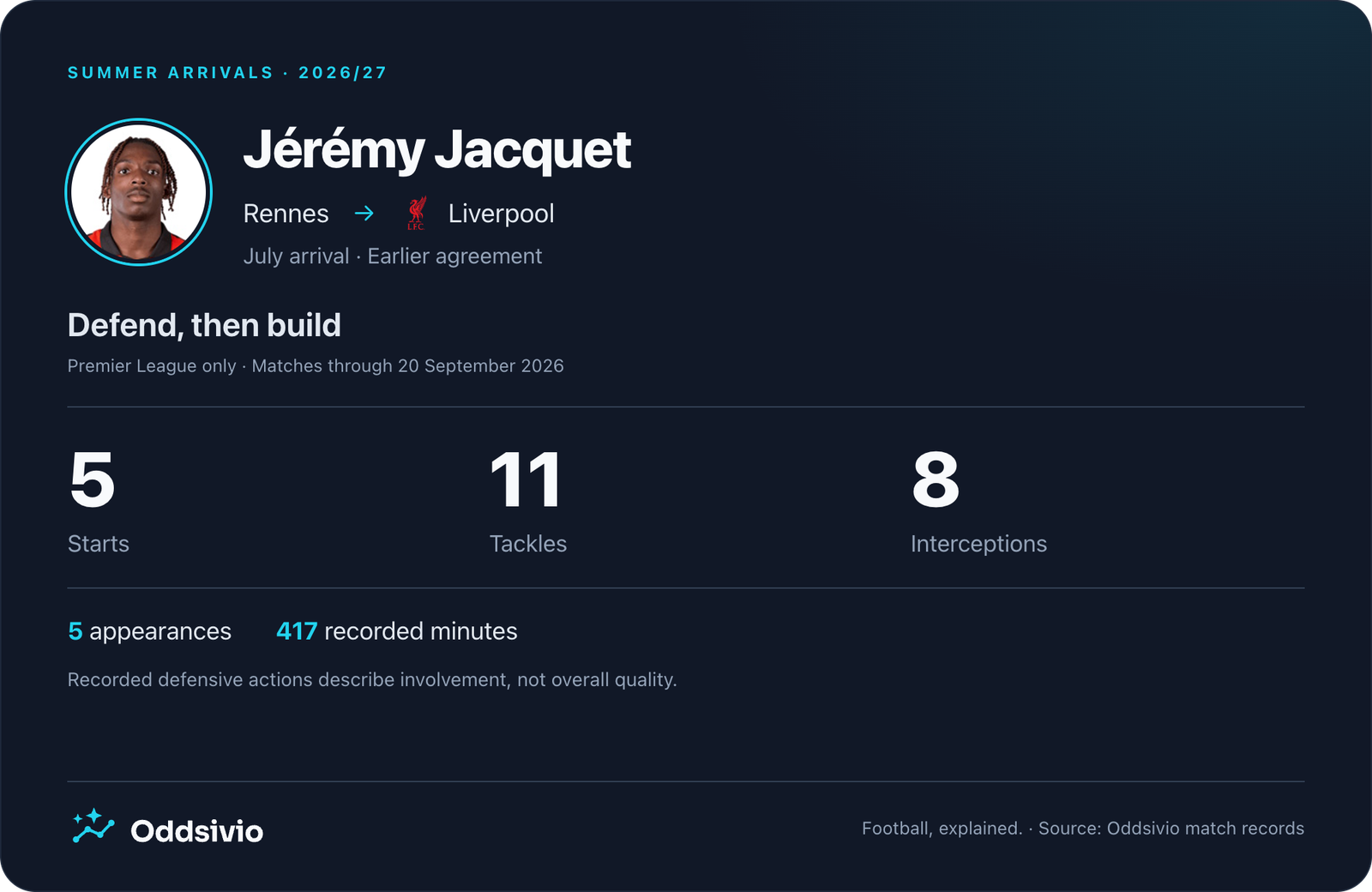
From Rennes, arrival completed July 2026 after an earlier agreement. Premier League: 5 appearances, 5 starts, 417 minutes.
Jacquet needs a transfer-date distinction. Liverpool agreed the deal earlier in the year, but completed his arrival from Rennes in July. He belongs here as a new member of this season’s team, rather than a player whose existing loan was simply made permanent.
His five starts have included the full match in Liverpool’s last three league fixtures, all clean sheets. The 1–0 win at Bournemouth offers a more specific picture than that team statistic alone.
In its analysis of the performance, Liverpool highlighted interceptions and a last-ditch block, alongside ten completed passes classified by Opta as breaking an opposition line. Those are passes that move the ball through a line of opponents, helping the team progress upfield. That separately attributed match figure is not part of Oddsivio’s season key-pass total.
His saved league record adds eleven tackles and eight interceptions. Together, the evidence suggests a defender contributing to both stopping attacks and moving possession forward. It cannot isolate his effect from Virgil van Dijk, the goalkeeper or the wider system. The promising part is that his responsibilities already extend beyond merely settling into the side.
Konstantinos Tzolakis, Hull: a new goalkeeper giving a promoted side a foothold
From Olympiacos, August 2026. Premier League: 5 appearances, 5 starts, 450 minutes; 17 recorded saves and 3 clean sheets.
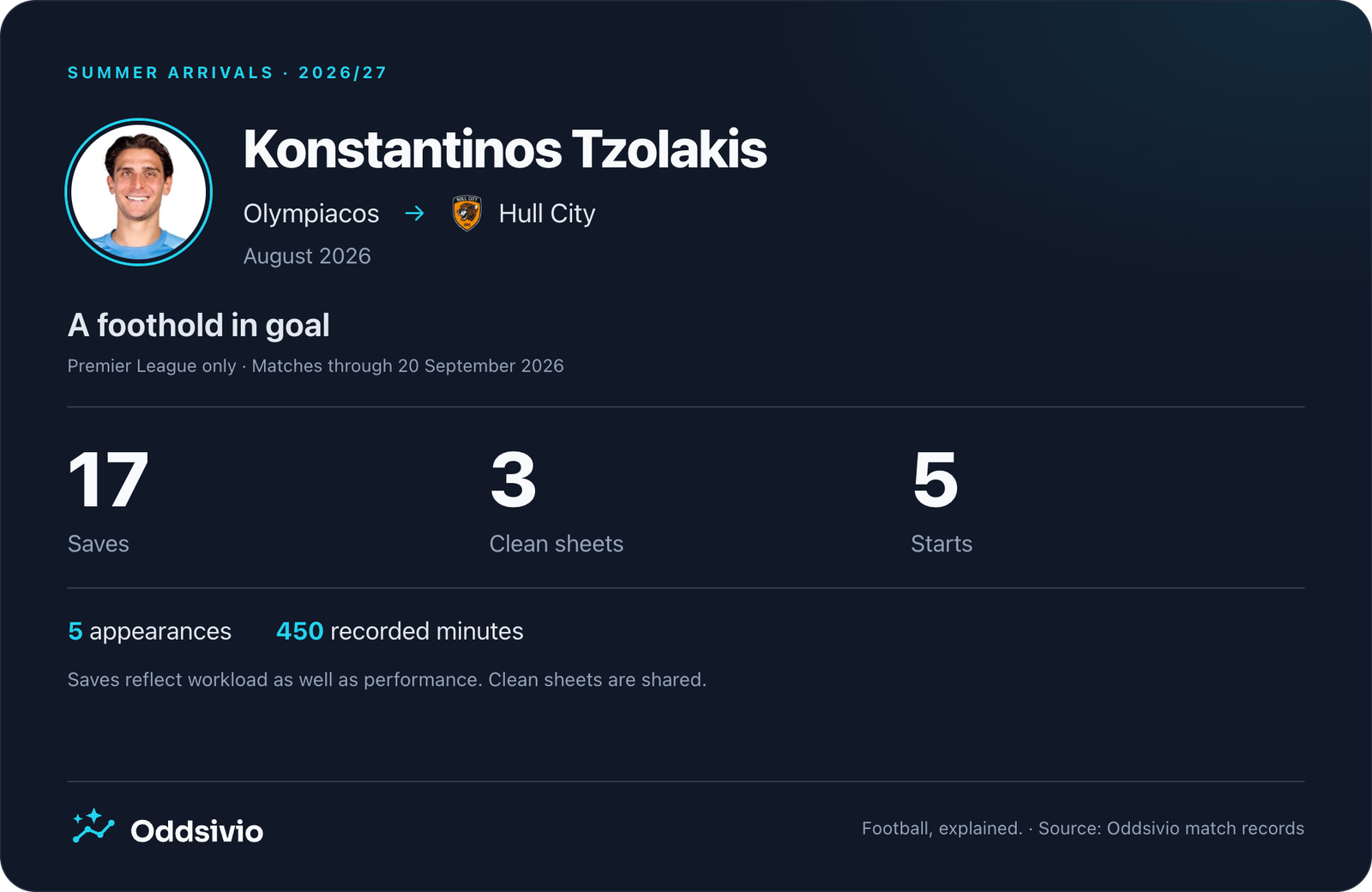
Hull’s first three league games ended 2–0, 1–0 and 0–0. Tzolakis played every minute of them. For a promoted team, reaching September with points already banked gives a new squad room to grow.
The Premier League’s transfer review described him as Hull’s new first-choice goalkeeper, replacing Ivor Pandur. Opta’s player profile also records his August arrival from Olympiacos and five opening league starts.
The saves give some detail to the results. Oddsivio recorded five in the opening win over Manchester United and another five in the 2–2 draw at Chelsea. Across the five matches, Hull collected eight points and conceded four goals.
That supports an early contribution, but not a claim that he has single-handedly transformed their defence. We do not have a comparable measure here of how difficult each shot was to stop. A busy goalkeeper can accumulate saves because his team allows chances; a quiet one can still play well. The question after the break is whether Tzolakis’s performances continue to support Hull when the margins are as narrow as they were in those first games.
Why some obvious names are outside the seven
Donyell Malen’s six league goals for Roma feature in our early-season standout players article. He is absent here because Roma first signed him in January. Making his loan permanent did not make him a new arrival for this season.
Jonathan David has made a strong early case at Atlético, with three goals and an assist. His 160 LaLiga minutes for Atlético fall below this article’s involvement threshold, so he remains a player to revisit rather than a like-for-like member of the main selection. The same threshold keeps a spectacular cameo from being treated as equivalent to several full matches.
This is also why transfer fees cannot settle the discussion. A fee reflects much more than immediate performance, including age, contract length and the buying club’s negotiating position. Four to seven games tell us something about how a player fits. They tell us far less about the financial success of a deal.
The most useful things to watch next are specific: Gutiérrez’s supply from the left, Frattesi’s arrivals in scoring positions, Sinayoko’s contribution between goals, the workload around Aubameyang, Chelsea’s balance, Jacquet’s passing under pressure and the quality of the chances Hull allow. Those questions will tell us more as the season develops than an early “signing of the year” label.
How we checked this
The league totals come from the same 250 completed matches used in the earlier opening-season team review. The cutoff is the fixture’s local league date through 20 September 2026 inclusive. The evidence was saved on 21 September at 13:59 UTC; the postponed Levante–Athletic Club fixture is excluded.
We checked arrival histories against club or league sources, then reviewed player involvement and concrete match contributions. Each selected player has at least 270 league minutes for their new club. The selections illustrate different roles; they are not an exhaustive ranking, a claim that every arrival was equally measurable, or proof that one player caused a team’s improvement. Club accounts help establish events and stated roles, while the interpretations above are ours.
Goals and assists for the seven selections reconcile with the saved scoring events. Penalties are identified separately. A key pass is a pass followed by a shot, without a claim about its quality. Missing data is not treated as zero. Displayed minutes use saved provider totals, capped at 90 per league appearance, consistently with the earlier series articles. We omit Sinayoko’s exact total because the player-stat rows disagree with substitution timelines, including his departure at Troyes; his five starts still clearly meet the selection threshold.
A fresh check on 24 September confirmed that the selected goals, assists and displayed minutes match the current Oddsivio records; that comparison does not resolve disagreements with event timelines or other providers. It also found a one-shot difference in the later live data for Aubameyang’s final match; no Aubameyang shot total is used here. Tzolakis’s previously recorded 96-minute appearance at Coventry now reads 90, matching the display convention already used. The original evidence remains preserved. Liverpool’s Opta-attributed passing example is a separate external supplement, not a merged statistical total.