The World Cup hangover, quantified
Spain won the World Cup on 19 July, and La Liga moved fixtures so its heaviest squads could breathe. We counted every minute of all 104 matches to rank which clubs start 2026-27 carrying the most tournament load — then checked our own data on whether the hangover is even real.
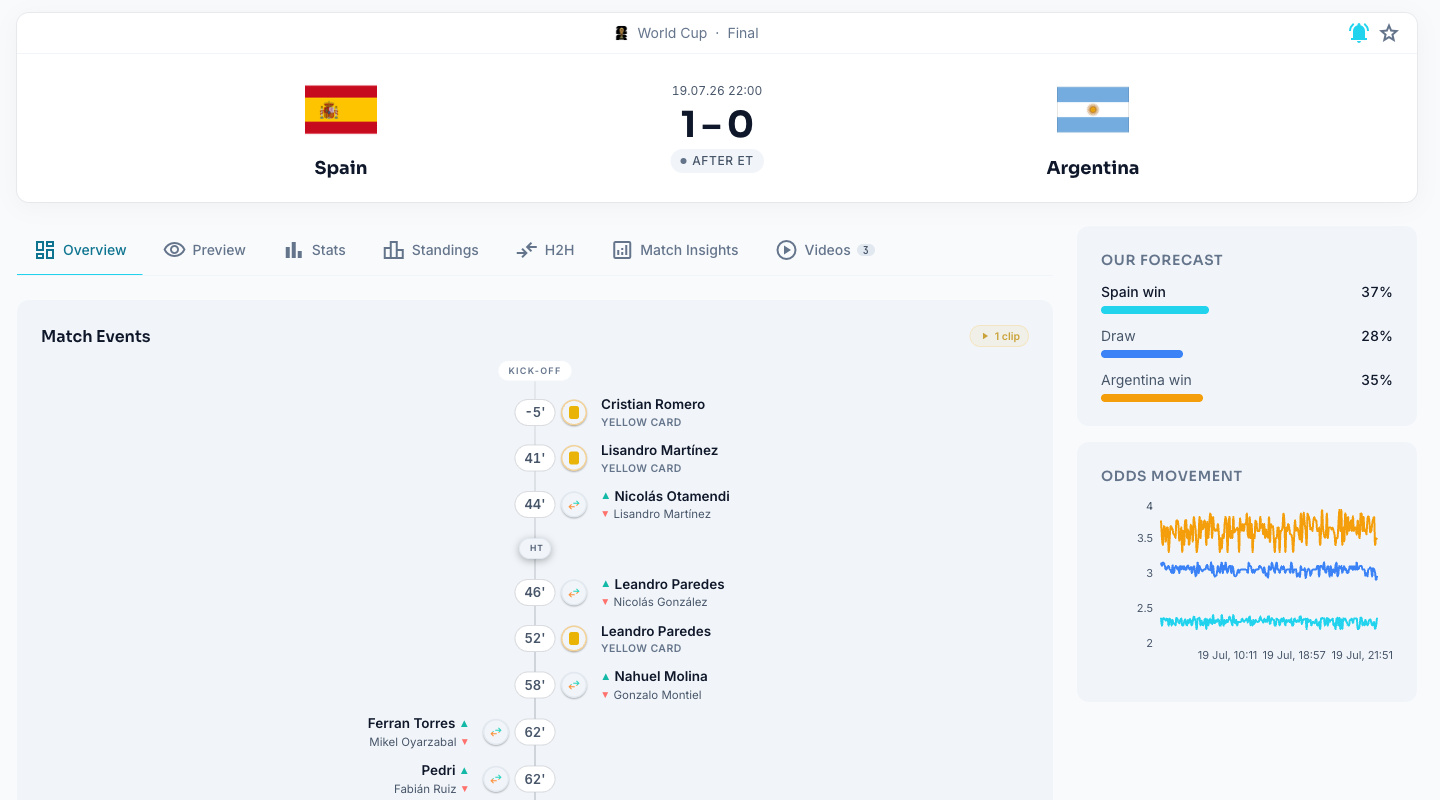
You can tell how heavy this summer was by what La Liga just did to its own fixture list. Spain won the World Cup on 19 July — 1-0 against Argentina after extra time, Ferran Torres with the only goal — and four weeks later, the Spanish league is starting its season without Real Madrid, Barcelona or Atlético on opening weekend. Under a special provision agreed for clubs whose players reached the World Cup semi-finals (ESPN explains the arrangement), their first-round matches were pushed back: Atlético against Málaga now lands on 19 August, Real Madrid against Real Sociedad on 26 August, Barcelona against Athletic Club on 27 August.
That is the league telling you, in scheduling form, that tournament load is real. So we did what we do: we counted it. Every minute of all 104 matches of the 2026 World Cup sits in our database, player by player. Aggregate those minutes up to each player's current club and you get something the postponement notices only hint at — a ranking of who actually starts 2026-27 carrying the most football in their legs.
One thing before the numbers: this piece quantifies load, not fatigue. Minutes played and days of rest are facts. What they do to a season is a much messier question — and further down we check our own data on that, honestly.
How we counted
Our database has player-level minutes for every one of the 104 matches, 11 June to 19 July. We summed each player's tournament minutes and mapped players to clubs using our nightly squad-roster refresh, counting only players whose current club is confirmed by a live roster — which covers 792 of the 865 players who got on the pitch. Most of the rest play for clubs outside the leagues we track. New signings count toward the club that holds their registration now — this is about who turns up to the new season tired, not who they were tired for in July. One honest wrinkle: the window is still open, so this table has a date on it — it reflects rosters as of 13 August, and at least one big number below is mid-move as we publish.
"Deep-run players" below means players from the four semi-finalists — Spain, Argentina, England and France — who between them played the maximum eight matches, extra time included. England's route even finished with that absurd 6-4 third-place match against France, the highest-scoring World Cup match since 1982.
The heaviest squads in Europe
Ranked by total World Cup 2026 minutes currently in the squad:
- Bayern München — 6,260 minutes across 18 players. The broadest load in Europe: eleven Bayern players logged 300+ tournament minutes. Dayot Upamecano (661) and Michael Olise (650) played all eight of France's matches; Harry Kane carried 654 minutes through seven of England's.
- Manchester City — 5,684 minutes across 16 players. Rodri played 726 minutes of Spain's winning campaign, and Marc Guéhi (682) and Elliot Anderson (634) each played all eight England matches.
- Real Madrid — 5,617 minutes across 15 players. The most half-tournament-plus loads anywhere: four players at 500+ minutes, including Jude Bellingham (629, England) and Kylian Mbappé (698, France), who left North America as the World Cup's all-time leading scorer.
- Barcelona — 4,774 minutes across 13 players. More on them below — theirs is the most concentrated deep-run load in Europe.
- Paris Saint-Germain — 4,551 minutes across 13 players. Ousmane Dembélé (597, France) and Achraf Hakimi (579, Morocco) lead; ten players at 300+.
- Arsenal — 4,263 minutes across 13 players. Declan Rice (571) and Bukayo Saka (357) each featured in seven of England's eight matches — Saka signing off with a hat-trick in the third-place game; William Saliba (480, France) and Gabriel (453, Brazil) add to it.
- Tottenham — 3,337 minutes across 11 players. Pedro Porro played 564 minutes of Spain's winning run. But a fifth of this total is the number that's mid-move — see the next entry.
- Atlético Madrid — 3,183 minutes across 11 players, not counting the one arriving: Cristian Romero, who carried 611 minutes for Argentina, completed his medical ahead of a move from Tottenham on 13 August. Julián Álvarez played 601 minutes of Argentina's run to the final.
- Liverpool — 3,031 minutes across just 7 players. The most concentrated list here: Alexis Mac Allister's 749 minutes for Argentina is the heaviest load carried by any outfield player in the Premier League.
- Aston Villa — 2,938 minutes across 9 players, one of whom deserves his own paragraph.
Emiliano Martínez played every minute of Argentina's eight matches, extra time included: 810 minutes by our count, the heaviest individual load our data recorded at this World Cup. Ezri Konsa (660, England) stood in front of a different national team all summer. Villa also played competitive football before almost anyone else — more on the calendar below.
Chelsea (2,736) rank only 12th on raw minutes but appear again in the next section, which is arguably the one that matters.
Deep-run load: Barcelona are the outlier
Total minutes flatter squads full of group-stage internationals. The sharper question is how many of your players were still playing in mid-July. Counting only minutes for the four semi-finalists:
- Barcelona: 10 deep-run players, 3,996 deep-run minutes. Pau Cubarsí played every minute of every Spain match — all 750 of them, at 19. Lamine Yamal (615), Jules Koundé (610, France), Pedri (499) and Dani Olmo (495) were all still on World Cup pitches five days short of August — and May signing Anthony Gordon scored England's semi-final goal weeks after becoming a Barcelona player. No other club in Europe comes close on this measure.
- Atlético Madrid: 8 deep-run players, 2,502 minutes — the second-heaviest semi-final load, largely Argentine and Spanish, before Romero's 611 join it.
- Chelsea: 8 deep-run players, 1,744 minutes, spread thinner across England, Spain, Argentina and France.
- Arsenal: 7 deep-run players, 2,136 minutes.
- Manchester City: 5 deep-run players but 2,653 deep-run minutes — the most semi-finalist minutes of any Premier League club, Rodri's 726 leading.
- Real Madrid: 5 deep-run players, 2,496 minutes.
It is not a coincidence that the clubs La Liga's postponement rule ended up protecting — Barcelona, Real Madrid, Atlético, plus Athletic Club, who supplied Spain's goalkeeper for all 750 minutes — are exactly the Spanish clubs near the top of this list.
The calendar is the story
Load only matters against time to recover. Here is how many days each heavy club gets between the 19 July final and its first competitive match:
- +24 days: PSG and Aston Villa have already played — the UEFA Super Cup on 12 August, which PSG won 2-1. The winning goal came from Désiré Doué, twenty-five days after his last of 398 World Cup minutes for France.
- +28 days: Arsenal against Manchester City in the Community Shield on 16 August; PSG go again in the Trophée des Champions the same day.
- +31 days: Atlético's rescheduled opener against Málaga on 19 August — the earliest of the postponed fixtures, with stadium bookings reportedly ruling out the later dates — a shorter runway than Madrid's or Barcelona's despite the second-heaviest deep-run load in Europe.
- +27 to +36 days: the big kick-off wave. La Liga's opening round starts 15 August; the Premier League opens 21 August, Ligue 1 the same night, Serie A on 22 August. Real Madrid's first match is 22 August at Espanyol, Barcelona's 23 August at Elche — both, unusually, starting at matchday 2 before circling back to matchday 1 in midweek.
- +40 days: the Bundesliga doesn't start until 28 August — its 2026-27 calendar was drawn up around the tournament. Bayern, the most-loaded squad in Europe, get the longest league runway of anyone here (their real return is the Supercup at Dortmund on 22 August, +34 days).
Notice what the Premier League's calendar does not have: any relief mechanism. England's players went as deep as anyone — eight matches, the last of them on 18 July — and their clubs open on the standard schedule. Rodri, Rice, Konsa, Mac Allister and company get exactly the recovery the fixture computer gives everyone else.
Now the honest part: does the hangover actually show up?
Here is where we could hand-wave about tired legs and August upsets. Instead we checked the nearest recent analog in our own database: Euro 2024, the last major summer tournament (the 2022 World Cup, played in November and December, tells you nothing about summers). This is a retrospective look, with all the usual caveats attached.
We took every player who appeared in a top-five league in 2024-25, split them by summer-2024 tournament load, and compared their early season (August–September league matches) with their mid-season (October–December), using provider match ratings:
- Heavy Euro load (400+ minutes, 50 players): average rating 7.23 early, 7.21 late. No dip.
- Semi-final-run players specifically (34 players): 7.31 early, 7.22 late. If anything, slightly better in August–September.
- No summer tournament (2,200+ players): 6.90 early, 6.89 late. Flat, as you'd hope for a control group.
- Copa América 2024 players (67): 7.02 early, 7.11 late — the only cohort that started below its later level, and even that gap is small.
Availability tells the same story: heavy-Euro players appeared in 81% of their club's early league matches, more than their own later-season rate. Managers did not mothball them; they mostly just played.
Standard honesty about what this can and can't say: it's one tournament, provider ratings are an imperfect lens, players only get rated when they play (so a rating average can't see a player who's rested entirely), and a Euro in one country is not a World Cup played across North American time zones and distances. But if you came in expecting our data to show semi-finalists visibly worse in August, it doesn't. The most defensible reading: the load is real, the relief rules are rational, and an automatic performance dip is not something the last summer tournament produced. The risk is better thought of as sharpened downside — less pre-season, less margin when fixtures stack up — than as a predictable August slump.
What we'll watch
The nice thing about publishing a load table in August is that it's checkable by October. We'll re-run this after the first international break: early-season minutes and ratings for the 500-plus-minute World Cup group, club by club, against the same players' later form — and we'll publish it whichever way it comes out.
Until then, the load rankings above are a lens for the opening weeks, not a verdict. Watch how Bayern rotate eleven 300-minute internationals through a late-starting Bundesliga, whether Barcelona's teenage core shows any seams after nearly 4,000 semi-final minutes, and what Atlético do with the shortest runway of the protected clubs. Every opener lives on our matches hub, each league has its own — Premier League, La Liga, Bundesliga, Serie A, Ligue 1 — and our engines' match-by-match read on the new season is on Predictions.
Football returns. The legs it returns on are, at least now, a matter of record.