A narrow lead for Sirius. Team scoring helps Janus.
Sirius finished almost level with the saved market forecast. Janus’s team-scoring estimates added more than its goal totals. Here is what held up, what missed, and where the record is incomplete.
Our forecasts, reviewed · 14–20 September 2026
220 Sirius matches scored · 214 Janus matches scored · 9 Janus categories
Data read: 21 September 2026, 11:27 EEST (08:27 UTC). Week defined by kickoffs in Europe/Bucharest.
A lead small enough for one match to reverse
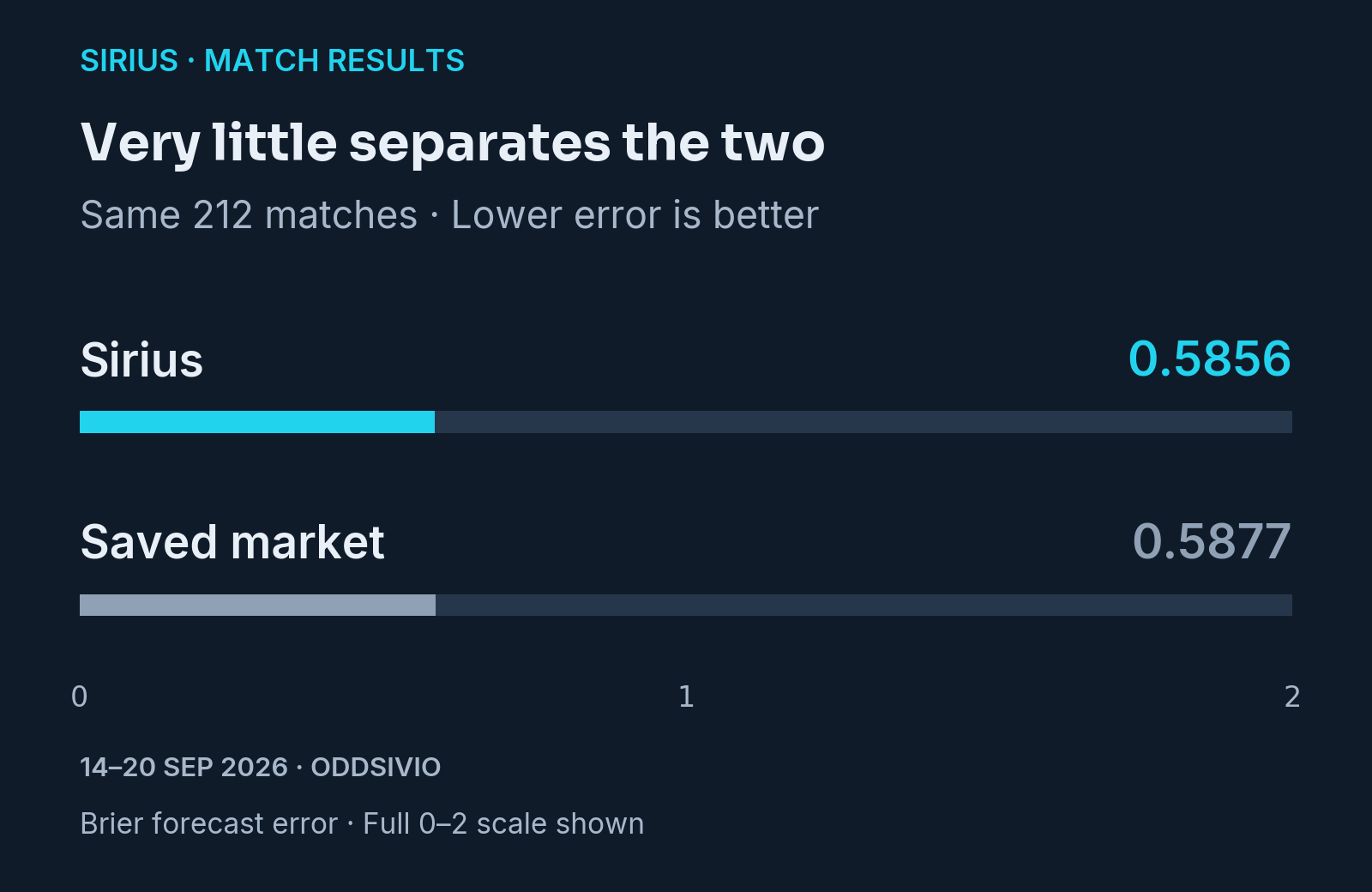
Sirius scored 220 match-result forecasts. For 212, we also had a saved market forecast, allowing the same matches to be compared. Sirius finished with 0.4% less probability error: a slight lead, with little separating the two reads.
The error score, called Brier, checks the home-win, draw and away-win probabilities against the result. Lower is better; zero would mean perfect forecasts. Both Sirius and the market ranked the eventual result first in 111 of the 212 matches. The small difference came from the probabilities themselves.
Torreense’s win at Lillestrøm made the largest contribution to Sirius’s advantage. Remove that one match and the market has slightly less error across the other 211. We keep every qualifying match in the score; this check simply shows how fragile the weekly lead is.
Team-scoring estimates added more
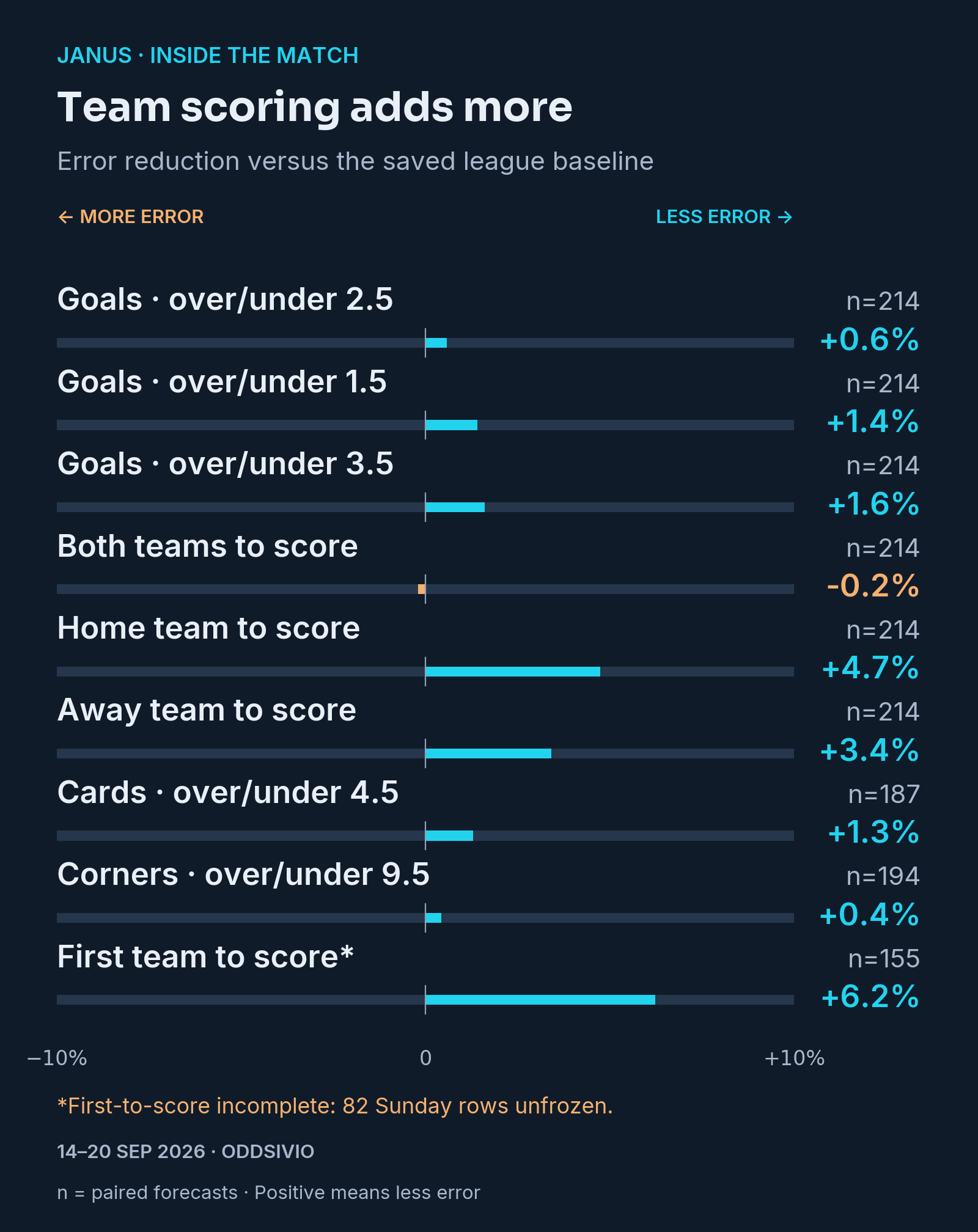
Janus scored 1,820 category forecasts across 214 matches. Eight of its nine categories had lower error than the league baseline saved before kickoff: the competition’s historical rate, without the match-specific adjustment.
Home-team scoring reduced error by 4.7%, and away-team scoring by 3.4%. The three goals-total categories improved by roughly 0.6–1.6%. Cards improved by 1.3% and corners by 0.4%; both-teams-to-score was slightly worse, with 0.2% more error.
First-to-score showed the largest reduction, 6.2%, but on an incomplete record. At the cutoff, 82 Sunday entries were still unfrozen, including 54 full forecasts. They are excluded under the tracker’s rules. Its chart row therefore covers 155 matches, and we cannot describe that as a complete Sunday-inclusive result.
Two matches, two lessons
Lillestrøm 1–2 Torreense
17 September · Europa League · Sirius: Lillestrøm 27.2%, draw 25.7%, Torreense 47.1%.
Sirius gave Torreense the largest individual chance of winning, while the saved market gave the visitors 16.5% and favoured Lillestrøm. Torreense won 2–1. This was the week’s largest favourable Sirius-versus-market error difference. Yet 47.1% still left 52.9% for a draw or home win combined. The forecast preferred Torreense; it did not make victory more likely than all alternatives put together. Match record · Result confirmation.
Grêmio 0–0 Palmeiras
20 September · Brasileirão · Janus: Palmeiras to score 88.5%; saved league baseline 70.5%.
Janus assigned Palmeiras a substantially higher scoring chance than the usual away-team baseline. They finished without a goal. This produced the week’s largest unfavourable difference against the baseline among Janus’s binary forecasts. The stronger assessment carried a larger penalty when it missed. Away-team scoring still improved overall, but this is the kind of miss that belongs beside the aggregate gain. Match record.
The same selection rules as the pilot: the largest favourable Sirius comparison and the largest unfavourable Janus binary comparison. These examples were selected after the results to explain the scoring.
What we are watching next
Home-team scoring and cards again beat their baselines, while both-teams-to-score again fell just short. That echoes the 31 August–6 September pilot, but different fixtures and model versions make it a watchpoint rather than a demonstrated trend. This edition does not review the intervening 7–13 September week.
For Sirius, the question is whether a lead survives across a longer record. For Janus, first-to-score coverage needs to be complete before its apparent strength gets a fuller reading.
How we counted: kickoffs from 14 September at 00:00 up to, but not including, 21 September at 00:00, Europe/Bucharest (13 September 21:00–20 September 21:00 UTC). Existing frozen forecasts were read at 11:27:40 EEST for Sirius and 11:27:46 EEST for Janus on 21 September; results and statistics are those available at those reads. Missing evidence stays unscored. Sirius and Janus answer different questions and use different score conventions, so their raw Brier scores should not be compared. These figures measure probability error, not financial returns. Exclusions, formulas, versions and exact cutoffs: methods note.