The closing line, explained — and how our forecasts measure up against it
What the closing line is, why forecasters treat it as the exam that matters, and an honest first look at how our forecasts compare with the market’s final word — real ledger numbers, caveats included.
11 August 2026 · Oddsivio — Football, explained.
Our prediction-terms glossary gives the closing line one entry. It deserves a whole piece, because it is the single most important idea in judging any football forecaster — including us. This is the follow-up: the concept in plain English first, then what our own public ledger can and cannot say about it today, with real numbers as of 11 August 2026.
What the closing line is
A bookmaker's price on a match is not fixed. It opens days before kickoff, then moves as information arrives — team news, market money, other bookmakers. The closing line is the last price available before kickoff: the market's final word, with every piece of public information (and every informed opinion expressed as money) already baked in.
Strip out the bookmaker's margin and the closing line becomes a probability — the market's final estimate of home, draw and away. That's the version we care about on this site: not a price to take, a forecast to compare against.
Why forecasters treat it as the exam
Decades of research on sports markets point the same way: the closing price is, on average, the most accurate public forecast of a match that exists — more accurate than the opening price, more accurate than almost any model, because it is the aggregation of everyone's models plus everyone's information, settled seconds before the whistle.
That gives honest forecasters a hard yardstick. Anyone can look accurate against a coin flip. The real questions are: how close do you get to the market's final word — and do your disagreements with it, over hundreds of games, cost you or pay you? The glossary's closing-line-value entry covers the professional version of that test; the short version is that beating the close consistently is the strongest evidence of skill a forecaster can show, and it is rare.
What we can honestly measure today
Our public record already grades every Sirius forecast against a market consensus — the margin-removed median of several books, captured at least 30 minutes before kickoff. On the 134 graded games with that consensus saved, the forecast-error scores sit at 0.6031 for the market, 0.6105 for Sirius, 0.6283 for always answering football's long-run averages — the market ahead of us, both of us ahead of the baseline.
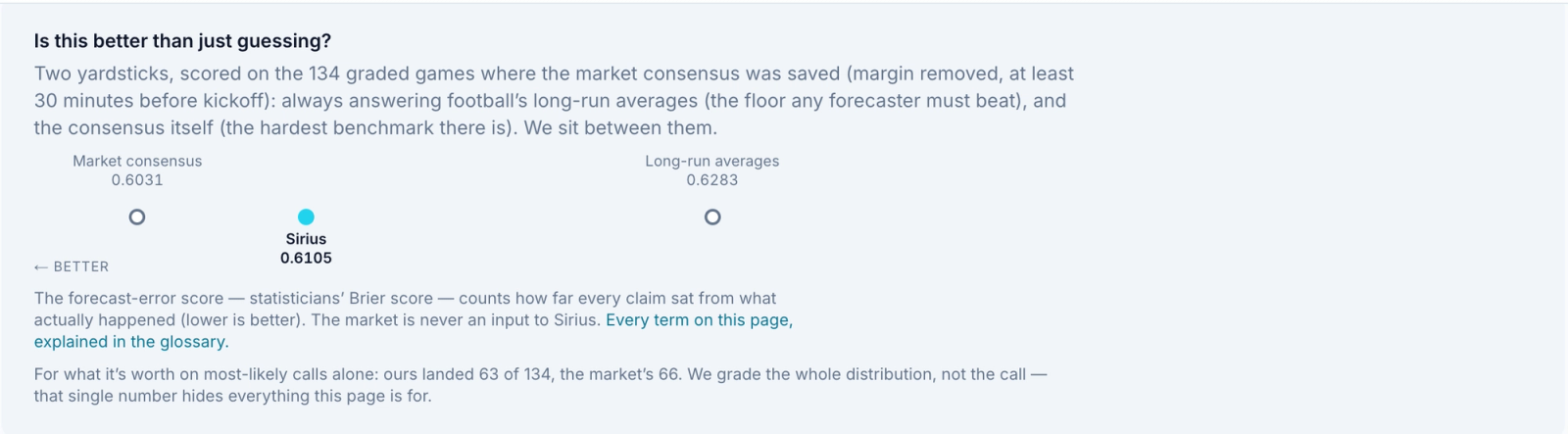
A T-30 consensus is not quite a closing line — a genuine close is captured at kickoff. Since late July our odds-collection engine has also been promoting a true closing snapshot for the leagues it watches. That gives us a second, stricter slice: of the 494 graded games on the ledger, 79 have a real closing consensus (the margin-removed median of usually six books). Small, and honestly shaped: those books are soft Romanian-market storefronts, not a sharp global exchange, and the 79 games are almost entirely MLS and Brazilian Série A — the competitions that were actually playing while Europe's top leagues were off-season.
What the numbers say so far
On that 79-game closing slice, as of 11 August 2026:
- Forecast-error score (multi-class Brier, lower is better): closing consensus 0.636, Sirius 0.648, coin-flip baseline 0.667.
- Most-likely-outcome calls that happened: 33 of 79 for the closing consensus, and 33 of 79 for Sirius — identical, which mostly shows why we grade the whole probability distribution rather than the single call.
- Gaps this small, on a sample this small, are within noise. The honest reading is not "we nearly match the market" — it is "the market's final word is a little sharper than us, exactly as the literature predicts, and the sample is too thin to say much more."
The last half hour does move the market, though rarely dramatically: between our T-30 capture and the close, the consensus shifted by a median of about 2.4 probability points per match (mean 3.0), and stayed under one point in only 18% of games.
The line moves — but it is not an oracle
Three of the biggest late moves in the slice, for flavour:
- Columbus Crew v FC Cincinnati (25 July) — the market walked Columbus down from 53% to 44% in the final half hour. Columbus won 2-1.
- Grêmio v Fluminense (26 July) — the away side was bid up from 35% to 43%. It finished 1-1.
- Austin v Seattle (23 July) — Austin rose from 29% to 36%, Seattle fell from 45% to 37%. Austin won 3-1: the one big mover in this trio that "got it right."
That's the correct mental model: the closing line is the best average forecast in football, and still routinely wrong about individual matches. Its authority is statistical, not clairvoyant.
Why our record page doesn't show a closing yardstick yet
We considered adding the closing consensus as a third dot on the record page's "Is this better than just guessing?" chart, and decided: not yet. Three reasons, recorded here so the decision is auditable:
- Coverage. 79 closing-covered games is too few; our own honesty bar for that chart is in the hundreds. Europe's top leagues are back from mid-August, and their closings are captured — the slice should pass 150 within weeks.
- Book quality. A closing consensus from six soft storefronts is a weaker benchmark than the sharp close the research literature means. Before we display it as the market's final word, we owe the chart a deliberate call on whether that's honest enough.
- Split universes. The T-30 consensus and the closing consensus cover different subsets of games; a chart mixing scores from different slices would flatter whoever got the easier games. When the closing yardstick ships, it will be scored on its own slice, labelled as such.
We expect to revisit around the September international break. When the third dot appears, this paragraph is why it took the time it took.
Where this lives on the site
The graded ledger, game by game, is at our public record; the plain-English forecasts themselves are on today's predictions; and every term this piece leans on — Brier score, calibration, implied probability, closing line value — is defined with live examples in the glossary.
Method notes: closing consensus = per book, take the closing 1X2 prices, remove the margin (normalise the inverse prices), then take the per-outcome median across books and renormalise — the same recipe as the record page's T-30 consensus. Outcomes are 90-minute results. All figures are a dated snapshot of the live ledger as of 11 August 2026 and will drift as games grade; the record page is always the current truth. This piece is education about forecasting benchmarks, not betting advice — we don't do tips, here or anywhere. If you gamble, set limits and stick to them: begambleaware.org.