September international break 2026: what to watch
England–Spain, Klopp’s Germany and Norway’s Portugal double-header: the fixtures, squad changes and club form shaping the September–October window.
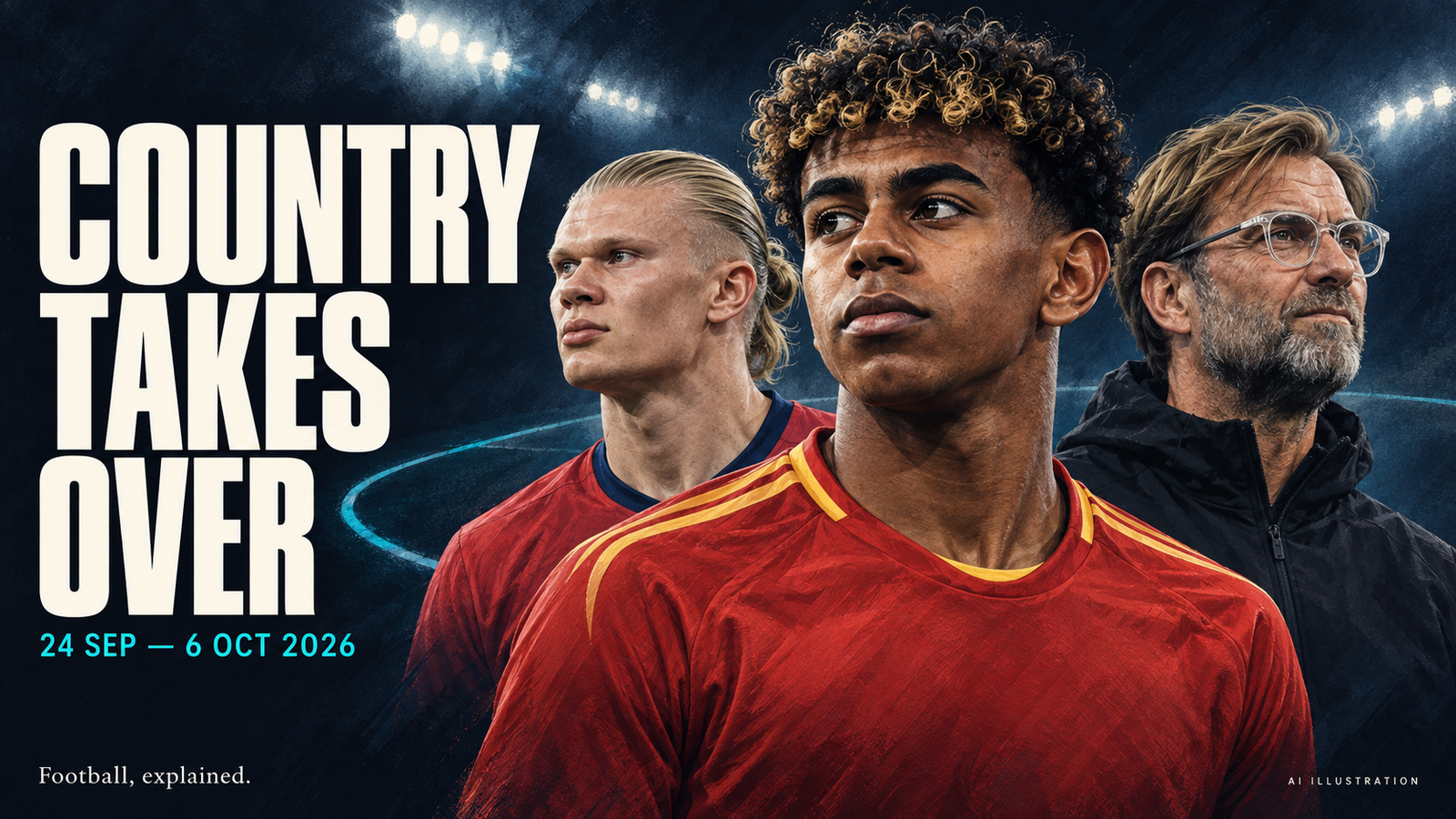
England face world champions Spain, Germany begin life under Jürgen Klopp, and Norway meet Portugal twice in eight days. There is plenty to fill the gap left by club football. The more interesting question is how different these teams will look by the time their players go home.
The men’s international window runs from 21 September to 6 October 2026, with the Nations League starting on 24 September. Most teams in that competition will play four group games during one camp. New coaches can introduce ideas, see them tested and adjust them again within days. Injuries and the management of minutes will shape what they can attempt. FIFA’s calendar decision, UEFA’s competition guide.
This is a selective viewing guide, focused on the Nations League with a look at Africa’s qualifying campaign. For the calendar change and domestic restart dates, our separate explainer covers why September’s international break is so long.
The international fixtures to put in your diary
The two weekends have different attractions: England’s meeting with Spain on the first, then Croatia–England and the Portugal–Norway return on the second. These are the games around which we would build the window:
- Thursday 24 September, 21:45 — Netherlands vs Germany. Two new coaches meet immediately.
- Friday 25 September, 21:45 — Türkiye vs France. Zidane’s first competitive examination begins away from home.
- Saturday 26 September, 21:45 — England vs Spain. An altered England squad faces the world champions.
- Sunday 27 September, 21:45 — Norway vs Portugal. The first half of an unusually quick rematch.
- Friday 2 October, 21:45 — France vs Italy. A meeting of teams establishing themselves under new leadership.
- Saturday 3 October, 19:00 — Croatia vs England. England’s third match of the camp, and a second successive away trip.
- Sunday 4 October, 21:45 — Portugal vs Norway. A chance to see what both sides learned from the first meeting.
- Tuesday 6 October, 21:45 — England vs Czechia. The closing night offers a useful measure of what has survived the full camp.
Times are converted from the fixture timestamps into Bucharest time; 21:45 here is 19:45 in the UK on these dates. The selection has been checked against UEFA’s fixture list. The Nations League competition page carries the wider schedule.
Netherlands vs Germany: the first test of Klopp’s plan
There are two debuts to watch in Amsterdam. Xavi Hernández takes charge of the Netherlands, while Klopp begins with Germany. Their club reputations make the meeting appealing; international football will test how quickly they can turn familiar ideas into habits with a different group. UEFA’s guide to the new coaches.
Klopp has already made one concrete choice about the longer camp. The DFB announced 44 players across two squads: an initial 24 for the Netherlands and Greece games, with another 20 joining for the Serbia and Greece fixtures. Most of the first group will then return to their clubs. Germany’s squad announcement.
That gives Germany a different kind of test from simply asking the same eleven to play four times. Watch what remains consistent when the personnel change: where Germany try to win the ball, which midfielder offers a safe pass under pressure, and how many players support the attack without leaving the defence exposed.
Those are questions for the matches, not conclusions drawn from the appointments. The Netherlands–Germany match page is the starting point; the later games will tell us whether the same patterns survive the planned turnover.
England vs Spain: Yamal’s supply matters as much as his goals
Spain arrive as world champions; England finished third at the summer tournament. That is a substantial first assignment for Thomas Tuchel’s side before considering the changes to his squad. England’s fixture and squad announcement.
The FA confirmed on 21 September that Tino Livramento, Kobbie Mainoo, Cole Palmer, Marcus Rashford and Declan Rice had withdrawn. James Garner and Morgan Gibbs-White were called up. It makes the midfield combinations and the support around the ball worth watching closely, particularly when England try to play out of pressure. The FA’s squad update.
Spain have also made a change at right-back, calling up Iván Fresneda after Pedro Porro’s withdrawal. It is a reminder to check the current squad rather than an old predicted eleven.
For a clear view of the attacking problem England face, look at Lamine Yamal’s club form. Oddsivio records seven goals, four assists and 28 key passes in seven LaLiga appearances, covering 581 minutes through 20 September. Key passes are passes that lead to a shot: they show how often he supplies an attempt, without telling us that every attempt is a good chance.
The Sevilla–Barcelona match supplies a recent example. Yamal finished without a goal but with two assists in Barcelona’s 3–1 win. The official LaLiga highlights on that match page put the creative contribution beside the scoreline.
England’s task is therefore broader than keeping him away from shooting positions. If they send a second defender towards him, watch who becomes available for the next pass. His player profile and our early-season players review provide the club evidence behind that question. Seven league games are context for the matchup, not a forecast of his international output.
Norway vs Portugal, twice: follow the service to Haaland
Norway host Portugal on 27 September, then visit them on 4 October. The first match gives both coaches specific problems to solve before the second. A change in how Norway reach their striker, or how Portugal protect the space around him, should be easier to spot with the earlier meeting still fresh.
Erling Haaland enters the camp with five Premier League goals in five appearances. Oddsivio’s league-only record shows 450 minutes, 19 shots and ten on target through 20 September. He has played the full recorded league minutes available to him. That gives the management of his international workload a clear club context without establishing that he is fatigued.
Haaland and Martin Ødegaard are both named in Norway’s official squad. The football question is how often Norway can get the ball to Haaland in positions from which he can finish, rather than asking his scoring record to explain the whole attack. His Oddsivio profile lets you follow the shooting and minutes alongside the goals.
There is a useful team-level check, too. At our 23 September snapshot, Oddsivio’s results-based strength rating had Portugal at 2,012 and Norway at 1,880. These Elo numbers describe the teams’ past-results standing. They are not win percentages and do not account directly for a new coach’s plans or the current injury list.
Portugal are beginning under Jorge Jesus, another of the new coaches identified by UEFA. That makes the pair of games an appealing combination: a stronger historical team rating, a changing setup and a striker capable of making limited service count.
The second weekend: what survives three matches together?
France–Italy on 2 October brings together Zinédine Zidane’s France and Roberto Mancini’s Italy. Both appointments are confirmed in UEFA’s coaching guide. By their third game of the camp, the useful question will be what has become repeatable: the way they build attacks, the positions they leave vacant, and whether substitutes can preserve the same structure.
England’s visit to Croatia the next day offers a related test. It follows Spain at home and Czechia away. Compare the Croatia match with the opening game: can England still progress the ball and support their forwards if Tuchel changes the midfield? A good result would matter for the group; a performance that holds together across different selections would tell us something more about the squad.
These observations will not settle a manager’s long-term prospects in one fortnight. They give us something concrete to assess beyond the opening lineup and the final score.
Romania’s route, and why the table will move quickly
The window has consequences below League A, too. Romania face Sweden away on 25 September, Bosnia and Herzegovina at home on 28 September, Poland away on 2 October and Sweden at home on 5 October. All four are scheduled for 21:45 Bucharest time.
Four of six group games will be played before the clubs resume. League B group winners go up automatically, while runners-up enter promotion/relegation play-offs. In League A, the top two advance to the quarter-finals. Those are the immediate stakes behind the changing tables. UEFA’s format guide.
Beyond Europe: AFCON qualifying begins
The same international window contains the opening two rounds of AFCON 2027 qualifying. That distinction matters: a four-match allowance does not mean every national team has four competitive fixtures. CAF’s qualifying calendar.
Côte d’Ivoire against Ghana is one opening contest worth following. CAF’s preview records a refreshed Ivorian squad under Hervé Renard and Mohammed Kudus’s return for Ghana. Egypt against Angola is another early test in a group offering two qualification places. CAF’s opening-round preview supplies the wider African context.
Keep the lineup beside the numbers
Start with the Nations League schedule, then use the linked match pages to follow each fixture. As confirmed lineups arrive, compare the players actually selected with the roles discussed here. Afterwards, the match statistics and any available official highlights can help explain which of those ideas appeared on the pitch.
The most revealing comparison may be between a team’s first game and its fourth: who stayed in the side, who earned a larger role, and whether the football still made sense when the names changed.
Source and data note: researched on 23 September 2026 using UEFA, FIFA, national federations, CAF and dated Oddsivio data. Club figures include only the named domestic league through 20 September; cups, Europe, friendlies and internationals are excluded. On player pages, choose that league in the Stats competition filter to reproduce the totals. Player minutes use the site’s normal-time cap of 90 per appearance. Elo values are rounded team-strength snapshots, separate from the club-form totals. Squad selection does not guarantee a start, and availability or kickoff times can change.